Though the inter-community riots involving Parsis triggered by the 1921 visit of the Prince of Wales lasted four days, the incidents are long forgotten
Farrokh Jijina
November 2021 marks a centenary of the "last time that Parsis were involved en masse in a communal fracas,” the Prince of Wales Riots. For at least four days, November 17 to 21, 1921, mobs roamed the streets of Parsi localities, while community members took it upon themselves to defend their property. Incidents of violence by Parsis were noted too. Historian and assistant professor at S. P. Jain Institute of Management and Research Dr Dinyar Patel notes that Hindus and Muslims were angry at the violations by Parsis of a strike that Mohandas Gandhi had called for on the day of the arrival of Edward, Prince of Wales in Bombay. (Edward later became King Edward VIII who soon after abdicated the British throne in 1936 in order to marry Wallis Simpson, the American divorcee he loved.) Both Congressmen and Khilafatists "joined together to attack supposedly loyalist minorities, especially Parsis.”
Patel first came across mention of the Riots while doing research into Gandhi in his first year of graduate school. "I was quite flummoxed to read headlines about ‘Parsee Hooligans’ and such,” unfamiliar as he was with the longer history of Parsi involvement in previous riots.
The historian writes in his paper "Beyond Hindu-Muslim unity: Gandhi, the Parsis and the Prince of Wales Riots of 1921” that early on November 17, 1921, soldiers and policemen lined the roads leading out from Apollo Bunder that were to be used for the Prince’s procession. The royal was to arrive at the yet-to-be-completed archway, the Gateway of India, built to commemorate the arrival into Bombay of his parents, King George V and Queen Mary, a decade earlier. Most Indian storeowners and businesses observed the strike called by the Congress to boycott the royal visit. The Bombay Chronicle (BC) remarked the next day that the reception of the Prince compared to his parents’ was to be "not even one-tenth in comparison and more artificial than real and spontaneous.”
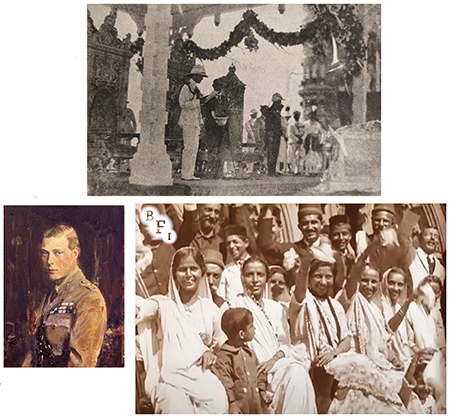
Clockwise from above: Portrait of Edward, Prince of Wales by Reginald Grenville Eves, c. 1920;
reception for the royal visitor Photo: Commemorative volume on the tour;
Parsi women along the Prince’s processional route Photo: Edward Prince of Wales’ Tour of India/YouTube
As the day wore on, trams carried supporters of the royal visitor to Apollo Bunder, but some supporters of Gandhi’s call for a strike stopped southbound trams and demanded that passengers, mainly Parsis, Europeans and Anglo-Indians, disembark. Striking mill workers stormed out of the Elphinstone Mills compound and burned a few trams and automobiles, wrote Patel, quoting from Parsi Prakash.
Meanwhile, an audience with a significant Parsi, Anglo-Indian and Jewish component, greeted the Prince as he stepped ashore. Sir Jamsetjee Jejeebhoy, fifth baronet, read out the Bombay Parsi Punchayet’s (BPP) welcome address on behalf of the community, one of the few communal addresses delivered on that day. Parsi schoolgirls staged a garba performance for the Prince. "There were visible signs of Parsi disregard for the Congress boycott,” wrote Patel.
Some distance from Apollo Bunder, men wearing Gandhi caps or the Khilafat fez threw stones at vehicles passing by Marine Lines and Charni Road. "Throngs of Hindu and Muslim protestors attacked trams, assaulting female Parsi passengers and tearing their saris…European and Anglo-Indian women on trams suffered similar fates,” stated Patel. Rioters moved into the predominantly Parsi precinct of Grant Road and into Anglo-Indian neighborhoods in Byculla, attacking those wearing non-khadi, Parsi and European attire.
Patel notes that over the next two days the Riots took on a decisively communal color. "From this point onward, newspaper accounts of the Riots sharply diverged… Parsi-owned broadsheets… depicted Parsis as the innocent victims of Hindu and Muslim mavalis (hooligans) bent on destroying their houses and businesses and defiling their places of worship.” "In every area, stones fell like rain upon Parsi houses,” the Jam-e-Jamshed reported. While The Times of India (ToI) tended to sympathize with Parsis and Anglo-Indians, the BC complained that "Parsis were responding with undue force and even blamed the police for conniving at, if not actively abetting, some violent sections of the Anglo-Indian and Jewish communities.”
By mid-day on November 18, mill workers in Parel struck work and joined in the violence. A swelling body of rioters mounted an attack on the Dadysett and Wadia Atash Behrams in the Chira Bazaar area and the Ranji Dar-e-Meher at Grant Road. Parsis reportedly responded with vengeance, identifying the rioters of the previous day as Gandhians. By November 20, a mob of 500 Parsis, armed with bamboo sticks believed to be supplied by a "well-known Parsi millionaire” gathered to defend the Wadia Atash Behram, "establishing an actual reign of terror as they harassed Hindu and Muslim passers-by,” noted BC of November 21. "Bands of Parsi and Anglo-Indian youth cried ‘Down with the Gandhi caps’ as they targeted individuals in khadi. Other Parsis brandished firearms as they patrolled neighborhoods in motor vehicles,” wrote Patel. A group of Parsis attacked politicians Makund Ramrao Jayakar and Jamnadas Mehta as they attempted to disband an unruly mob. At the same time, social worker Burjorji Bharucha was assaulted outside Cama Baug. Rumors reached as far as Calcutta that a group of Parsis had even assaulted Gandhi, noted ToI which called the events an "open manifestation of racial hatred.”
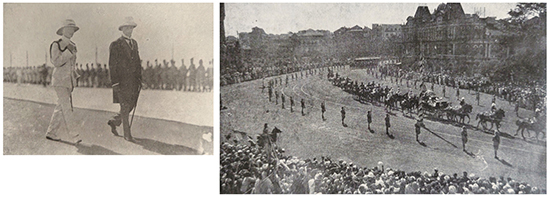
Ceremonial welcome and procession for the Prince Photos: Commemorative volume
Parsi-owned liquor shops seem to have been a prime target for the strikers. In Khetwadi, the ToI reported the destruction of all liquor shops… and evacuated residential buildings facing "a road strewn with broken glass.” On Grant Road, several Parsi families were trapped in a building while a surging crowd threatened to set fire to the liquor store on the ground floor. On Foras Road, a group of lathi-wielding Parsis protected another residential building with a ground floor country liquor shop. "By the morning of November 20, the storeowner, Cowasji Battliwalla, defused a worsening situation by bringing all of his casks onto the street and emptying their contents in front of an applauding crowd,” noted Patel.
The Parsis and Gandhi
Letters from that period to Gandhi reveal more information about Parsi involvement in the riots, noted Patel. One Harilal Jasani complained of police indifference while Parsis, displaying an intent to kill, assaulted Hindu merchants. From Mazagon, an anonymous writer recounted the story of Nusserwanji Dhondy, an admirer of Gandhi who "had rushed to help non-cooperators control riots in Khetwadi on November 18… While at Foras Road he had some hammering from the mob, and while returning he had some more from the Parsis from his own neighborhood — as a Parsi dressed in a khadi cap, he was an enemy to all and a friend to none.” Patel notes that Dhondy "subsequently died of acute mania from effects of the Bombay Riots.”
An anonymous letter available in the Sabarmati Ashram Archives signed by Ek dukhi Parsi bai (a despondent Parsi lady) who refused to divulge her name until she met Gandhi face-to-face narrated how, on November 19, she and two other women were on their way to Tardeo when passers-by warned them of disturbances. In a state of panic, they accepted an offer from three Muslim men, wearing white topis bearing the Khilafat crescent, who drove up in a car and offered to transport them to safety in Gamdevi. The three women were instead taken to a house near Null Bazaar where they were allegedly raped repeatedly. Gandhi’s response was empathetic. He wrote in Navajivan on December 18 that he would like to spend a lifetime investigating the root cause of the incident. "If that sister happens to read this, I request her to send me her name and address or to meet me,” he wrote.
Aftermath
At least 58 people lost their lives in the riots, including three Europeans, two Parsis, one American and five police officers. The government prosecuted over 400 suspects, eventually hanging two convicted rioters, transported two others for life, and sentenced over 100 others to rigorous imprisonment. Of the 600 establishments within Bombay licensed to sell alcohol, 135 were damaged and four were completely destroyed. Claims of compensation for personal injury or damage to property totaled Rs 25 lakhs by mid-December with Parsis having filed 132 of the total 159 claims.
Patel notes: "We have little idea of how the Prince reacted to news of the disturbances: he was, for the most part, holed up in Government House at Malabar Hill.” But the Riots provided a flavor of what the Prince was to experience during the remainder of his four-month tour in India: "He was welcomed to Allahabad with the lonely silence of an effective hartal (strike), ushered into Calcutta on the heels of mass detentions of non-cooperators, and greeted in Peshawar with threats of assassination.”
"The violent manifestation of Hindu-Muslim unity against (the Parsis) came as a terrible shock to them,” states Patel. As peace returned to Bombay, the ToI carried letters from several despondent Parsis. One such noted that "this attack on the Parsis was organized and engineered by those who want to bully us to go over to the side of Gandhism and the Khilafat movement, which so far we have seen are equivalent of mob rule which neither respects minorities nor other religions and to whom even women and children of their opponents are not sacred.” The writer presented a three-point plan for Parsi self-defense, including the purchase of government weapons by the BPP!
An Anglo-Indian writer similarly suggested a Mutual Protection Society of Parsis, Anglo-Indians, Jews and Europeans to "train themselves, get instructors, practice the single stick exercise and provide themselves with arms against any further outrages.”
"It is, of course, very difficult to evaluate how the entire community responded to Gandhi’s overtures and statements about minority rights, but several signs indicate that his diplomacy was effective.” Many Parsis denounced a post-riot petition circulating within the community that thanked the government for its protection during the disturbances. Their denunciations signaled a subtle change in sentiment towards the British and a dawning acceptance of the Parsis’ place within Indian society, notes Patel.
Other Parsis appreciated Gandhi’s contrition and focused their ire on pro-British aristocrats in the community. Their overt displays of loyalism, such as the BPP’s address of welcome to the Prince of Wales, was tantamount to "persistent and deliberate provocation” of other Indians.
Many Parsis responded positively to Gandhi’s assurances to their community. By the time of the Ahmedabad Congress in late December 1921, delegate Rustom Sidhwa mentioned the Riots almost as an afterthought. "It is true that the Bombay disturbances have hurt the feelings of a few Parsis,” Sidhwa told the attendees. "I desire to assure you that the Parsi community entirely identifies itself with you in the principles underlying the struggle.”
Patel states that perhaps the greatest sign of Gandhi’s success at diplomacy, albeit with a view to appeasing the Parsis, is the fact that most Parsis quickly forgot the Riots and moved on with their lives. The Riots were not etched into the community’s collective consciousness.
In fact, the Riots have all but disappeared from public memory. An article dated October 26, 2021 in The Independent, UK states that the Prince’s trip "that was meant to calm the discord in India did anything but.” The Bombay disturbances figure marginally, with the comment "riots continued for three days, with casualties on both sides.”
The historian told Parsiana on September 29, 2021 that the Riots "are a good lesson for how communalism is, ultimately, a political beast… It has very little to do with heartfelt religious beliefs…It has everything to do with political and economic interests…Politics influenced Hindus and Muslims to join hands and fight against the Parsis… Just a few years later, by the mid-1920s, the ground shifted so that now Hindus and Muslims were caught up in terrible communal violence in Bombay and elsewhere.”
Patel stated that the Riots serve as a "good check to the idea that the Parsis have always been a peaceable community or at least at peace with other communities…It is also a dramatic reminder of how much demographics have influenced the trajectory of Parsi history…There was a time when Parsis represented a sizeable chunk of the population of Surat, Bombay, Khambhat, Bharuch and other places. Because they were a sizeable segment, their interests were very visible, and this occasionally led to conflict. One reason why Parsis really haven’t been involved in riots since 1921 is that the community’s relative influence plummeted due to shifting demographics.”
The other riots
Three inter-community riots occurred in the 19th century in which Parsis were involved, states city historian Dr Simin Patel in her doctoral thesis "Cultural intermediaries in a colonial city: The Parsis of Bombay c 1860-1921.” "In 1851, the riots were caused by a portrait of the Prophet Muhammad in a Gujarati bi-weekly newspaper, Chitra Dnyan Durpun (The Illustrated Mirror of Knowledge),
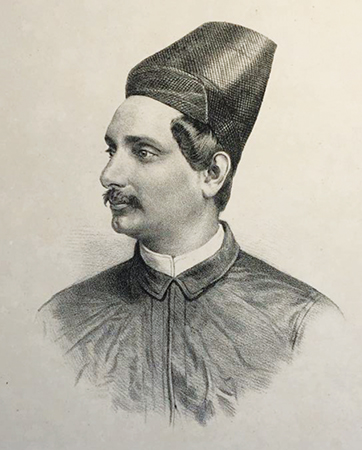
that was edited by a Parsi.” Reportedly, the city’s Muslims were offended by the quality of the lithographic portrait. After a meeting held among the Muslims, they began attacking Parsis and Parsi property. According to Patel, there were small skirmishes spread out over a few weeks in which one victim died and under 20 persons were injured.
The events of 1874 were caused by a Parsi author R. H. Jalbhoy’s portrayal of the Prophet Muhammad in his book The Renowned Prophets and Nations (1873) in Gujarati. Members of the Muslim communities were offended by the portrayal of the Prophet and riots broke out for three days in February 1874. These were the severest communal conflicts the city had witnessed, leaving seven dead, over 50 injured and property amounting to approximately Rs 32,000 destroyed and stolen, notes Patel. The 1874 rioting was more concentrated and severer than that witnessed two decades earlier, according to the historian. The Parsis were grouped more firmly in terms of class. Elite Parsis implicated lower class Parsis in the incidents of violence.
"Both the riots in 1851 and 1874 were strikingly similar. They had been instigated by publications by Parsis on Prophet Muhammad; they occurred just before the Mohurrum festival was due to take place…An awareness that the festival was approaching had an important impact on…the intensity of the violence…Lastly in the aftermath of the riots the leaders of the Parsi and Muslim communities jointly performed gestures of reconciliation publicly in the city.”
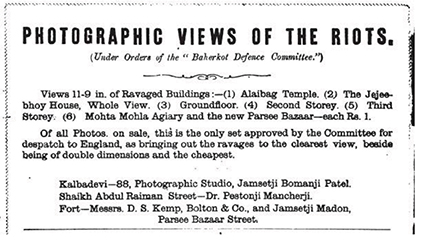
Top: Author R. H. Jalbhoy Photo: The Portrait Gallery of Western India;
above: advertisement for photographs of properties affected
by the riots Photo: The Bombay Riots of 1874
The "Tower of Silence Riot” in April 1873 was the culmination of a dispute over the ownership of a piece of land adjacent to Doongerwadi, writes Patel. A tenant of the Parsi Punchayet claimed possession of the land, and on the other hand, a builder, keen to develop the property. A horde of Parsis and Iranis attacked the builder’s employees, tore down two newly erected structures and escaped into Doongerwadi for shelter. Parsi accounts record the police’s entry into a sacred room on the grounds to arrest the rioters and the parading of the handcuffed prisoners from Malabar Hill to the police station at Mazagon. At the trial in the Sessions Court barristers Pherozeshah Mehta among others, defended the prisoners, all of whom were acquitted. The Bombay Samachar reported on the celebrations that followed: "The town wore a holiday aspect, and houses and offices were illuminated with lamps. Jashans were held in the evening in every locality, and thus was inaugurated the celebration of the triumph of justice and right over might.”