"Her research has helped establish and quantify the role that unconscious processes play in governing human social actions and judgments of others… For her ground-breaking contributions to understanding implicit social cognition” Prof Mahzarin Banaji of Harvard University was named a winner of the 2022 Atkinson Prize in Psychological and Cognitive Sciences. She has been instumental in introducing the term "implicit bias,” and developing the Implicit Association Test.
Instituted by the National Academy of Sciences (NAS) which, according to Banaji, is "the country’s most prestigious honorific society of scientists,” the awards ceremony in Washington DC on May 1, 2022 will be nationally broadcasted. "I will be there after much hand-wringing about travel (I am immunocompromised),” mentioned Banaji in her email response to Parsiana. In her engaging style, she added, "In my not so humble opinion, there are many people who deserve this award more than I do. It is not an award I had ever expected to receive and wasn’t even fully aware of its existence.” The biennial Atkinson Prize includes a cash component of $ 100,000 (Rs 76.2 lakhs) which Banaji hopes will help move her research in new directions. Four years ago she was elected to the prestigious NAS that was established by an Act of Congress, signed by US President Abraham Lincoln in 1863.
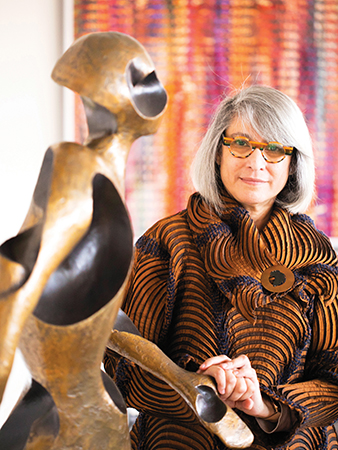
Prof Mahzarin Banaji: "understand the mind"
For Banaji, "To be recognized by an award named for the author (Richard Atkinson) of that very book (Introduction to Psychology) that was my bible so long ago,” made the honor particularly meaningful. As she acknowledged in her letter to the nonagenarian cognitive and mathematical psychologist now residing in San Diego, as a graduate student teaching Introductory Psychology to undergraduates at Ohio State University, she needed to constantly refer to Atkinson’s book. "When I got to Yale as an assistant professor, I happily taught Introduction to Psychology for more than a decade… Teaching for that length of time shaped my own research program as I was able to see that I should use measures of implicit memory to study social cognition…”
To explain the nature of her work to Parsiana readers, Banaji wrote, "My students and I use large language corpora (such as Google Books, The New York Times database, or what’s called the Common Crawl — a large segment of all words on the Internet from a two- week period in 2014) to understand the mind. We look at these databases using a machine learning approach called word embeddings to discover from the hidden aspects of language what our preferences and beliefs about social groups (elderly/young, Black/White, gay/straight, poor/rich) are.”
Past president of the Association for Psychological Science, Banaji has contributed to the field through her mentorship, public education, and ongoing leadership on science boards, committees and organizations. According to her Harvard University profile, Banaji continues in her role as the Richard Clarke Cabot Professor of Social Ethics at Harvard University to research the social attitudes of adults and children, beliefs and stereotypes, and individual responsibility.
An alumna of the Nizam College in Hyderabad and the Jawaharlal Nehru University in Delhi, Banaji earned a PhD from the Ohio State University, did postdoctoral work at the University of Washington, spent 15 years at Yale, and since 2002 has been at Harvard.
In her correspondence with Parsiana in 2014, Banaji had given credit to her "feminist husband Bhaskar (a Tamilian) who made many choices in our lives as a couple that favored my intellectual growth” (see "Passion and perception,” Parsiana, December 2014). Irked by the closed-door policy adopted by Parsis, she had recommended, "The solution lies in the broadest ‘giving away’ of the religion and ethnic practices to anybody interested enough, for any reason, in adopting them.” At the 12th World Zoroastrian Congress in New York City in July 2022 she will be speaking on "Blindspot: Hidden Biases of Good People” that happens to be the title of a book she has co-authored.
Constantly seeking to evolve, Banaji and her colleagues maintain a website implicit.harvard.edu where interested individuals can learn about their implicit biases. She is now involved in a program of education called outsmartinghumanminds.org. Reflecting on her three-decade-long career, the 66-year-old social scientist maintains, "It has not always been easy, but it has always been worthwhile.”