"I construct and sculpt commonly found objects, flora and fauna along with animal figurines... These installations are used as metaphors to depict the interconnectedness of all living organisms to our ecosystems and the need to maintain a healthy balance between ourselves and the environment,” stated 27-year-old sculptor Khursheed Nariman. "Hand crafted sculptures are primary to my practice which has evolved from small scale works to large installations,” said the artist, whose media encompasses clay, plaster, wood, metal and ceramics.
Nariman’s work Progress for her graduating exhibition at the University of Arts, London depicted a ladder reaching up to an open window on whose ledge an endangered Red Squirrel sits. A bird made partly of discarded feathers perched on the window ledge; three other endangered species including the Spider Beetle and a caterpillar, are also depicted in the installation. Nariman will complete her two-year master’s degree in fine arts at the University this July. Earlier, she studied sculpture at Triveni Kala Sangam in Delhi.
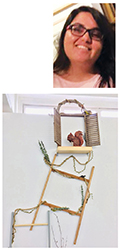
(Top) Khurshid Nariman; (above) her sculpture Progress: "installations as metaphor"
Nariman’s bronze The Rooster was on display at the annual exhibition of the Royal Society of British Artists from July 4-14. The artist’s work The Mountain Goat was selected for the Wildlife Artist of the Year competition at The Mall Gallery in London and was on display from May 28-June 2, 2019 along with 150 other artists.
Nariman studied under sculptor K. S. Radhakrishnan between 2015 and 2017 and was the only apprentice he taught for two years. The inspiration for The Mountain Goat came from her visit to Shantiniketan with Radhakrishnan, she stated. Though her medium of preference is bronze, Nariman was induced to use stone in her work by sculptor Sudarshan Sahoo in Bhubaneshwar, Orissa, with whom she studied for six weeks.
The artist returns to Delhi this September to restart working in her studio. She said that her work "exhibits the widespread threat to the environment in the face of unconstrained waste generation and developments in technology (that) pose monumental threats to wildlife... We find ourselves moving further away from our connection to our ecosystems. Therefore, my installations hope to impact the viewer on...environmental change, and how we as human beings can directly or indirectly damage our surroundings.” Nariman stated that there is a need for all to change our lifestyles and actions, if we intend to secure a healthy habitat for future generations to come. "Through art, we have the power to reach out to society — to inform, educate and ignite a curiosity towards improving our environment,” she ended.