The travails of growing up gay in a Parsi family
Hoshang Merchant
The Dalai Lama says: "We are all born without religion but we cannot be born without love.” In the upper middle class Bombay Parsi household in which I was born there was a lot of religion but no love!
Gays say that they are aware of their sexuality before they are aware of their nationality. In retrospect I can say I was made aware of my religious identity by my parents and had to ashamedly fumble with my gay sexuality. Nation came last, at least to me.
I am told that at birth I bled profusely from the cut umbilicus. My dad Dinshaw nearly killed the inept doctor at The B. D. Petit Parsee General Hospital who delivered me. My mother Dina, who had just enjoyed a good Parsi lunch, thought she had gastric pains but it turned out to be me! The widowed upstairs neighbor, at Tata Blocks, Bandra rushed the young mother-to-be to the distant hospital at Breach Candy. The Polish nurse on duty caught me by my heels and flicked my penis to reassure my mom she had indeed delivered her first male child. "You were so delicate, small featured, I thought you were a girl!” my mom always said. So the die was cast, so to speak, from my first moment on earth.
My mom’s mom had been sidelined because she had produced no sons. Not that my mother regarded the Hindu blessing, "May you be the mother of a hundred sons,” as a boon. Maternity did not fascinate this new woman of India who became a vegetarian and wore khadi for Mahatma Gandhi, studied music with Vishnu Bhatkhande at Prarthana Samaj, bowed before educator Dr Maharshi Karve’s portrait each morning before attending her BA literature class at S. N. D. T. Women’s University during the Quit India Movement, studied Annie Besant’s Theosophy with a Parsi Grand Master and whose mentor, Kapila Khandvala, a Lenin Peace Prize Winner, imbued in her the socialism of politicians Jayaprakash Narayan and Ram Manohar Lohia. But my mom was a Parsi priest’s daughter from Navsari and rejected by the womenfolk of my dad’s family for her pretentiousness, while her beauty didn’t exactly endear her to those women who failed the S. S. C., believed in Babas and whose obsession in life was Parsi food, Chinese silk embroidered saris (garas) and diamonds.
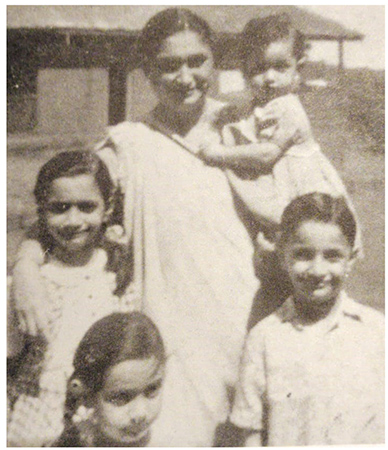
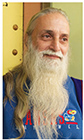
Top: Hoshang Merchant; Above: Dina Merchant with children (from l) Whabiz,
Maharoukh, Hoshang and Arnawaz, in arms
My dad was heir to his rich widowed mother’s wealth. His cardinal sin was marrying my mother for which he would never be forgiven. He had been brought up by his womenfolk as he lost his doctor dad when he was just one year old. Not having experienced paternal affection, he did not know till his last day how to show me, his son, any physical affection.
But my mother, despite having studied Freud and knowing all about infantile sexuality, beat me black and blue at the age of five for having a penis swollen red, probably from an insect bite, which she surmised had come from my precocious sexual activity at nursery school with a "bad” girl. Her Parsi puritanism had re-surfaced. And little knowledge is indeed a dangerous thing. The one act of kindness of my dad to me, which I will remember to my dying day, is gathering up a bruised and bawling me from the floor and carrying me in his arms to Dr Gandhi’s clinic across the road from our company quarters. I remember the doctor putting Lacto Calamine lotion on the little swollen glands and tying up my foreskin with thread so that the drying pink liquid wouldn’t flake off my affected body part.
From that day on I no longer looked at a girl in my kindergarten class at The J. B. Vachha Girls High School at Dadar. I shifted my attention to the only boy in my girls’ school. But his dad soon found out about our games in the sand pit and shifted him to Don Bosco High School. So it was back to gazing at a girl’s green eyes during class and being spanked for it by our English music teacher.
My dad liked all my young Parsi unmarried teachers and they liked him in return in equal measure, much to my mother’s chagrin. My old music teacher, who rapped my knuckles for going straight from the sand pit to her piano, could do no wrong because her family had endowed an atash behram though she instilled in me a violent hatred of Western classical music until one lonely American night I heard soprano Maria Callas pour out her heartbreak, mirroring mine.
In his second kindness to me, father had paid $ 4,000 in 1969 for me to study for my MA in Occidental College, Los Angeles. "Every Good Boy Deserves Fun (EGBDF),” so said my elder sister, model student who had tried to save me from my piano teacher’s wrath.
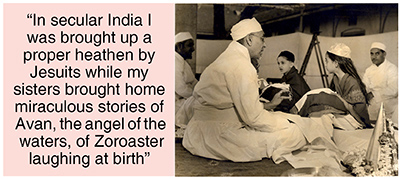
Hoshang and Whabiz Merchant being initiated into the religion
Dad tried to be a good Parsi father, driving us to the fire temple in the city from Pali Hill. The sun would have set. Mom would pray before a blazing fire in the warm twilight. I would rub my body against the cool marble to lessen my body heat. I saw only Zoroaster’s feet at my child’s eye level in the fire temple portrait. So vast was God, indeed!
I am a Midnight’s Child. Each Independence day dad drove us to Victoria Terminus to enjoy the illuminations, but the grime and sweat of the traffic jams would drive him literally mad and he would end up with the mai ben ni gaar (cuss words) he gave his mill hands at Tata Mills, Parel.
Before death he offered me his millions. His last Parsi act of charity. Too little, too late, I said. I refused. I am a bad son.
Ave Maria. Sister would sing for mother. Mother would ask her to sing it before our trek to Mount Mary’s in Bandra on foot as Mother Mary had appeared to her in a dream, promising her many children. Father, a diehard Parsi who would not let us go to Hindu temples and never to a mosque because "Moslems snatched Iran from us” would, however, accompany us to the church out of love for mother. Mom would be fixated on the one lakh rupee string of pearls that a Parsi philanthropist had donated to the Sisters of Mt Mary’s Convent. I would be absorbed in the naked boy putti (angels) flying around the gilded frescoed church ceiling. "Don’t look!” Dad would say. He would see my boy longings visibly stirred by the soaring Ave Marias, the Christi Lachrymoso, bleeding in color on the Cross in a side chapel, and the frankincense and myrrh from the swung thuribles by the novice Brothers. He soon stopped taking me to the church.
St Xavier’s Boys’ Academy had holidays for such exotically named days as Corpus Christi, the Feast of the Immaculate Conception, and the Feast of the Assumption. My sisters, Whabiz, Maharoukh and Arnawaz, in their Parsi school had Navroz, Pateti and Khordad Sal as holidays, when they feasted on vermicelli and pulav while I at my Jesuit school had to content myself with my 1,000th scrambled egg sandwich put together hurriedly at 7 a.m. by mom in her makeshift Pali Hill bungalow’s kitchen so that I could reach my school at Churchgate by 9 o’clock.
In secular India I was brought up a proper heathen by Jesuits while my sisters brought home miraculous stories of Ava, the angel of the waters, of Zoroaster laughing at birth, of the seventh heaven of Garothman Behesht, the house of eternal song where good Zoroastrians like my father would end up.
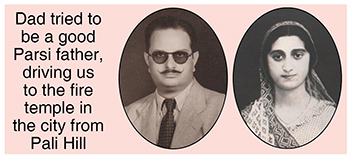
Dinshaw and Dina Merchant
From l: Dinshaw, Arnawaz, Whabiz, Maharoukh and Hoshang
I, for my part, had to be content with moral science, year on year, where we had to parrot the catechism according to St Secular: "Who made the world?/God made the world./ Who made God?/ No one made God; God made Himself.” O please! This went on year after year until the Std VII moral science exam where I refused to answer and Fr Principal gave me just passing marks which my mom thought adequately reflected my total lack of any moral sense.
By contrast, my sisters were taught Zoroastrianism by Dastur Khurshed Dabu, that angelic looking, sweet man, clad in white who would boost the ego of the much-put-upon-at-home Parsi girls in his charge with a rhyme: "Mai bolé maro dikro tau hero/Pan hoi tau narak no keero (Mother says my son’s a hero, though he is like a worm in filth)!”
O how I hated that rhyme! My Zoroastrianism extended to my severe guilt at my seemingly inborn homosexuality. My father once got tired of my reading the Gujarati transliteration of the Khordeh Avesta from cover to cover at our local Tata Agiary accompanied by profuse tears of guilt. He drove off home in his six-cylinder Morris but not before carefully giving me an entire rupee to take the 216, BEST bus to Pali Road instead of two rupees which would ferry me directly to the fleshpots of our city.
As English poet Walter Scott wrote: "O what a tangled web we weave/ When first we practice to deceive.”
I was more like the lilies of the field, who neither wove, nor spun. Leave aside such complicated arts, I could not even thread a needle for the full duration of the needlework class. The widowed teacher certainly hated boys. No help came from her. My sisters were busy collecting items for their wedding chests, radio-runners, tablecloths, tea cosies made under their crafts teacher’s watchful, cataract-clouded eye.
Dad said he had made woodwork pieces for his mother at Bharda New High School under the fatherly tutelage of his beloved Marzban Master.
Mother said boys in her rural Navsari built their bodies to the point where they could bend iron rods with their teeth. Sissies were unheard of there. Everyone had heard of Tehmuras Sarkari, the bodybuilder’s bodybuilder. But then she would add wistfully: "But there was one girl who acted like a boy. She’d play cricket.” Mom hadn’t heard the word "lesbian.” Neither had I. I have now, but as I said to my sister when she opted for an American husband: "Marriage with the opposite sex is marrying into another species, so why opt for someone from a different culture as well?”
As far as father was concerned, we were believers; everyone else was a kafir (infidel). I was shocked to hear from the Iranian Moslems that we, Zoroastrians, were kafirs!
Eden fled! My parents’ divorce in the Parsi Matrimonial Court was presided over by a High Court judge. The judgment arbitrated by Parsi jurymen whom sister and I dubbed eggheads, even though the jury system had been phased out after the "not guilty” verdict in the murder case involving Parsi Indian naval commander Kawas Nanavati, in the very same courtroom. Father had conveniently become a Freemason months before his "not guilty” verdict from this all Parsi jury of egghead men, presumably Freemasons all.
Shia Islam allows good gay men to enter heaven where they can sing and dance with sexless, beautiful, beardless, never-aging beings called Gilman. Miss Lakdawalla’s Indian dance class, I hope, will then stand me in good stead.
In Zoroastrianism there is no eternal hell despite the terror of dozakh, the Parsi hell our Parsi parents spoke to us about. And heaven is sexless, anyway, much like our childhood heaven in the garden of Pali Hill.