Ervad Xerxes Vispi Dastur
*7. Provided there are no legal cases pending and we have signoff on the same by the Bombay Parsi Punchayet (BPP) legal advisors and auditors.
*10. The process and collection of the voluntary service charge was not logical and not legally enforceable. You cannot have the same service charge for a large flat as for a small flat, for colonies where there are multiple amenities offered and for a standalone building or colony where there are no services offered. By unofficially instructing rent collectors to not collect rent if service charges are not being tendered (in spite of the service charges being voluntary), it deprived the trust of not only the voluntary service charge but also the rent. Addtionally, there were selective waivers of collection of said service charges to a chosen few. The entire process did not involve the community or the colony committees by taking them on board for the manner and process of collection of the voluntary service charges.
*11. Auction flats, sell property, build ownership flats and sell them: Additionally, there are many ways to augment the BPP finances apart from the ones mentioned below. We have a huge amount of locked flats which are in litigation. We need to bring these to the table and settle matters. We have some redevelopment possibilities. We need to involve the community and the colony associations and look at other ways like movie shoots, sporting activities, etc which could bring revenue on a sharing basis to the colony associations and the BPP. The colony associations would then be a little self-sufficient and able to do some more maintenance in the colonies independently.
*17, 18, 19, 20. For all such religious matters I would personally like to defer to the views of our learned vada dasturjis. I am an ervad but I firmly believe that the BPP is not a religious body and trustees should not interfere in religious matters which are the domain of our learned vada dasturjis.
I had made various promises during my election in 2018 as regards stepping down with the rest of the trustees, proposing to change the scheme of elections, reduction of the term of trustees, introducing a code of conduct for trustees as well as for the election, all of which have been fulfilled by me. I have given up nearly three-and-a-half years of my term to ensure that these changes are made and they would benefit the community. I would like to continue with the proposals I have made and ensure that I bring back the BPP to a stable and steady financial position where we are able to fulfil our responsibilities and commitments made as regards our priestly class, our welfare schemes for the needy and poor in the community, our financial and other support for the second and third child programs. One of the many things I believe in now is that we have a lot of charitable institutions and other community bodies who need to work together for the general betterment and upliftment of our community. I am associated with numerous Parsi trusts and organizations and I firmly believe that the BPP can play a leading role in getting these organizations together so that we can have a more focused and constructive interaction for the betterment of the community.
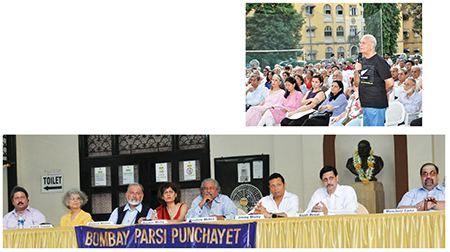
Samast Anjuman meeting at Rustom Baug in May 2013
Anahita Yazdi Desai
*4. It is important to communicate with the community. It may be in the digital/electronic format as having it printed and distributed free would be a costly affair. It need not be a monthly publication.
*5. Several decades ago the BPP had adopted the leave and license (L&L) system only because the L&L allows the Parsi only covenant to be enforced. It is a preferable legal system as it allows the trust to safeguard its covenant and to keep housing for Parsi Irani Zoroastrians only.
*6, 7. But only if the Parsi Irani Zoroastrian covenant can be easily enforced and legally guaranteed.
*8. In the case of certain large sized premium flats so that the BPP can get funds (especially if the amount is given as a donation rather than an interest free deposit) to be used for the welfare of the community. Auctions allow free and fair allocations but they must be subject to: being given to families and not to single individuals; to Parsi Irani Zoroastrians who have a genuine requirement; preference should be given to Parsi Irani Zoroastrians living in India and not to NRI (non-resident Indians) or foreigners.
Presently when the BPP is facing a tremendous cash crunch, any project which can generate a cash flow and income for the trust should be welcomed.
*9. I am fully committed to more housing for community members especially the poor and the much neglected, hardworking, middle class. Many middle class Parsis can pay a reasonable amount (Rs 20-30 lakhs) for a flat. The BPP needs to cater to this middle class segment also.
*10. Looking at the precarious financial position of the BPP, it may be necessary to reintroduce the Rs 750 service charge. Nearly 70% of the residents were able, willing and paying the increased service charges when it was introduced earlier. The ones who were not in a position to pay this charge had applied for a waiver or reduction and the BPP had, after investigating the applications, granted the waiver/reduction to genuinely deserving residents.
I also strongly feel that every decision which the BPP board takes, such as this one, has to be conveyed to the community along with the reasons and rationale for taking the decision. The facts and figures need to be put before the community. I am sure that transparency is the key to gain acceptance from the community for even "unpopular” but much needed hard decisions.
*11. I think that all the above points — auction flats, levy service charges, sell property, build ownership flats and sell them — can be adopted with sufficient, well thought of safeguards and by putting processes in place to bring the BPP out of the financial doldrums and make it financially strong. If the BPP is not on a strong financial footing, the trustees will not be able to serve the community efficiently or come up to the expectations of the community.
*12. It has great potential for transformational work to be done for the small anjumans and to protect and monetize community property which is unfortunately being encroached upon and whittled away by unscrupulous elements and land mafias. The Federation of the Parsi Zoroastrian Anjumans of India is also a good representative forum of Parsi and Irani Zoroastrians from across India which together with the BPP board can take up with the government issues which affect the community. It is in fact an essential and important representative body to have for any small community.
*13. My husband Yazdi Desai and I have attended Federation meetings all over India during his tenure as a BPP trustee and later as the chairman; so yes, I will attend all such meetings.
*14. I believe that any world body of Zoroastrians cannot have as its constituents organizations which include non Parsis as members.
*15. If a Parsi Irani Zoroastrian wishes to be cremated or buried, neither I personally nor the BPP can interfere in their choice. However such cremation or burial cannot be at doongerwadi ever. The trust deed of the doongerwadi complex is very clear that the land has been specifically donated for the dakhmenashini system only.
This is consistent with practices in other communities, e.g. a Muslim who wants to be cremated would not be permitted to have his funeral pyre in the burial ground. Nor would a Hindu who wishes to be buried be permitted to be buried at the crematorium.
Those opting for cremation have been using the Worli Prayer Hall where facilities for the four-day prayers are provided too.
*16. Once the sachkar (ritual bath) is given to a corpse in the bungli, the bungli ceases to be just another room and becomes a religiously and ritually consecrated place where Zoroastrian religious ceremonies are to be performed. Therefore, only those who are Parsi Irani Zoroastrians can use such a place or attend such ceremonies. All religions have traditions and a belief system according to which what is sacred is limited to its own people and what is not sacred is open to others. This is a matter of religious belief and it should be respected.
In fact, most non Zoroastrians are most respectful of the religious rules of our community and have little desire to flout our sacred regulations or hurt our religious sentiments.
*17. If the family is keen to accommodate their non Zoroastrian family members or friends who may wish to pay their respects/see the face of the deceased, then the body can be kept at home or in the pavilion in the doongerwadi for non Zoroastrians to view the face. After this the body can be taken into the bungli for the sachkar ceremony. Once the sachkar ritual has begun, all religious rules must be followed.
*18, 19. I respect the views expressed by our high priests in this matter.
*20. I am loath to defy any long-standing religious custom and tradition.
Tehmtan J. Dumasia
My responses are as per my beliefs. However once elected I may find some answers that I am probably not sure of now as a layman.
Prof (Dr) Zuleika Homavazir
*11. Development of stagnated properties.
The values of honesty, transparency, reliability, trust, and involvement of community members, should be the core principles driving the administration of the board. Our community must vote for educated administrators rather than politicians.
The elderly, the youth and the needy need to be cared for, more than ever if the community needs to progress. It will be my endeavor to ensure the board spends wisely, works for the lower and middle strata of the community and protects the interest of all and promotes common welfare which is the need of the hour to restore mutual trust between the community and the board.
Ervad Farhad Hosang Hozdar
*2. It should help.
*5. Leave and license basically protects BPP’s right to act if license terms are not adhered to and therefore from BPP’s point of view may be a preferred option.
*6. We should obtain a legal opinion on the protection of BPP’s right to act, if required, safeguard donors’ wish of endowment and protect the Parsi-Irani covenant.
*7. If the Zoroastrian covenant is protected under the Maharashtra Rent Control Act, 2000 then it may be considered after obtaining legal opinion and possible tax liabilities.
*8. As trustees it is our duty to follow the wishes of the donor.
*9. We should consider this option after taking stock of available flats and the projected future needs of the community.
*10. This decision should be made once the finances of the BPP are studied by the incoming trustees — basic expenses should be recoverable.
*11. This decision should be made once the finances of the BPP are studied by the incoming trustees. Decision should be based on short-term and long-term needs as identified.
*12. It is required as we Zoroastrians are spread across India and it helps in understanding community needs and protecting community interests across geography.
*13. But even if unable to physically attend, online option is always available to put forward points and even debate.
*14. We need to put our house in order before we consider forming other world bodies and determining their composition. Finally, decision of the high priests is important.
*15. I would prefer to follow the tenets and customs of our religion. However, every individual has a right to decide what is best for him or her.
16, 17. Personally, I would prefer that we continue with the present customs — however, the BPP should follow the advice of high priests in the matter.
*18, 19, 20. Our high priests who have studied our scriptures are better qualified to advise on this issue. As a BPP trustee, I would follow their advice on all issues relating to religion.
In all matters of religion, we should follow the advice of our high priests as they have knowledge of our scriptures and customs.
The duty of a BPP trustee is to follow the BPP trust deed and protect the funds and properties of the BPP which are for the benefit of the community at large.
Farhanaz Irani
*2. Certain things.
*3. It depends.
*5, 6, 7. It depends on our trust deed and for our community to survive.
*10. Would check the expenditure of each baug and also for low income groups the trust can waive off the service charge.
*11. Need to get feedback from illustrious community members. Good performance by the Parsi Punchayet would get donations. Also by building ownership flats.
*16. Can be present in the pavilion.
*18. According to the Parsi law.
*19. Not permitted by Parsi law.
One must preserve our Parsi/Irani Zoroastrian customs and traditions and identity at all cost and preserve and protect our estate constructed by our forefathers for the use of our community for generations.
Kaikhushroo Sam Irani
*11. Sell defunct properties or invite Parsi industrialists to finance such projects towards charitable purposes.
The world has reached a hi sci-fi era and Parsis are the pioneers in all fields as noticed and records will show. With due respect for our religion, if you survey the marriages of the last 10 years, more Parsis are marrying outside our community and hence we should also step forward and accept the world as per changing times. Together, united, we can move ahead with all and bring peace and prosperity in the community and for our younger generation who should get reservation for government jobs, medical admission and in other strata of life which is my priority vision for my community.
Hoshang J. B. Jal
*5. Until we find a more permanent solution, this appears to be the best option. In the interim we must examine the legality and viability of the issue in detail with regard to the trust deed and the donors’ wishes of Parsi only covenant.
*6. This would have to be determined keeping in mind the laws of the land and the protection of the Parsi only covenant of the trust. That being said, occupants who are presently protected as statutory tenants under the Rent Act should continue to be given protection as per the law.
*7. This subject would need to be assessed and examined and legal opinions would have to be obtained to ensure that the community property is adequately protected and used to fulfill the purpose of the trust mainly with regard to protection of the Parsi only covenant. Income tax and other liabilities would also have to be examined.
*8. The community is being informed that the BPP is facing its worst financial crisis ever and that the auction of high value flats was the only solution to raise funds. The legality of raising funds through this method and also the donors’ wishes and the trust deed need to be examined.
*9. If it is established that there is a requirement for constructing more housing for the community, then we must do so. For such purpose, we will first need to ascertain the number of flats presently in possession of the BPP and the status of such flats. We should also examine the waiting list and arrive at future requirements before taking any decision to construct new flats.
*10. Service charge needs to be levied on the basis of services provided to the beneficiaries. There can’t be a policy of one size fits all. The reasons for this common levy of Rs 750 will need to be examined and also the reason for its withdrawal.
*11. By reviving the stalled revenue generating projects like the Godrej Baug ownership building, redevelopment of demolished buildings at Bharucha Baug, etc. Also, by reaching out to our more prosperous community members for donations. To facilitate this, we would first have to determine precisely for what purpose the money raised would be utilized (on a project-wise basis), and ensure that donors are given full visibility on how their donation has been utilized and the positive impact it has had.
*15. Personally, I am a strong believer in the system of dakhmenashini.
*16, 17, 18, 19, 20. The questions under reference involve interpretation of religious texts, as well as tradition, customs and practices followed by our community brethren. It would therefore be advisable and prudent to allow the high priests/scholars of our community to make an informed decision in this regard.
It is my view that a BPP trustee has no role in interpreting or expressing his/her opinion on religious matters. In fact, the High Court of Bombay has also opined that the trust deed does not empower BPP trustees to interfere in religious matters.
The BPP trustees should take appropriate steps to assist the high priests and religious scholars and provide them with all the necessary support.
Dr Adil Malia
*1. Though not required under the law to do so, nor under the High Court framed scheme of elections, I personally believe that being a public charitable trust, the board of elected trustees should always observe the PATI rules for clean and good governance in their behavior: Probity, Accountability, Transparency and Inclusion of beneficiaries.
I, therefore, strongly advocate holding annual meetings with the community members on similar lines as done by corporates under Section 96 of the Indian Companies Act, 2013.
*2. Highly desirable from a clean governance point of view. BPP is honor bound to update its beneficiaries on the status of various projects, the trust’s activities and key critical decisions taken by the trustees with logic and reasoning. Publishing such annual reports of activities will certainly also mitigate suspicion, reduce unnecessary cross-rushing to media by factions and creating a ‘black-box effect.’ Norms to be followed for such an annual report could be, mutatis mutandis Section 137 of The Indian Companies Act 2013. Today, using technology and social media the official report (both financial and narrative) can be widely disseminated in a cost effective manner.
*3. Absolutely in favor of BPP publishing its audited statements of accounts. Distributing electronic copies or publishing the same on its website would suffice. The beneficiaries should be made aware of the state of financial health of the trust which would help to avoid any rumors and gossip.
*4. BPP Review was quintessentially the news bulletin of the BPP. The cost of publishing a very large number of copies was becoming prohibitively high and thus a burden. I understand that it was discontinued for this reason. The times have now changed. I would support the decision to publish and disseminate the same electronically. ‘Black-boxing’ of communications which is a sore point would also get addressed.
*5, 6, 7: This issue requires a very deep and detailed study as it includes and is fraught with implications from Rent Act, taxation, conversion costs, protecting our trust properties, supporting our poor beneficiaries and upholding the intentions of the original donors and settlors.
Currently, the study done appears to be superfluous and incomplete. It does not answer all the dimensions of this challenge at hand. Ideally, outcomes of half-baked studies should not have been announced to create an imbroglio that it appears to now have.
I believe that a serious time-bound study needs to be undertaken by a set of lawyers, tax experts and other relevant professionals and all the trustees should commit to cooperate and not litigate to operationalize the outcomes and recommendations of this study group.
*8. This is a ‘devil and the deep sea’ dilemma. The current cash-flow challenge, I understand, is for real. I have personally not examined it myself. However, true as it may be, this practice needs to be evaluated from its legal validity as also its conformity with the purpose of the trusts as reflected in the trust deeds and the intentions of the original donors and settlors. Ideally, assets of the trusts should not be sold. Personally, not in favor of that. However, the proposed study group as suggested above should cover this dimension as well.
*9. Most certainly. There are several young couples waiting to be married. There are displaced Parsis and Iranis from locations that need protection. There are other old people residing in dilapidated buildings under threat of collapse that needs addressing. Yes, yes, yes, we need to construct more housing. The big problem is finding funds for the same.
*10. I am personally not very familiar, unfortunately, with this issue. It needs a deeper study. However, the job of trustees is to protect the intentions and purposes of the donors and settlors and offering maximum welfare to the beneficiaries.
*11. Once we build the trust and rebuild our credibility, we could approach high net worth individuals (both Indian and overseas) to support our community projects and programs. We need to creatively work out ideas to generate funds through better commercial use of our trust assets without touching any aspects of their religious sanctity. Commercial trade outside our housing complexes could generate substantial profits which currently are flowing to other traders. We could evaluate and encourage Zoroastrian entrepreneurs to carry out their commercial trade from such assets on a sharing basis.
*12. Certainly, there is a great scope to do better and I wish FPZAI a bright future. I think we need a strong apex body that unites the community and its institutions pan India. In the USA there is FEZANA (Federation of Zoroastrian Associations of North America) which has reportedly been very effective.
*13. Attend… any location.
*14. Needs to be deeply examined for its implications before responding. However, if the rules applicable in the different countries where these anjumans are situated allow them participation, they cannot be legally disallowed.
*15. I personally believe in dakhmenashini. However, it is a matter of personal choice how each individual chooses to dispose his or her body. Sanctity of that choice is critical. It should not be taken away.
It is critical for us to understand that the BPP is not a religious body. The sacred doongerwadi and the agiaries under its management must be governed strictly as per the trust deed, the applicable law, and the intentions of the donors and settlors. This is a legal obligation that every trustee must discharge in his/her fiduciary capacity. It is a public trust which has been created by donors and settlors for welfare of the beneficiaries. The trustees are only supposed to ensure protection of the trust, its funds and assets whilst fulfilling its purpose.
All matters with linkages to our great religion, its practices and interpretation of scriptures, etc would be in line and under advice from our vada dasturjis and our other religious scholars.
*16, 17. Continue current practices and no change unless approved by vada dasturjis and other religious scholars. Also, it would not be prudent to upset our long-standing customs, practices and usages and further divide our community.
*18, 19. This is a legal matter and not subject matter for the trustees to decide. Trustees are legally duty-bound currently to observe the 1908 judgment rendered by Justices Dinshaw Davar and Frank Beaman. Till this judgment is overturned/modified by the Supreme Court in a matter that is presently sub judice before it, the current practice has to continue. Trustees are duty bound by the law of the land.
*20. BPP is not a body to originate or approve religious practices. BPP has to be guided by recommendations of our high priests and other religious scholars in matters of religion/religious practices to be adopted. Iran has women mobedyars as approved by their council of mobeds. However, in India our learned high priests have not considered this issue.
Viraf Mehta
*7. As long as there are no legal cases with the BPP and within the guidelines of the trust.
*11. Auction flats, build ownership flats and sell them. Donations, settle legal disputes, refundable deposit scheme, redevelopment.
*15. But those who do not wish for dakhmenashini should not force other methods onto the doongerwadi. They are free to do as they please outside.
*17,18,19, 20. For religious matters will refer to the counsel of high priests.
Maharukh Kobad Noble
*5, 6. Each case has to be reviewed individually on its merit.
*7. Not without reviewing the same individually.
*10. And subsidize the same for those who apply for subsidy.
*11. Auction flats; build ownership flats and sell them.
*15. Not in favor of alternate methods of disposal… but where choice is concerned unfortunately cannot impose.
Daara Bahadur Patel
*11. Sell property. Build ownership flats and sell them.
I believe in upholding and following the time tested tenets and religious practices and traditions which have enabled us to survive for centuries amongst people of all religions.
Religious decisions are to be left to the vada dasturjis and learned priests.
In my opinion the BPP is not the custodian of our religion but custodian of the assets, lands and properties.
Kersi Randeria
*11. Build ownership flats and sell them; through donations.
*15, 20. Subject to the advice of our own high priests and the laws of the land.
I have been a trustee for six-and-a-half years. The work I have done in doongerwadi, our colonies and for the welfare of our less fortunate brethren is for all to see and judge.
Armaity Rustom Tirandaz
*1. But every two years.
*2, 3, 4. I would like to do via the BPP website or electronic format and not in physical print.
*5. Choice should always be open to the person being allotted.
*6. As long as it protects the Parsi Irani Zoroastrian covenant.
*7. With the choice of the occupants as long as there is no conflict with the trust and with the same reply as in point 6.
*8. At least until the financial status of the trust is strengthened and stabilized.
*10. Ad hoc increase, if done, should be levied according to the area of the premises and the economic status of the residents.
*11. Auction flats; levy service charges (see *10); build ownership flats and sell them.
*15. They already do have a choice.
*18, 19, 20. These are matters of interpretation and guidance from the high priests of our community. Their decisions and directions would be sought in the matters of such significant nature. But in my personal view, it is an unwise direction to take as it would have tremendous ramifications in the long run for our community, the trusts and properties, and the beneficiaries.
Rumy Zarir
*4. Can do online version too, in order to save costs or can put it on BPP website.
*7. As long as there are no conflicts with the trust. Also needs to be within the guidelines of the trust and most important is to protect the Parsi only covenant.
*8. High value flats in order to generate funds for the trust.
*10. The service charge amount should be decided and then levied in a fair and phased manner which is in the interest of both the trust and the beneficiaries.
*11. Auction flats; levy service charges; build ownership flats and sell them. Permit activities like film/advertisement shoots, putting hoardings on our BPP properties after discussing with the elected committee of various baugs/tenants. This will help generate funds not only for the BPP but also for the respective baugs.
*15. They do have a choice already. If they opt for any method other than dakhmenashini then it should not be done at doongerwadi.
*16, 17, 18, 19, 20: In my opinion, all religious matters should be addressed by our high priests.