A former resident’s nostalgia steeped recollections of this self sufficient world
Porus P. Cooper
Just as the heated landlord-tenant dispute in Malcolm Baug simmered down, residents got this text alert: "We have not recvd water from BMC (Bombay Municipal Corporation) today morning. The main water supply pipe repair work has been going on since 11 p.m. last night. We have called for water tankers. Please use water very sparingly.”
Finally, I thought, things have returned to normal in the colony that once was my home.
For weeks Malcolm Baug had been the subject of headlines, shared worldwide on social media, about a quarrel over lease terms between some residents and their landlord, the N. M. Wadia Charities.
The alert to conserve water took me back to when I used to live in this emerald of a Parsi enclave in Bombay. It is where I grew up. Then, residents had only two vexations — how long the municipal water supply would last and when the kaamwali (cleaning lady) would show up. Nothing worthy of international headlines.
It was the late 1970s and I was in my 20s. I had come home to Malcolm Baug to visit my parents after some years of study and work abroad. To my delight I found that things at home were mostly as I had left them.
My trusty bicycle was parked where I had left it, and my old cupboard stood where it always had. The cupboard door still displayed clippings I had taped on its inside — inspirational quotations, R. K. Laxman cartoons, photos of cricket heroes and one of Dadabhai Naoroji.
But one prized boyhood possession, usually stored at the bottom of the cupboard, was missing — a pair of roller skates.
Many a weekend, my friend Pervez and I had click-clacked up and down the long, coconut palm-lined slope that marks one edge of the colony.
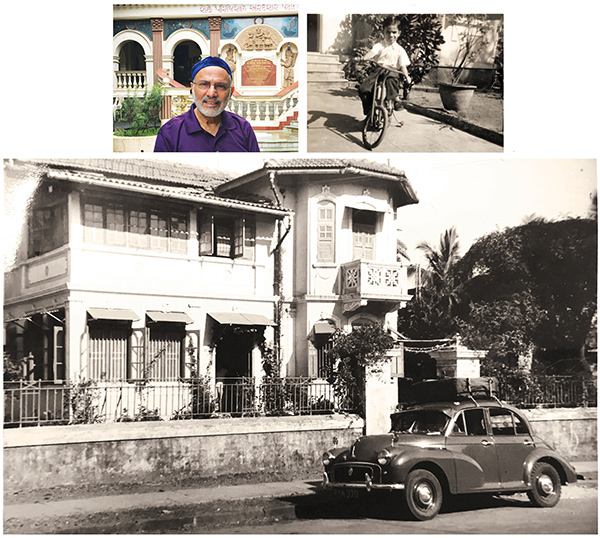
Porus Cooper (top l) at the Seth Pirojshah Ardeshir Patel Dar-e-meher, Andheri
and as a child (top r); above: Avan Cottage
The next morning, I saw where they were: My father, Pessie Cooper, had repurposed them as carriage wheels under tapelas (large pots) that he was hurrying to fill at the kitchen sink and rolling over to a storage area before the tap ran dry.
He was a retired Tata engineer and a World War II naval officer. When a warship he served on was sunk, his resourcefulness was tested to the utmost as he fled through the jungles of Burma to elude capture by the enemy. He was not about to surrender in a skirmish at the household sink.
Similar campaigns to hoard precious water unfolded across the colony each morning, choreographed by the invisible person in charge of the colony’s water-pump switch.
With apologies to Rohinton Mistry’s fictional Tales from Firozsha Baag, you might say such scenes were something out of "Tales from Malcolm Baug.”
The Malcolm Baug of my long-ago memories was a self-sufficient world. It was a little Parsi republic whose citizens did not have to step outside its borders for their daily needs if they did not want to.
The pauwallo brought bread. The eedawallo brought eggs. The machhiwalli brought fish. The goswallo brought mutton. The tarkariwalli brought vegetables. The doodhwallo brought milk. The paperwallo brought the morning Times, Express, or Free Press Journal. The mochi fixed shoes. The dhobi picked up the dirty laundry.
This republic had an army of one — the Pathan watchman who patrolled its streets after sunset. We children knew him only as "Lala,” which was a term of affection for men of his community. Our Lala looked formidable with a tall turban on his head and a big stick in his hands. He was our hero. Then one day word spread that overnight he had collared two would-be burglars, and he became a bigger hero.
Keshav the barber came to cut hair — if the latest style was not important to you. At our house he worked on me and my brother Khershed under the watchful eye of my grandmother, Tehmina. For her, our hair was never cut short enough.
Tailor Dara, a relative with his own inspirational life story — he was born deaf-mute and was losing his eyesight — came on the 4 Ltd bus from faraway Byculla to measure us for our school uniforms. Unlike with our hair, our grandmother ordered that our short pants be on the long side – so we did not outgrow them too quickly. (She had lived through hard times and frugality was her only extravagance.)
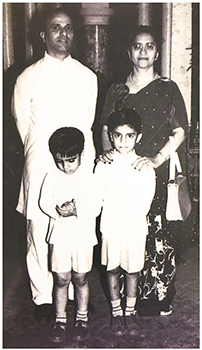
Pessie and Coomie Cooper with sons Porus (r) and Khershed
Above, from l: Khershed, Khorshed and Porus Cooper;
above right (l-r), seated: Rati Shaher, Coomie Cooper, Roshan Laskari, Banoo Katila,
Dinu Kheshwala and Sheroo Kalvachia; standing: Faredoon Shaher, Pessie Cooper,
Behram Laskari, Rusi Katila and Tehmul Kalvachia
Kindergarten was steps from home, operated in their residence by the Kavasmanek couple.
Unwell? Dr Driver, the colony’s resident physician, marched to house calls like the former army officer he was. For youngsters like me, his clinic was a wonderland of exotic aromas as his compounder mixed the potions he prescribed.
Needing branded medicines or toiletries? Hormusjee uncle’s Jogeshwari General Stores was just outside the colony gates.
Craving kheema-pau? Boman uncle’s Malcolm Restaurant also was just outside the colony.
Wanted bread after the pauwallo left? Loaves could be picked up at Goolcher aunty’s home store in the colony.
Piano lessons? Kids went to Mrs Nallaseth.
Religion lessons? Naju aunty.
And many households relied on all-purpose helpers such as our Mali (gardener). This soft-spoken man resided in our backyard shed. He tended to my mother Coomie Cooper’s beloved garden, escorted us children to school, lined up at the ration shop for us, and responded to our cry of "Mali” so readily, as a youngster I assumed that was his name. I did not know where he came from or where he went when one day he left. I have a slightly out-of-focus photograph of the man. It was one of the first I took as I tested a newly acquired camera. To my regret I still do not know his name.
Outside home, the focal point for many, young and old, was the gymkhana. Then, in the mid-sixties, the colony acquired an agiary; now both recreational and spiritual needs could be satisfied right inside the colony.
About this agiary, the Bai Motlibai Wadia Adaran, if I may digress for a moment.
I was just 15 when its consecrated flame arrived in Malcolm Baug to great excitement. But during my immature years, having an agiary in the neighborhood felt like a mixed blessing.
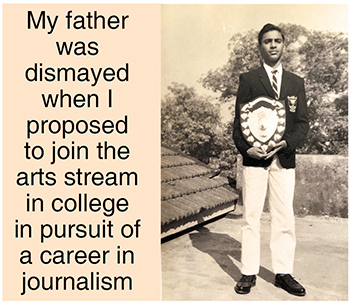
Porus with a college elocution trophy
I was among the hundreds of faithful who had proudly escorted the urn bearing the fire, on foot, from Wadiaji Atash Behram to its new home many kilometers away. I had joined one of the three overnight stages of the solemn procession, thus earning my cherished footnote in this history. And as my parents did, I held in awe the colony’s two persistent moving spirits of the years-long agiary project, Sorabji Nentin and Soli Mehta, the latter a close family friend.
But the ease of access to an agiary at times was also a source of annoyance because it seemed to increase family pressures to attend jashans or other rituals there when I would rather be playing table tennis at the gymkhana. (Sometimes the pressure felt doubled because of our longstanding family allegiance also to the Patel Agiary at Andheri. That Agiary was founded by my maternal great-grandfather, Ardeshir Bhicaji Patel, in memory of a son who died prematurely).
I recall this juvenile petulance of mine with amusement because in the years since, even as a visitor to Malcolm Baug, I have looked forward to spending time in this Agiary where my parents spent so much of theirs.
Sitting in its tranquil environs, with the fire softly crackling in the afarganyu in front of me and a portrait of the inspirational Bai Motlibai Wadia on the wall behind me, I collect my thoughts. I recite prayers that my parents said, bow to portraits of noble souls they bowed to, offer sukhar (sandalwood) as they did, drop donations in the collection boxes as they would, and anoint myself with rakhia (consecrated ash) as I watched them do.
I don’t know if these little acts of devotion and tradition of mine (repeated at any agiary I may visit) are connecting me to Ahura Mazda. But I feel they definitely link me to my parents and to countless generations before them of family and community in a bond of identity and history that I do not wish to be the one to break.
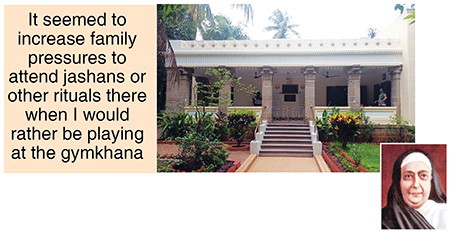
The Bai Motlibai Wadia Adaran in Malcolm Baug Photo: Yezdi Mody; inset: Bai Motlibai Wadia
Above: A present day street in Malcolm Baug; right: Malcolm Baug gymkhana Photos: Yezdi Mody
From the perspective of time and distance, the self-sufficiency and homogeneity of life in the colony had some cons to go along with its pros. Coming of age in this insular world left me ill at ease among the diverse multitudes outside, as if I didn’t belong.
It recently struck me that during the time I lived at home my family never entertained members of other communities or were invited to their homes. We were not unusual in that, and I do not attribute anything unsavory to this mutual social aloofness. People of all cultures got along fine in the workplace. The great vegetarian-non-vegetarian divide probably was one reason for the reluctance to socialize together. (Mali once declined food my mother made for him when he fell ill, citing caste constraints.) Whatever the explanation, it deprived people of an opportunity to know each other’s authentic selves.
On the other hand, no better social arrangement has been invented to preserve the ethos and self-esteem of minorities than for them to reside in congregated housing. Parsis are not alone in this, especially in the vividly multicultural Indian context, and may well have the greater justification given their paltry numbers.
Shared cultural mores facilitated lifelong friendships. The Coopers, Katilas, Laskaris, Kalvachias and Sahers were inseparable, and I am probably missing a couple of names. Countless evenings together. Endless potlucks. Trips together to Udvada. The dispatch of chasni or sev to each other on auspicious occasions.
Proximity also enabled other types of bonds.
One group assembled workday mornings in a First Class compartment of the 7:05 fast train from Jogeshwari to Churchgate. Nariman uncle, heading for the stock exchange in his trademark starched whites, briefcase in hand, was a veteran member of this band of talkative travelers. Members of other communities joined in the banter. I was briefly part of this group as I commuted to my first job out of college.
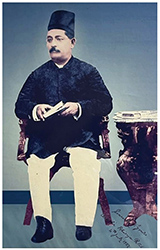
Portrait of Ardeshir Bhicaji Patel
Dhanji Rana: "Zodiac Man"
Evenings, the gymkhana benches brought together yet another set of familiar faces. Sukhia, Divecha, Kapadia, Nicholson, Khareghat, Irani, Billimoria, Dalal, Parbhoo, Kalvachia, Arethna, etc. Their conversation was a mix of mutual teasing, gossip, flirting, political analysis, and practical advice to any youngsters present.
Here is where Noshir Dalal, a labor union official at Union Bank, announced one year that he could place colony teenagers in vacation jobs as tellers at the bank. I signed up, and so it is thanks to Noshir uncle that I discovered I was not cut out for banking.
Another prominent member of the bench coterie was Homi Sukhia. A giant with a booming voice to match, his occupation was exotic even in that time: He was a locomotive fireman, shoveling coal into engine boilers. His muscular arms attested to what he did for a living. Technology soon would make him obsolete, but there still were enough steam engines around on India’s tracks to require his services.
I attribute two marriages at least in part to the socializing on the benches, and there probably were more. I was surprised to learn recently of one that never happened. Let’s call her A. Her beguiling smile and languid manner set her apart from her contemporaries. Surely, she was the object of many a colony boy’s secret desire. But last I heard she was retired from work, still single. Was this a conscious life choice, or were there heartbreaks along the way?
There would be no dearth of memorable characters to populate our "Tales from Malcolm Baug.”
Add to the list Rusi uncle, a corporate executive and close family friend, who was for a time the only car owner on our street. Thus, his Premier Padmini was often in demand for rides, especially during the monsoon. Like all Parsi car owners he could be unpredictably generous or possessive when it came to sharing his tenderly maintained vehicle.
Kali uncle, the colony impresario with Bollywood connections. (He once introduced me to one of the great Kapoors, leaving me wide-eyed.) He organized us youngsters in staging plays and elocution competitions. I suffered from chronic stage fright so neither came easily to me.
"Gaadi” (mentally disturbed) Daulat, the woman who lived alone and shouted imprecations at passersby. For young children the stretch of street past her house felt scary to negotiate. I remember picking up the pace as I walked by. Some youths, more brazen, lingered to provoke her.
Only years later, after she died, did it occur to me to wonder how she came to lose her mind, how sad that was, and who took care of her daily needs. Too late, it occurred to me that she had deserved courtesies and understanding from us, not derision or avoidance.
My childhood friend Cyrus told me recently that as a teen he did check in on her and that in her calmer moments she could be lucid.
Speaking of Cyrus, when he was 15 his curiosity led him to climb to the roof of his family house to watch repairs. A step gave way and he fell, shattering his hip. In the lottery of life, he won a lifetime of pain and surgeries. Defying his disability, he never stopped joining in our volleyball and cricket games and continued to share with youth groups his passion for hiking nature trails. After relocating to the US, he continues to be active in the community.
My cricketing friend Homi Miller. In my mind’s eye I can still see him, lanky and pale, running in to bowl in a distinctive gallop. He was our "fast” bowler, though often his gallop appeared to outpace the ball that left his hand. Years after I had moved away, I learned of his premature and tragic end. He had a chronic health condition, lived reclusively, and was found lifeless in his flat several days after his death only when neighbors noticed a foul odor. Which calls into question the notion that in a colony everyone knows everyone else.
Cowasjee, whose trousers were drawn up nearly to his chest as he wandered the colony’s streets and politely acknowledged every "Kèm chhèo (How are you) Cowasjee?” Today he might be diagnosed as intellectually challenged, but back then we were ignorant of such technical fine points and saw no harm in gently ribbing him.
Naval uncle, who drew snickers for the khaki shorts he favored in an era when only the help and children wore short pants. But I came to know him as a patient teacher, generous with his time and his gifts of books to me. That my math skills remained mediocre despite his tutoring was not his fault.
Khorshed aunty, who was widowed early and then resolutely raised three young children by herself. If she was assailed by doubt or weighed down by anguish along the way, it never showed. She remained a mixture of feisty and gregarious.
Burjor, who lifted weights and befriended me at a time when the cool group of boys had no use for me. He carried himself as a leader of men even at a youthful age and shared his passion for lifting with me. He was unaware that the hobby he introduced to me boosted my confidence in facing a colony bully. A belated thank you, Burjor.
And my friend Behram, almost exactly my age but with a far better head for numbers than mine. That, coupled with an enterprising spirit, would enable him to prosper in business, eventually in one of the Emirates. But he began humbly in egg wholesale in Jogeshwari. The profit was one paisa per egg, he told me. But then, he sold a lot of eggs.
Behram was also responsible for getting my career in journalism going. It was he who spotted an advertisement in the Times for trainee journalists and brought it to my attention. I used to read the news pages of the paper meticulously but ignored the advertisements section in the back. Behram, thankfully, scanned the whole paper.
Malcolm Baug claimed a celebrity, the "Zodiac Man,” Dhanji Rana. His bearded visage was on city hoardings and in newspaper ads as ubiquitously as cricket hero Virat Kohli’s is these days. It didn’t matter that Rana was a Calcutta resident when he became the face of the Zodiac apparel brand and his link to the colony was only through his younger brother, Behram, who still lives in Malcolm Baug. Dhanji was "apro (our) Zodiac Man.” Behram Rana’s resume, by the way, also lists "model,” along with "actor” and "artist.”
Two others would go on to celebrity status after I left Malcolm Baug — sisters Jasmin and Armin Arethna. As kids they whirled around the colony on bicycles even more avidly than many of the boys. Next, I heard they were winning national and international honors in competitive bicycling.
Then there were the nicknames. There was "Smiley,” who deserved that moniker since he was ever smiling. But how did another boy come by his nickname of Gilori (gecko)?
Paradise was not without discontent.
There were murmurs among adults that block-wallas (renters) and bungalow-wallas (bungalow owners) were not getting along. My youthful eyes and ears picked up zero evidence of this.
For the younger generation this Parsi cocoon sometimes did feel more confining than nurturing.
My father was dismayed when I proposed to join the arts stream in college in pursuit of a career in journalism. "You will starve,” he said. I allowed myself to be sidetracked into enrolling in a commerce college, but couldn’t cope and left it at the first opportunity.
Looking back, it was a play-it-safe, middle-class world we inhabited. Jobs were scarce and meant to be for a lifetime, so it was best to start out at Tata, Godrej, Air India, or one of the big banks. Such conservatism was well-intentioned, but as my Malcolm Baug friend Rusi Mistry points out, it could be stifling.
Rusi tells this story in a memoir (From Mumbai to Dubai) he published: As a child, he writes, his father often took him to Santa Cruz Airport where the sight of pilots in smart uniforms and airplane propellers whirring to life inspired him to contemplate a career as a pilot. But his father, fearing that flying was unsafe, wanted him to "take a proper job.” That turned out to be clerical work at a charity that Rusi found unfulfilling and left. His little rebellion led him to work in Dubai, and then to grab opportunities to pursue another childhood passion — Bollywood. He has made a career playing small character roles in films and TV commercials.
(Honorable mention here for an inanimate resident — the lamppost in front of Rusi’s house. Here is where he, I, and mutual friends Darayus and Adi met to play street cricket. The lamppost was our wicket. While it did not do much to improve our cricket skills, it deserves full credit for forging our lifelong friendship.)
The setting for this Malcolm Baug story was as colorful as its inhabitants.
I once counted 48 varieties of flowering plants and fruit trees — just in the garden of my home, Avan Cottage. Red roses, white roses, pink roses. Fragrant jasmine. Brilliant shoe flowers. Sunflowers. Scarlet bougainvillea. Also, chikoo, jackfruit, custard apple, papaya, lime, and mango trees, two towering coconut palms, and two limro (neem) trees standing like sentinels at either flank of the front gates.
Our garden was not unusual. Many others, as well as common spaces, were just as lush. As the colony’s surroundings became increasingly built-up, Malcolm Baug became more and more the last haven for desperate suburban wildlife — from the ever-present crows to unwelcome snakes to exotic visitors such as herons.
Weddings and navjotes were not the only reasons to go to Malcolm Hall. Near the hall was a knot of tamarind and bor (Indian jujube) trees that generously dropped their bounty to the ground. The mango trees, scattered around the colony, required more effort to make them part with their treasures.
As the American novelist Thomas Wolfe wrote, You Can’t go Home Again, for you are not the same when you return, and neither is the home you left. But nostalgia remains, as true as an old snapshot, fading and fraying though it might be.