The Bai Ratanbai Gharda Memorial Library built in
memory of his book-loving mother by Dr Keki Gharda
is a haven for students and those who wish to read
Text and Photos: Farrokh Jijina
One of the earliest memories of industrialist and philanthropist Dr Keki Gharda is that of his mother Ratanbai telling him while cooking: "It is your duty to make as much money as you can, but you have to die poor.” The 89-year-old founder chairman and managing director of Gharda Chemicals Limited (GCL) was instructed to "make money honestly and then donate it,” he said to Parsiana at a meeting late last year. The Bai Ratanbai Gharda Memorial Library, one among his many charities, is housed in the glass-fronted Gharda House, headquarters of GCL, on Bombay’s Hill Road.
"I may go up but my books will go down,” he said, allowing himself a small guffaw. The industrialist, who said he owns over 15,000 books personally, literally lives "above the shop” on the top floor of Gharda House. The Library, founded in 2009, is housed in the basement of the building; a large reading room is located on the first floor.
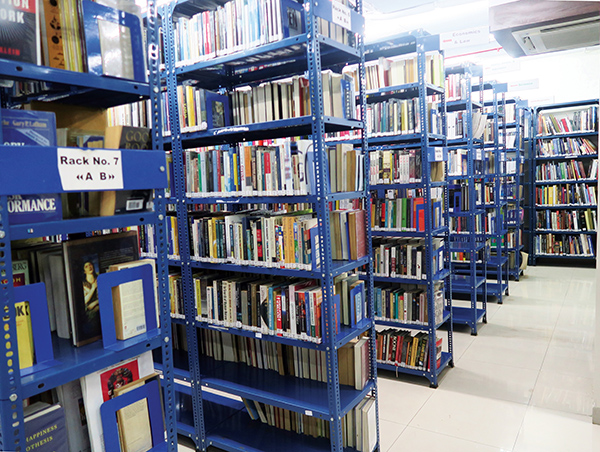
View of the Gharda Memorial Library founded by industrialist and philanthropist Keki Gharda in
memory of his mother Ratanbai
Keki Gharda (l) and Ratanbai (r)
Librarian Bharati Banerjee informed us that the 11,000-book cache was started with Keki personally donating 4,000 books. "He was setting aside his much loved possessions,” she stated. Banerjee has heard that there used to be competitions between Ratanbai and Keki as to who was the more voracious reader of the two. Most of the books in the Library are purchased by the senior entrepreneur himself. "His only outings are to bookstores,” Banerjee told us. Some volumes are purchased online.
Bestsellers and literary classics, tomes on self improvement, art, linguistics, medicine, poetry and world history all rub shoulders with those on religion and biographies. The air conditioned, spotlessly clean 2,000 sq ft space, the helpful staff, the neatly lined shelves are added bonuses. Membership comes at an affordable annual Rs 1,000. Discounts are available for senior citizens. The 250+ members can check out two books at a time between Monday and Saturday from 10 a.m. to 8 p.m., for up to 15 days. The Library sees about 20 footfalls daily.
While a small 16-seater reading room on the ground floor of Gharda House has a stack of magazines and newspapers, the one on the first floor can accommodate a maximum of 250 readers. A popular venue for students, Banerjee stated that during examination season she has to make additional space available in the adjoining halls. "Once I told Sir (Keki) that I had to send back some students (for lack of space), and he asked me, ‘Why don’t you get some more space in the building?’” Keki stepped in to provide space for 50 additional users of the reading room.
For 22-year-old Hoshang Motafram studying chartered accountancy, at the reading room "the ambience is great… the privacy afforded by the individual tables is great.” "Very peaceful,” echoes Kanaki Malani, also an aspiring chartered accountant. Twenty-one-year-old Aftab Sara started using the reading room two years ago. Now in his second year of engineering, he finds the place "affordable.”
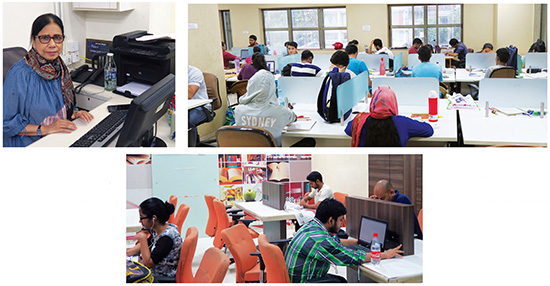
Clockwise from above: librarian Bharati Banerjee; views of the reading rooms
"It was difficult to convince my (late) wife (Aban) that next to her, books were my first love,” stated Keki. Holding a doctorate in sociology, she championed the rights of domestic helpers. Aban passed away in September 2017 (see "A supportive sociologist,” Parsiana, October 21, 2017). Seated behind his large desk overlooking Bandra’s growing sprawl, Keki informed us of his admiration for the "Lake Poets” (group of English poets who lived in the Lake District of England in the first half of the 19th century: William Wordsworth, Samuel Taylor Coleridge and Robert Southey). His personal collection includes translations of German and Italian classics and "classic” fiction. Fourteenth century English poet and author Geoffrey Chaucer remains his all-time favorite, he emphasized. Detective stories give him an opportunity to indulge in "problem solving.” "I love the enhanced thinking that is required… looking for hints… I like to keep my mind sharp,” he stated. "I spend at least four hours every evening reading new books…. I call it my ‘first time reading’… I hope to read as long as I live,” he remarked.
While on business trips overseas he would "always prowl in book stores,” Keki said. He recalls purchasing new books with travelers’ checks. "How many nightclubs can you go to? How many concerts of Western classical music can you attend…” he tapers off. When Parsiana met him, the soon-to-be nonagenarian was reading Penelope Murray’s Genius: History of an Idea. The book explores the history of the concept of "genius” from its origins to the modern day, he described.
Proudly humble
Keki noted that he was teased as "Fatty” at St Stanislaus School in Bandra where he studied. An alumnus of Elphinstone College and the Institute of Science, he pursued a master’s degree in chemical engineering followed by a doctorate from the University of Michigan before setting up GCL in 1964. The philanthropist remarked that when he could not solve a business problem himself, he sought the solution from elsewhere. Describing himself as an "innovator of the obvious,” Keki remarked, "It is not obvious till I find it… I think, and I think well,” he says cheerfully.
GCL enjoys a pioneer status in the agro-chemicals industry, with many firsts in the field of dyestuffs, veterinary products, pesticides and polymers (see "The chemistry of Gharda,” Parsiana, July 7, 2011). Manufacturing facilities are spread over Lote in Maharashtra, Dombivili on the outskirts of Bombay, Panoli and Ankleshwar in Gujarat, and Jammu.
"I make good amounts of money… In this business you have to be clever and resourceful to double your assets every four years,” noted the technocrat whose company exports 65% of its production. Not a believer of patented technologies, which is somewhat rare in the chemical industry, he said, "I succeed, others catch on (and copy)… Patents don’t have any meaning in our country.”
 On September 19, 2018, The Economic Times (ET) reported that Gharda Chemicals posted an operating profit of Rs 683 crores on revenue of Rs 2,608 crores in fiscal 2018. "Based on that, the valuation (of the company) could be more than Rs 9,500 crore,” said the news report. "I leave the numbers to others… I focus on the Foundations,” Keki said. Besides the Library, the Gharda Foundation, created in 1996, runs a 20-bed hospital in Lote. Gharda Institute of Technology in Khed (Maharashtra) offers undergraduate programs in five streams of engineering. Keki transferred a significant chunk of his shares in Gharda Chemicals to the Gharda Medical and Advanced Technologies Foundation, an unlisted company in 2012. "I do not create Foundations to milk them,” stated Keki.
Calling himself a Parsi by birth and an Indian by nature, Keki reveals that he is not religious minded. Born into a middle class athornan family, his father Hormusji was a government servant, Ratanbai a housewife.
Keki remarked that he is "very proud of his humility!” Of the score of awards that he has received, the most recent is the Lifetime Achievement Award in 2018 from the Indian Council for Food and Agriculture. The only businessman from the chemical industry to be recognized with a Padma Shri award in 2016, he describes the honor as "Too little, too late.” As the book lover puts it, "My principal reward is in being happy with what I am doing.”