Danesh Nejadkay’s biscuits and cakes
have made Paris Bakery a household name
Text and Photos: Parinaz Gandhi
Shokré Khuda (with the grace of God) my clients are all top class; not lukhas (broke),” declares Danesh Nejadkay, major, running partner of Paris Bakery, who over the last three decades has built up and retained a loyal clientele with his brand of limited yet immensely popular biscuits and cakes. Reputed for their quality products, customers are happy to make their way to this nondescript outlet located on the road that lies parallel to Princess Street near Marine Lines station.
While regular patrons know they have to reach the shop at an opportune time to purchase their favored product lest the stocks run out, others learn by making repeated trips. And dare some newcomer comment that the Paris Bakery prices are steep, akin to "daylight robbery!” he/she is sure to earn a prompt rebuke from the partner, "Please go to other shops down the road.”
Patrons who come to the outlet are willingly offered products to sample. "Eat and decide whether the quality justifies the price,” reasons Nejadkay whose items are sold in a minimum quarter kilo package. "I am confident of my quality,” proclaims the baker who is constantly experimenting with new varieties to replace items that are not selling fast: "We keep changing; keep creating new things.” When Parsiana visited their shop on February 2, 2022 coffee cake was their latest entry.
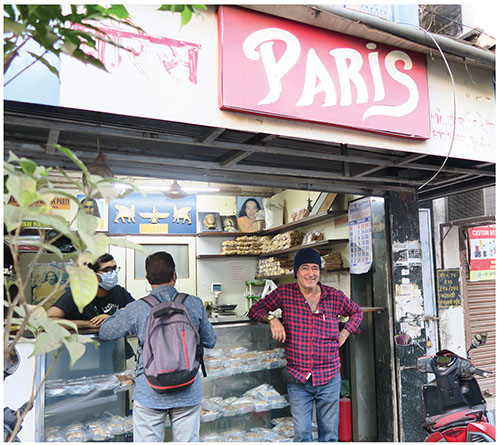
Danesh Nejadkay (in cap) at Paris Bakery
Fast-selling biscuits
Batasas though are their most running item. "Parsis cannot live without batasas,” observes the proprietor. A staple with their morning/evening cuppas, batasas are considered indispensable by many in the community for whom these crisp, round biscuits serve as a comfort food. In contrast, among his Gujarati clientele, the flaky khari biscuits are popular. Their cheese straws and cheese batasas are often gifted by those visiting family and friends in other parts of the country or even overseas.
Associated with Paris Bakery for the last 36 years, Danesh recalled his father Kaikhushroo selling only breads in the initial years. "He only believed in serving the poor. He was a gareeb gai (docile) quite different from the Irun junglis (uncouth).” The shop ran into trouble when labor problems compelled its closure. Thereafter Kaikhushroo allowed a Gujarati to run the shop but things did not move as anticipated and eventually the matter was taken to court.
Originally planning to make a career in automobile engineering, Danesh, an alumnus of St Xavier’s Boys’ Academy, had joined the M. H. Saboo Siddik College of Engineering. To his disappointment the faculty there never gave him an opportunity to gain hands-on experience, dismissing his interest as a passing whim for they were convinced that the only career in store for an Irani was the bakery business! Disillusioned that he could not kickstart a career in automobile engineering, Danesh, then 18 years old, joined the Brabourne bakery at Chira Bazaar where his father was a partner. In the mid 1980s he started taking an interest in Paris Bakery, initially introducing biscuits and gradually cakes. Experiments with recipes for new products are always at the kitchen at Paris Bakery. "The taste and texture of a product, when made in large ovens, is quite different from that made in a small appliance at home,” states the 58-year-old self-taught baker.
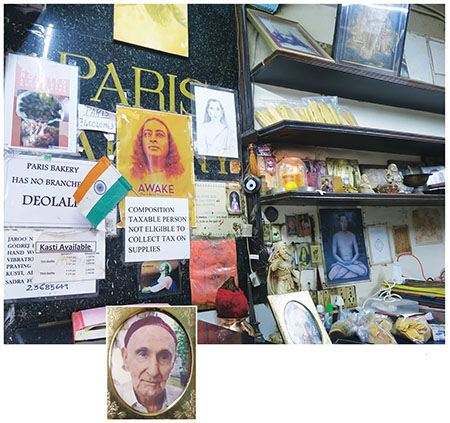
Top : At the Paris Bakery: respect for all faiths;
above: Kaikhushroo Nejadkay
As compared to the 15/16 workers who used to originally work for him, with business slowing down due to the pandemic and machines replacing manpower, he currently has four to five loyal workers toiling with him. At the sales counter he is helped by his brother Behram Tafti, a retired marine radio officer, and Behram’s son Zehan, a disc jockey by profession. There was a time when Danesh’s staff would service customers while they sat in their vehicles and ordered products after sampling the variety. But since this required a staff member to put in a minimum of three trips back and forth from the shop, he has chosen to discontinue this facility.
In his efforts to boost the business of a couple of young Iranis, a trusting Danesh had shared with them his closely guarded recipes. However that backfired when a protégé in Deolali started proclaiming that Paris Bakery was his branch. An irked Danesh has therefore put up a notice at his shop announcing "Paris Bakery has no branches in Deolali.” He firmly believes, "To cheat is a sin. To get cheated is also a sin.”
With partnerships souring among Iranis, Danesh feels that "everything is going to the dogs — ego, money power, courts and ultimately closure. Within 10 to 15 years I don’t think Irani businesses will survive. It is very sad.” Preferring to "mind my own business,” Danesh has learnt, "Duniya niyat ni ooper chaaléch. Everything runs on dua and baddua (The world moves on blessings and curses).”
Arrayed in his shop, alongside photos of his parents, are images of different prophets and saints whom Danesh respects, saying, "I believe in all religions. They are all Masters, preaching the path to God. Following and practicing the religion is in your hands. Karma hi dharma hai (work is worship),” Danesh repeats a popular Hindi adage.
"Don’t discriminate between a Parsi and Irani. It’s ruining our community,” notes Danesh who takes pride in his "staunch, pure Zarathushti bloodline. Aléti-paléti (mixture) nai.” He is particularly irked when "some arrogant Parsis think we are junglis. Please talk with respect,” he admonishes those who tend to look down on the Iranis. A firm believer in prayers and visiting the fire temple, Danesh vividly remembers his paternal grandmother Meherbanu waking him up early morning at 5 a.m. to do his kusti. Thereafter he was permitted to go back to sleep! Since she resided in a building which had a well, lighting a divo there every day was also impressed on the youngsters in the family.
It is these same values that Danesh and his wife Behnaz, a retired Montessori teacher from Casa Bambino, tried to impress on their daughters, 27-year-old Znoishta, a veterinarian in Australia and 23-year-old Zenia who is a graphic designer in Canada. Finding a Zoroastrian marriage partner for his daughters weighed heavily on Danesh who has currently taken a baadha (vow) that he will not cut his hair for a year because of which he covers it under a skullcap. When asked the reason for this decision, he said it was for his children. On the earlier three occasions when he undertook a baadha, he stopped eating mangoes, gave up jalebis and ceased tea consumption.
When we sought an interview with Danesh, he initially declined saying he was not interested in publicity. Our persistence though paid off. He made us repeat the name of the magazine. On registering the name Parsiana, he acquiesced, saying he would do "anything for the Zarathushti community.”
Each morning, Danesh comes to the shop on his bicycle and uses the same mode to travel home for lunch. When he returns in the evenings, it is on his bike. Health and fitness is important to Danesh. For some years, the entrepreneur had pursued horticulture in Deolali just as his forefathers had in Iran. His bakery though consumes "so much of his time” that he is unable to even enjoy a vacation and often thinks of giving it up. The increasing bureaucracy with umpteen permits and licences required to operate a business is one of the other reasons why he says he is "saturated.” As of now he is continuing since he realizes "it is my father’s nishani (imprint).”