During the summer holidays, the 20-room house reverberated with the
laughter of cousins, friends, relatives of friends and friends of relatives
Arnie Mehta
Extracts from Arnie Mehta’s account of a happy, carefree and fun-filled childhood in their ancestral home in the village of Davier, written for her family, are reprinted here with permission.
Davier-Dehri; two names for a village so small and so little known to the outside world, yet to us it was the ancestral home to which we rushed on the very first day of our school vacations. Bombay was where we went to school; my brother Roomi, my sister Roshan and I. I was born in Bombay on November 4, 1936, but spent the first seven years of my life in Davier with Mum Bachamai, Dad Hormusji and widowed Kaki Goolbai, Gulki to us.
With only a paathshaala (school) in the village, I had to be educated at home. I was taught all subjects in Gujarati by a very good teacher, Bhagwanji to whom I will always be grateful for the way he made maths so easy and interesting that I have always liked the subject. I remember Mum paying him with a little pile of those lovely silver rupee coins; teachers didn’t make much money in those days! English was taught to me by the compounder of the government dispensary where hardly anyone ever went for medicine, because they had more faith in household remedies or the little grey tablets, Ayurvedic I think, that Mum and Dad handed out. No bad side effects — and they were free!
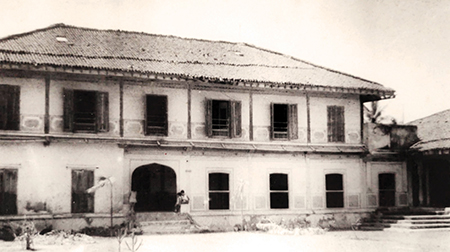
The ancestral house in Davier beckoned
Life was quiet, peaceful and safe. It was our good fortune that centuries ago our ancestors settled in Davier, cultivated the land, and in the time of Portuguese rule were awarded the hereditary title of Police Patel with a duty to maintain peace and settle disputes by being judge and jury. For that they received an honorarium of a few rupees. Although Dad was the youngest, he inherited the Patelship because Nadarsha Kaka, his eldest brother, went off to sea and Keku Kaka, his second brother who was entrusted with the grasslands, died young. Of all our paternal first cousins, Keku Kaka’s children Rati, Adi and Fredy were closest to us, and with them we enjoyed a happy, carefree and fun-filled childhood.
Mum and Dad were liked and respected by everyone in the village, and our home was always open to a daily stream of visitors and tradespeople: an old woman selling a couple of eggs for an anna each or baby chicks at four for a rupee, a fisherwoman selling freshly caught fish, government officials, the village barber to give Dad a shave along with the latest gossip, or someone asking for the use of one of our horses to carry a bridegroom through the village accompanied by the ear-shattering cacophony of the "Gajanan” band. The Bombayites who came during May and December to stay with relatives or at the sea-facing Baralakh Sanitarium, often had requests and queries and bought our fruit. Most of those people enjoyed themselves so much in Davier that they booked the Sanitarium in advance for the following year.
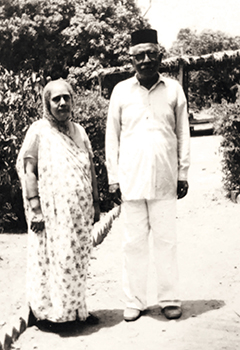
Bachamai and Hormusji Patel in Davier
Because we Parsis enjoy non-vegetarian food, the butcher from the next village would put up a tent during the peak season and slaughter extra goats. The price of fish would double; it was a matter of who spotted the fisherwoman first and bargained for the almost-live catch. During their breeding season, mud-hoppers, levtees, were brought to us for purchase in deep clay pots covered with a saucer; a cup was used as a measure. It took practice to keep those frolicsome things from jumping all over the place. The hardest part though was washing them to remove all the mud. This took a lot of water, so it was Bhikoo, our jack of all trades who took on the tedious task while seated right next to the well.
There was no indoor plumbing. We used water from two wells, one adjoining the house and the other further out in the wadi (orchard). Next to the latter, Dad had another well dug, but unfortunately there was no spring there, so it only served as a reservoir for rain water. It was five times the diameter of a normal well, about 15-20 ft across. I remember watching the men at work as they dug, singing "Hai sha ré hai sha, pani nikalva hai sha (this is it; this is for taking out water: a litany chanted while working).’’ One of the men, Jethia, fell in love with and married one of the temporary workers.
In the wadi, Dad grew the best mangoes and chikoos I have ever eaten. Coconuts were plentiful — all we had to do was ask someone to bring them down from the trees. Dad reminded us that in Bombay people paid good money for these things, but we were too busy playing to care. With mangoes in season, even chikoos were neglected. The first Alphonso mangoes of the season were put into cupboards or drawers to ripen, and sometimes forgotten until the delicious fragrance reminded us of their presence. Then Dad would hand out slices of the first lot to all of us. As the days went by, more and more mangoes ripened and we did full justice to them — morning, noon and night. We had mango juice at teatime and ended the day with small gorias ("jungli” but sweet mangoes meant for sucking the juice), squeezed and eaten on the upstairs balcony, under the open sky.
Mum and Dad pleaded with us to give them the names and addresses of school friends and teachers to whom they could send mangoes. Half the yearly crop was probably gifted away in this manner, which pleased my parents very much; the other half was sold in Bombay. The mangoes were packed in crates or baskets and I loved writing the addresses with brushes made from date palm stems and ink made from a powder mixed with water. I wonder if this powdered ink is available any longer. With raw or semi-raw mangoes, especially the Malgoba variety, Mum would supervise the making of muramba (sweet preserves) and pickles in huge quantities for distribution to relatives and friends. These were stored in large ceramic jars that were placed in enormous wooden chests which sometimes required two people just to lift the lid.
The month of May was the most fun-filled. The 20-room house reverberated with carefree laughter. Besides us, there were other holiday makers. All were equally welcomed. Mum and Dad believed the more the merrier. At night, mattresses were rolled out on the huge upstairs bedroom floor for the girls. This was fun, but we envied the boys who slept outdoors in a spacious open area behind the house that we called the kharaa. Throughout the summer, beds were laid out under the mango trees for the boys, though in the daytime we used to sit on them and play board games. If there was a surprise pre-monsoon shower, the mattresses had to be rushed back into the house, while the beds withstood the weather bravely.
It was here in the kharaa that after harvesting, the threshing and winnowing of rice was done. A hand-operated press was hired to make the half-dried hay into compact bales to be sold for animal fodder. Most important to us, it was where we played games without risk of breaking windows or disturbing anyone. Under the mango trees, we had a see-saw and two swings. Rati and Roomi often competed to see who could swing the highest and be first to touch the thatched roof of the nearby shed with their noses. In one of our games of make-believe we used an old perambulator (baby carriage) as a train in which two "passengers” could sit, pushed by us in turn. The ticket office was a square of wood with a round hole in it, and the platform was a section of broken railing; the imagination and simple joys of childhood!
These improvisations were the ideas of our cousin Hijoo who once harnessed two bullocks to Adi Masa’s wood-framed Pontiac car. I can’t recall if it moved even an inch. Hijoo was an active member of the Bombay Flying Club, and would fly in on a two-seater aircraft, circling the house and waving to us. Dad was the one who most enjoyed his antics, and was always pleased when he knew Hijoo was coming to Davier for the holidays. The front of the house had another open area that was perfect for cricket, rounders and seven tiles. In the latter, Roshan was a terror with the ball, and anyone who was a potential target would immediately give up, shouting, "I’m out, I’m out” even before she took aim at them. Though Mum and Dad did not join in the games they sat on the verandah, the otla, and enjoyed watching us having fun.
An ideal spot for a picnic was the grove of casuarina trees along the beach, a short distance from our house. It was in the path of the sea water at high tide. In the 1950s the government made an agreement with Dad that if he could cultivate the area with its saline, sandy soil, he would own the land. Dad succeeded by building a lock to stop the incoming seawater and growing all sorts of things there, including paddy. A part of the area that he did not think was worth the effort was left fallow. The produce was ours to use, so the casuarinas were sold for firewood as they provided excellent heat. After Dad’s death, Roomi returned the land to the government.
To the east of our house, just two minutes away, was a pond to irrigate the surrounding paddy fields. Just recently I discovered that our grandfather Jivanji had had it dug, in return for which the government gave him the rights to enjoy the fruits growing on the periphery. As the pond was only fed by monsoon, by the month of May every year the water level would be low.
On one day in the year Dad let the whole village, young and old, come with fishnets, baskets and whatever devices they had to catch the tiny fish that inhabited the pond. We kids would stand at the exit points with tapelis (vessels), request a handful from everyone, and take the little fish home to divide among the house servants.
In those days it was safe for a little girl to wander around alone and once while walking along the banks of the pond I spotted a brilliant emerald snake. It appeared to be transparent, while the darker pattern along its body looked as if it was the bone structure inside. Luckily I had not yet developed a fear of snakes, and watched spellbound! Many years later I watched as a much larger snake slithered over my Dad’s feet as he sat at his desk, paying the servants their daily wages. My Adi Masa, a conservator of forests, had told us that the wisest thing to do is stay still and let the snake pass.
Halfway to the pond was an enclosure called a kondwara where stray animals that caused destruction to farms and gardens, were held until their owners paid a fine for their release. The penalty for the housing of various types of animals which even included elephants and camels had been decided by the government a long time ago. The larger the animal, the greater the fine; but I could see that goats were the worst offenders.
To be continued