Misconceptions and prejudices must be dispelled to preserve and spread Zarathushtra’s universal message
Meheryar N. Rivetna
The Bombay Parsi community is rightly concerned about the perpetuation of our great faith. To make their point, they strike at the Zoroastrians of North America, UK and Australia as the despoilers of Zarathushtra’s teachings and principles.
It behooves all Zoroastrians to dispel their prejudices, misconceptions, inadequate knowledge of the religion and be united in understanding the true facts enshrined in Zarathushtra’s teachings to ensure the survival of the religion. I address some commonly misunderstood aspects here.
Some believe that allowing conversion to the Zoroastrian faith is "a travesty of our most sacred and fundamental rituals.” They claim this is "validated by our scriptures.” Let us examine this proposition: While praying the Hoshbam, Khorshed Nyaish, Meher Yasht, Din-no-Kalmo, the Yasna (8.7. 42.6, 60.10), and the Gathas (Ha 29.7, 31.3, 44.10) the worshipper promises to spread the Zoroastrian faith to all humankind.
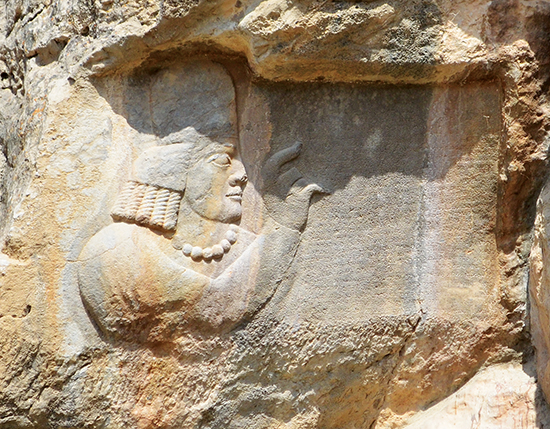
Inscription of Kirtir at Naqsh-e Rajab Photo: Wikipedia
Zarathushtra’s concept of frashokereti means eternal "perfection of the entire world,” not just "perfect Zarathushtis!” Zarathushtra’s teachings are a panacea for all that ails humankind. Our scriptures obligate us to spread this palliative around the world. Convoluted reasoning in opposition to this obligation of universalism diminishes the greatness of the Zoroastrian religion. Now there will be some who will say I have misunderstood the scriptural references I have given and will come up with contorted explanations that make no sense.
There are some Parsis who quote from American historians Will and Ariel Durant’s The Lessons of History. In that book, the Durants advocate the theory that the white race is superior to all the other races. They attribute this superiority to the disavowal of miscegenation (interracial marriage or sex) by the "white race.” Hence the aversion to intermarriage. The Durants go on to say that the whites in the United States and Canada are superior to the whites in Latin America because the latter intermarried and the former did not! In fact, there are Caucasians who are married to a host of "non-white” ethnicities. No religion, culture or ethnicity has deteriorated due to such marriages.
The Zoroastrian faith is a religion and not a race. Races are classified based on physical characteristics such as bone structure, shape and color of eyes, skin tone, etc. Religion does not define race. The argument that the Zoroastrian religion will come apart if other "races” are accepted as Zoroastrians falls flat on its face. Christianity which flourished, and still does, in Europe and North America was spread by missionaries to people of all races. There are Africans, Indians, Chinese, Japanese, all peoples of different races who converted to Christianity. Christianity has not disintegrated nor have the races of Africa or Asia.
Racism is antithetical to Zarathushtra’s tenets.
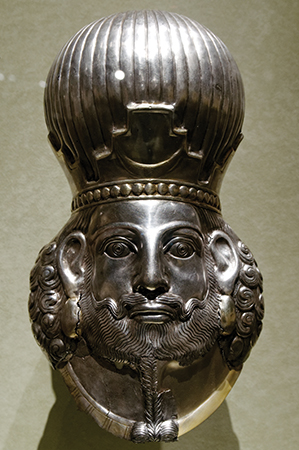
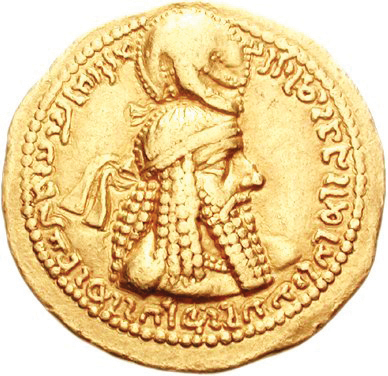
Above l: Image of Shapur II; above r: gold dinar of Ardashir-I (Papagan); 230 CE Photos: Wikipedia
Misunderstanding history results in dire consequences. Some Parsis reference Adarbad Marespand, the Sasanian high priest in the fourth century CE, enforcing a "spiritual injunction” against intermarriage.
This is twisting history to nurture one’s prejudices. Ardashir Papagan, the first Sasanian monarch (224-242 CE), commanded his high priest Tansar to reignite the Zoroastrian religion of his forebears, the Achemenids. Ardashir made the Zoroastrian religion a state religion. Tansar declared that the Zoroastrian religion had decayed under the Seleucids and the Parthians, dynasties preceding the Sasanians, after Alexander conquered Achemenid Persia. Tansar and the monarch instituted changes as they saw fit. Another high priest, Kirtir, during the reign of Ardashir’s son Shapur I (240-270 CE), also instituted changes deviating far from Zarathushtra’s teachings. Kirtir wielded enormous power and authority with a superficial interest in Zarathushtra’s doctrines. He was more concerned with rituals, church disciplines, conversions and the discouragement of infidels.
It was during the reign of Shapur II (309-379 CE) that Adarbad Marespand became the high priest.
From Tansar’s and Kirtir’s time and continuing to the time of Marespand the Zoroastrian populace was becoming disenchanted with what the priests advocated as it made little sense nor could they explain the meanings behind the religious principles promoted, not unlike in the present times. The Zoroastrian religion of the day was heavy in rituals which economically benefited the clergy. The Zoroastrians turned to other faiths, particularly Christianity which was muscling its way into the area in and around Iran. This alarmed the priests, compelling them to devise ways to stem the apostasy (abandonment of the faith).
One way was to feign a trip into the "great beyond” telling the masses they had witnessed heaven and hell and listed punishments or rewards awaiting departed souls. One of the many sins postulated was the loss of the Zoroastrian faith due to marrying non-Zoroastrians. In the Arda Viraf Nameh, Dastur Hoshangji Jamaspji Asa states that the priests of the day devised novel ways to curb apostasy calling their tactics "religious doctrines.”
The disquiet of apostasy continued all the way to the Arab invasion of Iran. Darab Dastur Peshotan Sanjana says: "...it is quite conceivable that the Parsi priesthood, about the time of the Mahomedan conquest, was anxious to prevent marriages with strangers in order to hinder conversions to the foreign faith...”
So, the priests branded intermarriage a "sin” to prevent the Zoroastrian numbers from declining due to apostasy. The priests tapped into the angst of the laity arising from a fear of punishment in an unknown, unknowable afterlife.
The unaware ask, which religion teaches one to have bad thoughts, words and deeds? None, of course. But the very question reflects a poor understanding of Zarathushtra’s profound message. This triad is not meant to imply superficial indulgence in pleasant thoughts, words and deeds.
Zarathushtra’s message in the Gathas is to implement good thoughts, words and deeds to perfect an imperfect world. Good thoughts develop from a mind imbued with wisdom, intellect and rational thought (Vohu Mana). Good words are words arising from good thoughts guiding our fellow humans towards devotion (Armaiti) to righteousness (Asha) to create a worthy social order. Words of wisdom when put into righteous action become good deeds which create a perfect dominion — the kingdom of God (Kshathra Vairya) — here on earth. Thus, we achieve a state of well-being (Haurvatat) for ourselves and humankind and realize everlasting bliss (Amaretat).
By applying Ahura Mazda’s attributes to Zarathushtra’s triad of good thoughts, words and deeds we bring perfection to ourselves and the world. This is unique to our faith.
The religion will survive if Zarathushtra’s teachings are not corrupted with irrational, irreligious ideas that contravene his principles. Let us share with the world the means to achieve a perfect dominion with which Ahura Mazda, through Zarathushtra, has charged us. Ultimately, we must know, that here on earth, God’s work must be our very own.
 Since his retirement a few years back from Merck & Co., Inc., where he held positions in research, sales and marketing, Meheryar N. Rivetna has devoted his time to an in-depth study and research of the Zoroastrian faith. He is the author of Zarathustra: The Man and the Message. Based in Houston, he has also written articles for the Federation of Zoroastrian Associations of North America and Chereh Nama.