Two recent Supreme Court judgments trample on
human rights, state two prominent lawyers
Shiraz Balsara
"The political infrastructure will hound and victimize anyone who fights back… We are living in an India where we have neither rights nor recourse,” stated lawyer Aspi Chinoy. He, along with lawyer Chander Uday Singh, addressed a public meeting organized by the People’s Union for Civil Liberties (PUCL) on July 30, 2022, at Dadar. Titled "Criminalizing Human Rights Defenders: the Supreme Attack on Democracy in India,” the session was moderated by advocate Gayatri Singh.
The purpose was to discuss two recent Supreme Court (SC) judgments that allegedly sought to punish those seeking justice on behalf of hapless victims of heinous crimes. The first case concerns the arrest and incarceration of Teesta Setalvad who tirelessly endeavored to bring to book the perpetrators of the 2002 Gujarat riots, and Indian Police Service (IPS) senior officer Shree Kumar who dared to depose against the then Chief Minister of Gujarat, Narendra Modi and other powerful persons before the Special Investigation Team (SIT) constituted by the SC to inquire into the various cases of riot victims.
The second case pertains to Himanshu Kumar, a Gandhian working in Chhattisgarh, who was slapped with a fine of Rs 5,00,000 reportedly because he brought to light the alleged brutal massacre by the police and vigilantes of 16 adivasis, including women and children in Gompad village in Sukuma district of Chhattisgarh. Kumar has filed a total of 519 cases of excesses by the police and armed forces in the name of containing left wing extremism; in many cases the guilty have been convicted. However, the SC has now permitted an application by the Union of India to label Kumar a Maoist sympathizer and thereby opened up possibilities for prosecuting him under draconian laws.
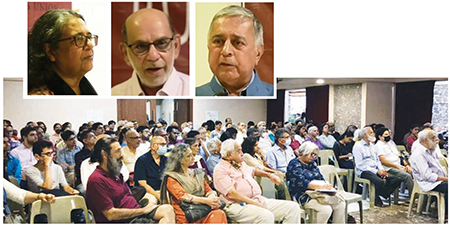
Top row, from l: lawyers Gayatri Singh, Aspi Chinoy,
Chander Uday Singh; above: audience
Chinoy spoke of two visions of India, the plural, multicultural India of Mohandas Gandhi, Jawaharlal Nehru and Bhimrao Ambedkar versus the majoritarian Hindu Rashtra of Rashtriya Swayamsevak Sangh (RSS) leader Madhav Golwalkar and Vinayak Savarkar, a leading figure of the Hindu Mahasabha. After Independence we lived in the Nehru-Gandhi-Ambedkar India, but since the last 10 years we have been living in Golwalkar’s and Savarkar’s India, he said. The same democratic institutions exist but they mean very little; de facto they give no recourse.
The PUCL was founded by Jayprakash Narayan (JP) in 1976 to resist the excesses during Prime Minister Indira Gandhi’s Emergency and continues to call out attacks on human rights all over the country and speak truth to power. The meeting was attended by over 300 people, including renowned lawyers, activists, journalists and trade unionists.
Chinoy analyzed various SC judgments that paved the way to where we are today, beginning with the 42nd amendment to the Constitution of India introducing the word secular in 1973, the Shahbanoo judgment in 1985, opening up the gates of the Ayodhya Babri Masjid in 1994 and finally the 1996 judgment equating Hindutva with Hinduism that completely undermined the secular basis of India. He likened today’s India to the Nazi Germany of 1932-34 and noted: "Judges don’t live in ivory towers; judgments are influenced by the socio-political environment.”
Lamenting love jihad which targets fraternizing between Hindus and Muslims, the beef ban, the osmosis between state action and vigilante groups and the narrative of fear and paranoia, Chinoy spoke of the need to fight back. The road ahead is fraught with danger, he noted.
Singh noted, "In the 1970s, 80s and 90s our SC was lauded all over the world. Post emergency it was described as the strongest court that spoke for the downtrodden (and was) the last refuge for the oppressed and bewildered.” Today, however, our Government feels under threat and seeks protection from people who raise questions. The recent SC judgments are the new weapons to licence revenge, he averred.
He listed the atrocities both in Gujarat and Chhattisgarh and the yeoman service provided by Setalvad and Kumar to hapless victims in search for justice. Both these stalwarts are in the dock. "We are in a Kafkaesque nation where right is wrong and wrong is right. (Bohemian writer Franz Kafka’s works fused elements of realism and fantasy — editors.) Our nation is afflicted by an auto immune disease where it is destroying its own defenders,” he said. Singh ended saying we must not allow Hindutva to brazenly carry forth its agenda in our name. The meeting concluded with the spirited slogan "Not in my name.”