Ervad Yazdi Aibara, panthaky of the Karani Agiary in Cusrow Baug, refused to perform funerary prayers for a Zoroastrian man who died of Covid on September 27, 2020 because he was married to a Christian lady who many years earlier predeceased him. Their three children have had their navjotes performed and were brought up as Zoroastrians.
It comes as a surprise to find that men who marry outside the community can be disqualified as Zoroastrians. It was always understood that when a woman married outside the religion, her children would not be considered Parsis, though they may have their navjote ceremonies performed. This very patriarchal worldview was perhaps adopted by Zoroastrians who first migrated to India centuries ago in order to keep the community from being diluted by mixing with the majority religion.
Aibara speaks of priests being allowed to act according to their conscience. As a psychologist, also a born Zoroastrian who has married outside the community, I believe that Aibara and the trustees of the Agiary belong to what is known in psychology as "Threshold Guardians.” These are people who claim they want the best for us though in reality they do not want us to change. The idea of change threatens them, and when they resist it, we must understand that they are, in fact, playing out an age-old archetype. Their education and upbringing have been of a bygone era and they will not be able to adjust to changing times. Their education is limited, very much like that of the RSS pracharaks (full time workers of the Hindu extreme right Rashtriya Swayamsevak Sangh) who are trained to believe in the purity of their race. It would be impossible for them to accept the democratic ideals of equality and fraternity because the hard disk of their brain does not allow them to be exposed to changing times.
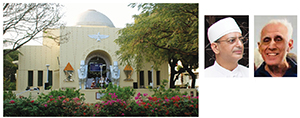
L-r: Karani Agiary, Ervad Yazdi Aibara, Bahadur Hansotia
These rules and regulations were probably framed by the early Zoroastrians who landed in India, fleeing persecution in Iran during the Islamic invasion in order to save their way of worship. Were there any rules laid down by Zoroaster himself specifying that Zoroastrians could not intermarry? Good words, good thoughts and good deeds are our tenets. The good and the bad exist in every one, but our religion teaches us that we should tend towards the good. That is what I have passed down to my child. If I married outside the community, it was because my conscience allowed me. I was educated in a free India and it is my constitutional right as a citizen of this country to marry the man of my choice. I still consider myself a Zoroastrian because I was born one, and no one can take that away from me.
If the priests and the trustees are unable to change and perform prayers and rituals for all members of the community, thankfully we do have a few progressive ones who take care of these duties outside the agiaries.
I am reminded of Rabindranath Tagore’s poem:
"There is no god in that temple,” said the Saint.
The King was enraged,
"No God? Oh Saint, aren’t you speaking like an atheist?
On the throne studded with priceless gems, beams the golden idol,
And yet, you proclaim that’s empty?”
"It’s not empty; it’s rather full of the Royal pride.
You have bestowed yourself, oh King, not the God of this world,”
Remarked the Saint.
The King frowned, "Two million golden coins
Were showered on that grand structure that kisses the sky,
I offered it to the Gods after performing all the necessary rituals,
And you dare claim that in such a grand temple,
There is no presence of God?”
The Saint calmly replied, "In the very year in which 20 million of your subjects were struck by a terrible drought,
the pauperized masses without any food or shelter
came begging at your door crying for help, only to be turned away.
They were forced to take refuge in forests, caves, camping under roadside foliage, derelict old temples;
and in that very year
when you spent two million gold to build that grand temple of yours,
that was the day when God pronounced:
‘My eternal home is lit by everlasting lamps,
In the midst of an azure sky,
In my home the foundations are built with the values:
Of Truth, Peace, Compassion and Love.
The poverty stricken puny miser,
Who could not provide shelter to his own homeless subjects,
does he really fancy giving me a home?’
That is the day God left that Temple of yours.
And joined the poor beside the roads, under the trees.
Like emptiness of the froth in the vast seas,
Your mundane temple is as hollow.
It’s just a bubble of wealth and pride.”
The enraged King howled,
"Oh you sham cretin of a person,
Leave my kingdom this instant.”
The Saint replied calmly,
"The very place where you have exiled the Divine,
Kindly banish the devout too.”
With all due respect to the panthaky and trustees of the Karani Agiary, this was the day Zarathushtra left your Agiary.
RASHNA IMHASLY-GANDHY
I would like to express my deep regret and disappointment at the refusal by Ervad Yazdi Aibara to perform prayers for the soul of Bahadur Hansotia because his wife, who had died several years earlier, was a Christian. Despite the honorable life he led, Hansotia was not deemed worthy of Zoroastrian prayers.
In these dark days when the country is facing the greatest challenge to its democratic principles and the tenets of the Indian constitution are being flouted, we look upon the Zoroastrian faith and our community as a guiding light. They embody and uphold the basic principles of good thoughts, words and deeds and permit us to stand tall as an example amidst the cacophony of religious intolerance on display. This action of the priest in refusing final blessings for a man who had always lived his life in an exemplary manner is particularly shameful and distressing.
Aibara’s understanding of the faith and doctrine are clearly at odds with the sentiments of the wider community and many well qualified interpreters of the Zoroastrian religion.
BEHROZE GANDHY
London, UK
behroze.gandhy@googlemail.com
Though we wish for our children to marry within the fold, there has been a steep rise in interfaith marriages with 45% marrying out. The children of intermarried Parsi males are permitted to be initiated into our religion, but the same is not applicable to intermarried Parsi women. Since mothers have a great influence on the child’s behavior, a Parsi mother can motivate her child to follow the tenets of our religion even though they may not be initiated as Zoroastrians.
A new controversy has now cropped up with Ervad Yazdi Aibara denying prayers for the soul of a Parsi because he had married a non-Parsi. Though Aibara said he held the deceased in high regard, he chose to abide by the voice of his conscience and would not compromise on his religious principles.
Marriage is an honorable and legal union of two individuals even if it is between persons of different religions. It is not a sin, nor adultery, nor illicit, nor a temporary live-in arrangement to gratify lust, but a union of two loving souls. Today, other communities encourage intermarriage to bring about peace and religious harmony.
If all the Parsis who marry out are excommunicated, it will soon become difficult to find a match for the so-called pure Zoroastrians. Even today, a DNA test will reveal dilution, which cannot be reversed or restored. The wisest option would be to accept those who have any one parent who is a Parsi Zoroastrian and retain our Parsipanu to a certain extent, rather than fighting and creating fatwas.
PIROJA HOMI JOKHI
piroja.jokhi@yahoo.com