In the 1960s, formula Bollywood films invariably showed a bawaji dressed in daglo and pugree, guaranteed to elicit a loud guffaw from the audience, as if they had seen an extra-terrestrial. Raj Kapoor’s Bobby, a hit at the box office in 1972, lampooned a large Parsi aunty (veteran thespian Piloo Wadia) breathlessly showering kisses on the young hero. Cute, comic, eccentric, harmless, barmy.
Although Parsis were the pioneers of Indian cinema, the community did not take kindly to women actors, singers and musicians. The Minocherhomji sisters were heckled, threatened, persecuted and derided by the enraged orthodox, compelling the ladies to adopt Hindu screen names like Saraswati Devi and Chandraprabha. Saraswati Devi was Bollywood’s first woman music director.
Percy, Pestonjee and Being Cyrus, highlighted the pathos and loneliness of a dying community. No longer cute and comic. While the eccentricities and idiosyncrasies of the protagonists were handled with empathy, the audience did not leave the theater with a feel-good factor, as it had with an earlier lighthearted Parsi family comedy titled Khatta Meetha. Lonely old bachelors, mother-obsessed boys and cantankerous battle-axe like women did not project a pretty picture of the community. The conservatives disliked this portrayal. We do not exist to be sport for others; leave us alone, they said. All this was small change, compared to the cinematic religious controversy which was about to emerge.
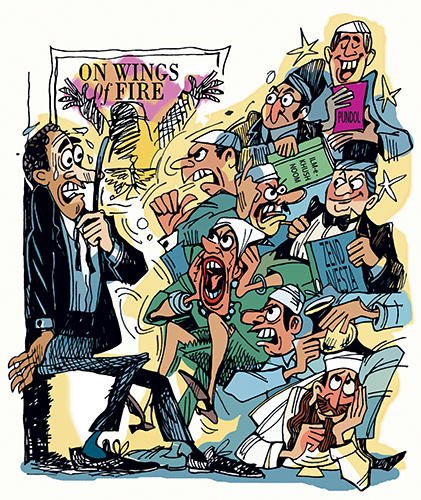
Illustration by Farzana Cooper
In 1986, the renowned conductor, Zubin Mehta, acted in a film on Zoroastrianism initially titled A Quest for Zarathustra, but later changed to On Wings of Fire. He would rue the day. Directed by Cyrus Bharucha, a North American Zoroastrian, and produced by Meherji Madan, the movie had front rank Bollywood actors like Sayeed Jaffrey and Amrish Puri. Dastur (Dr) Firoze Kotwal, the high priest of orthodoxy, was a consultant and gave expert advice. Khojeste Mistree, who had studied Zoroastrianism at Oxford, played a cameo in the film as the Dasturji. And yet the film generated the most vituperative religious backlash.
Three years earlier some Zoroastrian priests in North America had converted to their faith an American Christian, Joseph Peterson. His navjote was performed. All dojakh (hell) broke loose. The ultra-orthodox were spontaneously combusting with fury. The slightest deviation from the accepted position was perceived as heresy. The traditionalists were still bristling with anger at Peterson’s navjote. Had Bharucha’s film come a bit earlier, there may have been only a whimper of protest. This marked the beginning of the split between the mainstream orthodox like Kotwal and Mistree and the ultras like Behram Mistry (father of noted novelist Rohinton Mistry), Adi Doctor and K. N. Dastur (later to be the high priest of Navsari) and other Khshnoomists.
Though the film had nothing objectionable, the ultras apprehended that any widespread advertisement of the religion would result in many more Petersons. They dreaded the possibilities of opening the floodgates of outright conversion. Hence, they started to nitpick. Ahura Mazda is the one supreme God; how can the film talk about twin spirits? Zarathushtra was a celestial being; how can he be portrayed in human form? And, finally, how can a non-Zoroastrian actor like Nigel Terry who acted in Shakespearean plays at Stratford-upon-Avon, be Zoroaster in the movie ["Badha Parsi actors mari gayach su (have all the Parsi actors died)?”]. They moved heaven and earth to prevent the release of the film.
They termed the production a gross distortion, a misrepresentation of our prophet, a deliberate and malicious act intended to outrage our religious beliefs, an unhallowed portrayal of our religion. Under strong pressure from the vocal and strident ultras, the high priests began to relent one after the other. Kotwal, the ultimate authority and scholar of Zoroastrianism, was also compelled to change his earlier stand endorsing the film, and signed a letter denouncing it.
During stormy public meetings in the Framjee Cawasjee Hall at Dhobi Talao, unanimous resolutions were passed, after heckling a lone dissenter. Demonstrations were held. The Council Of Vigilant Parsis, backed by a vocal, traditionalist, Bombay Parsi Punchayet trustee and former Bombay High Court Justice Jal Vimadalal whipped up mass hysteria against the film’s release. Demands for more and more cuts and changes followed. An eminent American scriptwriter, an Emmy award winner, was so disgusted that he disassociated himself from the production. The ultras now smelt blood.
Finally, Mehta had enough. By this time, even the mainstream orthodox were fed up. Kotwal changed his mind once again and actually made an appearance in the film. The ultras then decided to mount a judicial challenge. They were aware that the eminent jurist Nani Palkhivala, trustee of the Oriental trust which had contributed monetarily to the film, would certainly defend the production. The ultras couldn’t care less. Mehta, Palkhivala, Kotwal, Mistree, scholar Dr Mary Boyce, the entire elite of the Parsi community were now pitted against them. The moderates reasoned with them. A sleek production like this would make the religion more enticing and interesting to the youth, they argued. On the other hand, the ultras were incensed at being lambasted in the columns of The Bombay Samachar by the editor Jehan Daruvala. The terms, "lunatic fringe” and "heretic scum,” came into vogue at that time. Outright conversion will dissipate our uniqueness. Our religion is in danger, they said.
Finally, Behram filed a writ petition in the Bombay High Court stating that their fundamental right to practice religion was being contravened and the deeply offensive film ought to be stayed. Palkhivala demolished the arguments of the ultra-orthodox within an hour. The writ was dismissed. Frivolous, said the judges. The rich and the famous are against us, muttered the ultra-orthodox. The film was hastily completed with a Zarathushtra who spoke with a clipped accent.
When the appeal filed by the ultras against the order dismissing the writ also failed, they resorted to street action. In 1986, when the controversial film was premiered at the Sterling theater, a stone’s throw from the Victoria Terminus, about a hundred odd Parsis gathered to protest. As a bemused elite walked in to see Mehta’s pet film, few understood what the protest was all about. There was not a word in the movie about conversion or crematoriums.
But the curse of the agitators remained. The movie bombed at the box office. After all those cuts and changes, it was a mishmash. Nor was it particularly well made. Some five decades earlier, Wadia Movietone reportedly had planned a film on the prophet, which too was hastily shelved after the elders grumbled.
Three decades later, Little Zizou, a film written and directed by Sooni Taraporevala, lampooned an orthodox cult figure who took it in his stride even though he was not amused.
Berjis Desai, lawyer and author of Oh! Those Parsis, and recently Towers of Silence, is a chronicler of the community.