Countering male biases and financial hardships, Allan
Mistri strove to receive an education
Extracts from Roshan G. Shahani’s Allan: Her Infinite Variety, published by Sparrow, are reprinted with permission from the author.
My mother was born Allan P. Gimi on February 15, 1904 in a house on Sachapir Street in Poona. The eldest of four children, she had a younger sister, followed by two brothers. However, her father had had five other sons by his first wife, my grandmother’s
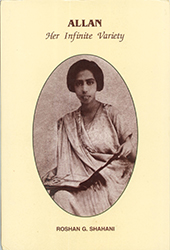
sister, before he became a widower. It was such a common occurrence in those days. When women died young, often in childbirth, men remarried, seeking out not only a companion but also a caretaker for their large families. I don’t know if it was a prevailing custom among other communities, but it was a common practice in the Parsi community for a widower to marry his sister-in-law. And my grandfather proved no exception.
Among all her siblings, my mother was, with the exception of Rustom mama (maternal uncle), the only one who entered the portals of a college. In 1926 she graduated in English Literature from Wilson College, just as my father (Jamshed Mistri) had, three years before her, and just as all three of her children would in the course of time and take up teaching as they had done. Yet another family inheritance!
However, unlike her children, my mother’s college education was not without a struggle. None of her brothers believed in the need for education, not even Nari mama who thought it was a preposterous idea. "Who will cook and keep house?” was the general grouse. She would recall walking in the pouring rain from her home at Grant Road to Wilson College in order to save on tram fare. She would, as a result, arrive at College drenched. The oldest college in Bombay, older even than Bombay University, Wilson College has a very wide, majestic staircase, which in our student days we used to call the "Royal Stairway.” My mother used to feel terribly embarrassed climbing those stairs, her wet sari clinging around her legs, her damp hair matted on her head. Fees too posed a problem and often she would give tuitions to pay her way through college. At the same time this is certainly not a hard luck story. There were plenty of women in the second decade of our century who would not even have dreamt of becoming graduates. In fact, in my class of 30 at school, my mother was among the five mothers who was a graduate, notwithstanding the fact that she was older by five to 10 years than most of my friends’ mothers. It was just that it was remarkable how persevering and determined she was because she loved learning and was thus ready to face all odds.
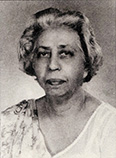
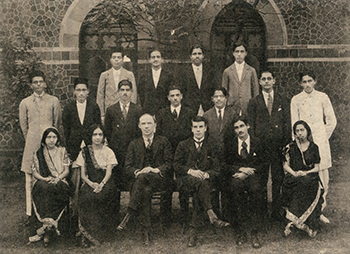
Allan Mistri, top and above, seated ext r, at Wilson College
Allan (seated 3rd from l) and sister Gool (ext r, same row) in Nagpur
My grandfather was not alone in encouraging my mother to complete her education. She got further support, moral and emotional, from my father. She had first met him when she was still at school, the Panday School, to which my mother owed a lasting loyalty. My father was her English and French teacher. Given my father’s temperament, it must have been a lively, even tempestuous courtship, but a tender one as well. He was a stern, unbending man and her schoolmaster as well, but he appreciated pluck and intelligence, both of which my mother had in plenty. They would both recall the time when my father had given the class an essay to write, entitled, "Is poverty an evil?” Since it was a hypothetical and not a rhetorical question, and since my mother had an independent mind, she asserted in the manner of (Irish playwright George) Bernard Shaw that poverty was the greatest of crimes and the worst of evils. My father, who must have expected a more conventional and romantic response to poverty — the poor-but-happy syndrome — reprimanded her for her unorthodox views. My mother, however, argued her way through, as she did in all the subsequent years that I knew them as parents. My father would feel extremely angry that she dared to contradict him, and yet paradoxically, he respected her for that very daring. Had she been a more pliable woman, I’m afraid my father would have trampled all over her in contempt for it. She was not so and hence it didn’t happen! My father used to jokingly call my mother his Pygmalion, implying as her teacher, she was his creation, one that he came to love. My mother, not to be outdone, would retort, with matching wit, that she was nobody’s creation but her own.
My mother graduated from Panday School with many scholarships and prizes to her credit. Some of the books she won are still with us, our family heirlooms. Yet another precious possession was a note written by my maternal grandfather, highly recommending Jamshed for having tutored his daughter so well in French!
If my memory serves me well, she was one among seven girls in her undergraduate years at Wilson College. She remembered with devotion bordering on reverence, the various professors who taught her and all of whom were Scottish missionaries. She had kept in touch with the principal of her school, a scholarly old lady by the name of Piroja Banaji. She may not have been very old, but in my child’s consciousness she seemed so. She was to be our neighbor as well, and had on her verandah a swing that held for me the greatest of attractions. My mother kept in touch with her college professors as well; 24 years after graduation, when my parents visited Scotland for the first time in 1950, they made it a point to visit their former principal — Prof Mackenzie, whose testimonial for my mother now lies with me. I have a hazy recollection of a film recording of the old retired gentleman with his wife and my mother, self-consciously posing in their garden before the camera, though trying to appear natural.
After her graduation in 1926, my mother left for Nagpur, accompanied by her younger sister, a woman far prettier and much gentler than her. My mother was to teach at a school while my aunt was to keep house for her. The sisters shared a very close relationship till their dying day. This was literally so, because when my aunt died, suddenly and swiftly, my mother was right by her bedside. And when my mother was on her deathbed, her blurred mind would mistake me for "Goolan,” as she used to call my aunty Gool. Had my mother possessed a jealous nature, she might have quarreled with her kid sister because neighbors and relatives (never my grandparents) were always making comparisons between the two. One of the mamas would call my mother daantri on account of her buck-teeth. Aunty Gool, I recall, had very even white teeth in contrast. My mother would laugh when these simple folks dropped in for a visit and would declare (in Gujarati), with a singular lack of tact: "Look how chubby and sweet Gool looks and look at you Allan — so scrawny and dark. Don’t you eat well? Or are you forever poring over books?”
Today when I think about it, I find it rather unusual that two women, both in their early 20s, were allowed to stay on their own, away from Bombay. It is true that my mother had taken up the Nagpur job because she had needed to save money for her marriage. This was the only way, for my grandfather had become an invalid by then and the family had never been very well off at the best of times. But when I look back, I appreciate my grandmother’s very enlightened spirit and I suppose her pragmatic views that allowed this independence to her two daughters. I am not very surprised however, because my grandmother or Mai, as we used to call her, had always been very progressive in her ways.
Roshan Shahani taught undergraduate and graduate students English at Jai Hind College. The book is a tribute to her independent minded and determined mother.