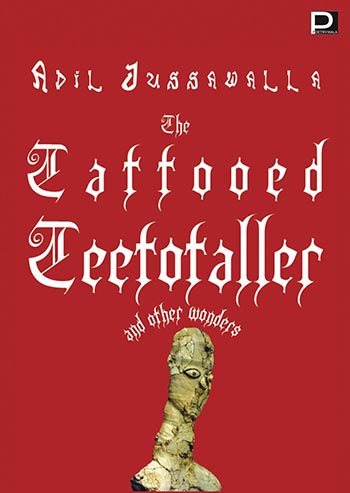
The Tattooed Teetotaller and other wonders by Adil Jussawalla. First Published in India in August 2021 by Poetrywala, An imprint of Paperwall Publishing, A/103 — Krishna Residences, 379, Cardinal Gracious Road, Chakala, Andheri (East), Bombay 400099. Pp: 30. Price: Rs 200.
The Tattooed Teetotaller and other wonders is not the first collection of poems for the young reader that Adil Jussawalla (pictured Photo Noshir Gobhai) has written. In his letter in The Right Kind of Dog, an earlier collection for teenagers, he mentions his belief 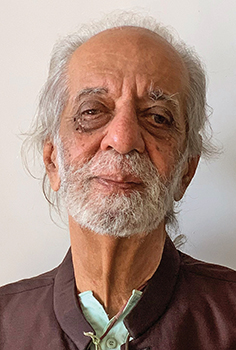 that no one is too young to appreciate poetry: "No one even the wisest of (adults) can fully understand a poem.” If his poems transform their world into a "surprising place even for a little while, they have done their job.”
This book of verse is a departure from his earlier work which, with the exception of The Right Kind of Dog, was written keeping in mind a more serious and adult audience. Though some of the poems have serious themes, most of them are lighthearted, and witty and can be read by both children and adults. In IT, a "Kohinoor thiefter” has chloroformed the guardian Beefeater and robbed the Kohinoor diamond from the Tower of London. She tried to throw it to her accomplice who was not quite ready to catch the booty. He missed the diamond and:
"Glug glug goes a thug
in a nearby pub
seeing what happened,
seeing the diamond
fall in the moat.”
Shapurji Muncherjee, in The Scandal at Muncherjee Hairdressers, was in love with his professor, Ma’am Jones, who rejected his advances and who "publicly shamed (him) in a lecture.” So depressed was he, that he thought of becoming a monk and
"made it his passion to fashion our heads
in monkish cuts.”
 The citizens were furious with him when they found that they had been tonsured, their bald pates "encircled / by moats of neglected straggly hair.” They "ejected” him and now he roams around the city with sunken cheeks.
Also very amusing is the tale of Veeru Moily, in What? The narrator’s aunt was horrified when the one-legged beggar, Veeru Moily, a guest at her nongovernmental organisation’s charity event, not only devoured a valuable doily, her "aunty’s grandmother’s / prized bequest” but before anyone could stop him he also ate two more. One wonders if there is a slightly darker angle to the poem with the hunger and poverty of Moily on the one hand, and his aunt’s innocent idea, on the other, that inviting a beggar to a party would solve his problems. There is also a streak of naughtiness in Questions. Referring to Samuel Taylor Coleridge’s poem Kubla Khan, he wonders if a poet is required to eulogize a Khan when "Bollywood does it better.”
But not all of the poems are in a lighter vein. In Thinks Baby, the baby cannot understand why he "was born to be / like the people I do see.” Tiny Hibiscus can throw a discus further than any man but is discriminated on account of her social status by the head coach who is from the "upper.” But Tiny Hibiscus, takes her revenge by throwing the discus in such a way that, as a result, the "head coach’s leg is in plaster.” One of the most disturbing poems is when On Returning from a Holiday, a baby gecko is found in a kitchen drawer which reminds the narrator
"of the small christs on display
at Mount Mary Fair long long ago!
their arms spread crossless in air.”
However, possibly the most serious poem in the collection is Tickling the Teats of the Tattooed Teetotaller. Jussawalla, Dilip Chitre and R. Parthasarathy, "high on bhang,” coined the phrase which is the subject of the poem. Jussawalla strongly feels that this phrase truly reflects our folly and criticizes our tendency
"of pleasuring power, of our own volition
in raising the god we needed to save us.”
The playful nature and the occasional grim images will certainly fill the reader with "wonder.” F. G.