How I came to know a legend before he became a household name
Kersi Meher-Homji
It happened 64 years ago but I remember it as if it was last month. My cousin Fili and I were returning from a morning show in Bombay’s Metro cinema. On our way home we stopped to watch cricket matches being played at Azad Maidan.
It was a break for drinks at one of the matches and a handsome cricketer wearing pads and gloves was calling out to young spectators: "One short, one short.” When he turned to us, we queried, "One short for what?”
"We are one fielder short. Would you like to field for us?” he replied. Although not good cricketers, both Fili and I enjoyed playing the game. The problem was that I had worn white pants with a colored shirt. And Fili was clad in brown pants and a white shirt. Fili unselfishly insisted that I play, exchanging his white shirt for my colored one and volunteering to inform my parents that I would be home after 6 p.m.
Though I did not shine, I did not disgrace myself either, stopping some balls heading for the boundary and scoring two runs not out. What impressed me was the acrobatic wicket-keeping of the man who had approached us calling out "One short, one short.” When his turn came to bat he was spectacular, hitting fours and lofting sixes. At the end of the match I asked him his name and he said, "Engineer, Farokh Engineer.”
He was relatively unknown then but made his first-class debut for Bombay in the following year, 1959, going on to play 46 Tests for India from 1961 to 1975, scoring 2,611 runs at an average of 31.08, hitting two centuries (highest score 121) and 16 fifties, taking 66 catches and stumping 16.
Engineer had become a legend before he retired from Test cricket. Imagine, playing with a legend before he became a household name!
I recall January 13, 1967 with nostalgia. My fiancée (now wife) Villie and I had taken a day off from work to go shopping, selecting rings for our wedding in February. But my focus was more on the Madras cricket Test being played between India and West Indies; especially when Engineer approached his century.
There were no mobile phones those days, so I asked for Test match scores at every shop. To my ecstasy and my wife-to-be’s relief Engineer scored 109 enthralling runs. He nearly became the first Indian to score a century before lunch but missed by six runs.
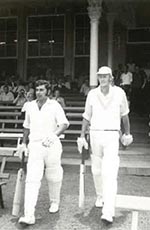
Farokh Engineer (l) going out to bat with England’s Tony Greig
I wrote an article on him for Sportsweek magazine, posted a clipping to him which he appreciated.
When he was selected for the World XI to tour Australia in 1971-72, I had the pleasure of inviting him, Sunil Gavaskar, Bishan Singh Bedi and Subroto Banerjee to our home in Sydney. Engineer enjoyed time with our two-month-old son Jehangir and laughed out loud when I related the "One short, one short” story of 1958 and how his century in the 1967 Madras Test had delayed the selection of our wedding rings!
I was surprised to learn that the friendly and flamboyant Engineer had once wanted to be a pilot.
His aggressive batting and acrobatic wicket-keeping impressed the Australian commentators and spectators on that 1971-72 World XI tour. He was at his best against a Combined XI at Hobart in December 1971 when he hit an aggressive 192 runs, adding 260 runs with Pakistan’s great batsman Zaheer Abbas.
The Sydney unofficial Test match in January 1972 was memorable for me — Engineer, Gavaskar and Bedi invited me to sit in the players’ dressing room. What an honor, to sit next to the great Sir Garry Sobers and other cricket immortals!
I must have brought Engineer good luck as he scored 36 runs in a crisis, adding 66 runs for the seventh wicket with the tall Tony Greig after the World XI was in trouble losing six wickets for 68 runs.
Born on February 25, 1938, he remains the last Parsi to play Test cricket. He played first-class cricket for Lancashire from 1968 to 1976, entertaining spectators with his debonair batting and wicket-keeping.
A few years ago Villie and I had the pleasure of meeting and sharing steak with Engineer in Sydney. He was his same old friendly self, although he had put on weight.
When it was reported in 2016 that he had died, he responded in mid-day, "A friend of mine called and when he heard my voice, he asked whether it was really me. I responded by saying jokingly, ‘No, it’s my ghost you are listening to!’ Friends, I am alive and kicking. I am very well and let me tell you I don’t even need Viagra at my age!”