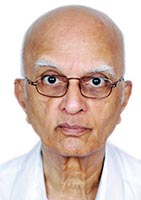
Dr Phiroze Billimoria was a pioneer in the field of radiology
Dr Sunil Pandya
From the start of his career as a radiologist, Dr Phiroze Billimoria (May 8, 1929-April 13, 2019) had developed a style of functioning that he continued to the end. When a patient was referred for a test, he took the patient’s history and performed a full clinical examination. Having arrived at his own diagnosis and opinion on the radiology test required, he would then read the referral note to see what the clinician in charge had requested.
Phiroze’s father Edulji had served as a senior officer at the Hindustan Construction Company that executed large-scale civil engineering and infrastructure projects. Phiroze studied at Wadia College in Poona, joining Grant Medical College (GMC) and the affiliated Sir Jamsetjee Jejeebhoy Hospital (JJH) in Bombay for his medical studies. Dr Piroja Wadia (then Irani) was a co-student. They were a couple of years junior to Dr Noshir Wadia, the reputed neurologist. Piroja recalls Phiroze’s need to excel in whatever he did even as a student. They both represented GMC in the inter-collegiate table tennis tournaments.
Strangely, in the anatomy dissection hall, Phiroze preferred not to soil his hands and watched his fellow students dissect as he peered from on high, perched on a stool.
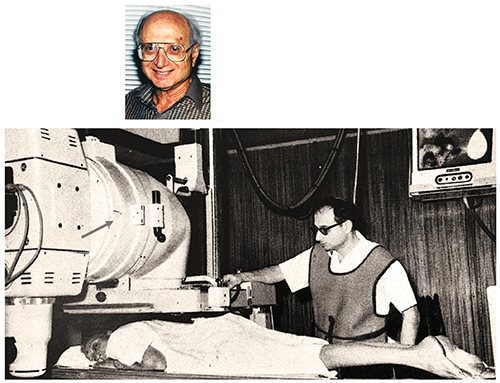
Dr Phiroze Billimoria (top) and at work during his younger days
On obtaining his MBBS degree, he moved to Britain where he initially worked in Newport, near Swansea (Wales) and later at the Middlesex Hospital in London. In one of the hospitals where he worked, he noted that the head of the radiology department would do his rounds around 11.30 p.m. Whilst the local residents would disappear after their work was over Billimoria would await his chief’s arrival. As a consequence, the chief developed confidence in Phiroze’s abilities and asked him to perform many of the radiology procedures that he would ordinarily have done himself. This gave the young radiology resident many opportunities to develop his own abilities.
My colleague Dr Aspi Billimoria (not related to Phiroze) had met Dr Donald Ross, the internationally reputed cardiac surgeon who had performed the first heart transplant in Britain in 1968. Ross asked Aspi if he knew Phiroze. On learning that he did and that he held him in high esteem, Ross exclaimed: "Dr Billimoria would be a respected colleague in any department, anywhere in the world.”
It was during his stay in Britain that Phiroze met his future wife, Mary, who remained a steadfast and affectionate companion.
The radiologist sharpened his own clinical acumen and was able to perform each test with the full cooperation of the patient. As he was fond of saying, "I always examine each patient several times. Before the test, to see what is needed, after each image is made to see whether it needs modification for better demonstration of findings, changes in the patient’s position to obtain more satisfactory views and then on completion of the test.” Often, there was yet another visit, to check on the findings from other tests, at surgery and from histological examination of tissues.
To the end he continued to feel that this is the only way radiology can be learned and performed and bemoaned the current practice of machines taking over, the assembly-line approach of performing tests on a multitude of patients and the radiologist seeing the films made by the technician without once having seen the patient himself.
Another point he emphasized to students and residents was the absolute necessity of interest. "Not the interest on investments,” he would clarify, "but interest in your work. Unless you are keenly interested in your work, you can never produce satisfactory results.”
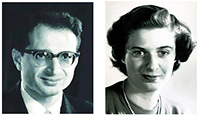
Phiroze and his wife Mary
Newsletter cover sketch on Phiroze’s retirement
On completion of his studies in Britain, he spent time in Sweden, then home to some of the finest radiologists in the world.
In 1956, Dr R. V. Sathe, eminent physician and Professor of Medicine at GMC, JJH, along with his wife, Dr Kashibai, were visiting England where they met his erstwhile registrar Noshir, then working with Dr Russell Brain. Noshir introduced him to Phiroze. Wanting to learn of the new developments in radiology, Sathe agreed to Phiroze’s suggestion that he visit Sweden. Phiroze accompanied him to Sweden and took him around some of the leading radiology centers in the country, a kindness Sathe never forgot.
Whilst in Sweden, Phiroze learnt of an opening in his alma mater and returned to Bombay to apply for the post of honorary radiologist at JJH. When applications for the post of honorary consultant radiologist came up for consideration, a board was appointed to make the selection. Phiroze appeared for the interview and requested permission to show some of the work he had done. The studies he showed were far superior to anything being done in JJH or, indeed, anywhere in Bombay.
Through the grapevine Phiroze learnt that although his qualifications and work were impressive, there was talk of appointing another radiologist on communal grounds. He approached Sathe who made enquiries and felt that the exclusion was unfair. He took up the matter with the Dean of GMC and the Surgeon-General in overall charge of government medical institutions. Phiroze got his appointment.
I remember being awed by Phiroze whilst we were still doing our anatomy dissections during our first year in GMC. Farsighted professors of anatomy Drs P. S. Dastur and B. B. Sethna had installed an x-ray machine with a fluorescent screen in the anatomy department. Once a week Phiroze would visit and demonstrate anatomy in the living human. One of the attendants in the department served as the subject for study. This is where we first saw the beating heart, lungs inflating and deflating with each breath and the movements of the two domes of the diaphragm. A suspension of barium sulphate in water was used to show us the act of swallowing, entry of swallowed liquid into the stomach and its passage into the duodenum, the first part of the small intestine.
Phiroze started his private radiology clinic at Chowpatty where he had a 90-90 tilting table and an image intensifier replacing the fluorescent screen. He also had a cine-radiology camera mounted on this machine. Perhaps no other consultant in Bombay at that time had such equipment.
This is where he carried out his barium studies using air as negative contrast to show the inner lining of the small and large gut to stunning effect. He also performed catheter angiography here, studying the aorta artery and its branches, especially the renal (relating to the kidneys) and iliac (carrying blood to the lower intestine) arteries. As far as I can tell, he was the first person to carry out such vascular (circulatory system) studies in Bombay.
During a visit to his clinic with a patient from JJH Phiroze asked me to see some films. This patient had been referred to him for plain x-ray studies and a myelogram (a diagnostic imaging test). The patient’s chief complaints were pain in the lower back that radiated down one lower limb. His straight leg raising test on that limb was restricted. He had segmental hypoesthesia and weakness of the muscle that pulled the great toe up. As was usual with him, Phiroze did lateral tomographic studies of the lumbar vertebrae. He had been puzzled by a finding, hence his need to seek a second opinion on them.
The studies clearly showed that the antero-posterior diameter on the affected side was considerably reduced as compared to the asymptomatic side. He later confirmed this finding on films exposed after the injection of iofendylate. He had never seen or heard of hemi stenosis of the bony spinal canal. Had I seen any such instance? It did not matter to him that I was a resident doctor with just two years of experience in neurosurgery whilst he was a veteran in the field! I confessed that I was ignorant in the matter and offered to look up books and journals for further information. "Do that and let me know your findings. In the meantime, I am reporting my findings to the consultant who has referred this patient.” I failed to find any reference then. The advent of CT (computerized tomographic) scans and MRIs (magnetic resonance imaging) studies have shown a few such patients. Most reviews on spinal canal stenosis, even today, do not refer to hemi stenosis of the lumbar spinal canal.
I also recall that Phiroze was the first to provide his radiological reports on an electric typewriter. Coupled with his films, these made a striking impact.
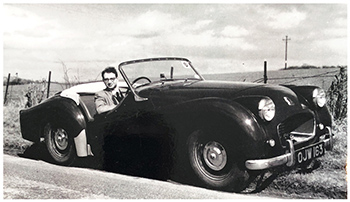
Phiroze at the wheel of his sports car
While collaborating with Dr Buji Colabawalla, professor of urology at St George’s Hospital, they studied the epididymis (a duct behind the testes) in patients suspected to have tuberculosis of the genitals. Once again, these studies were performed free of cost and the contrast studies were unprecedented certainly in India and perhaps anywhere.
When the family moved to America Phiroze started work in Loma Linda University Medical Center in California. His interests now shifted to the developing field of MRI scanning, and the established field of CT scans. He threw himself into these studies with enthusiasm, arriving at the hospital at 5 a.m. to study the films of all the procedures that had been carried out the previous day, completing his reports by 9 a.m.
He disliked radiologists making statements like "his chest x-ray is normal.” He would explode: "You cannot see x-rays! What this doctor is reporting on is an x-ray film. And what is normal? The term is used with reference to a range. Values outside this range are considered either too high or too low. Our reports must be precise. Since we do not have absolute values in terms of numbers to describe our findings, we should describe what we see in terms of their features. If these fall within the normal range, our conclusion must be that we do not see any abnormality. To say that an x-ray film is normal betrays laziness in describing the features we have studied and faulty use of the term.”
He used every available opportunity to teach and enjoyed showing students and residents how he had examined a patient under consideration and obtained his findings. Practical pointers were provided. His talks were laced with humor and his brand of philosophy. For many years Phiroze was voted the best teacher of the year in the radiology department at Loma Linda University Hospital.
He travelled extensively, attending meetings in America and other countries both to learn and to impart what he had learnt during his studies. At each center he would seek out the finest radiologists and attend their clinics and teaching sessions to increase his knowledge. Sometimes this had unexpected outcomes. At a seminar in a medical college, he was asked to provide his views on a set of films that had been shown. He suggested that more information would have been obtained had the study been carried out differently. The chief of the department asked Phiroze if he would perform some such studies on the following day. He agreed, was keenly observed and received kudos from all the specialists present.
Often, heads of departments would progressively divest themselves of their own work, passing it on to Phiroze. "I never objected to this,” commented the radiologist. "More work meant more experience, and this always helps!”
Soon after making his home in Loma Linda, he started indulging in his hobby of cooking Indian food. He was banished from the main kitchen as the odors of the Indian spices clung to the furnishings and affected the internal environment. He set up an outdoor kitchen and did his cooking there.
He used cooking as an analogy. "Radiology is like cooking. You have to be interested in it and learn all you can about what is to be done. You must know what is to be put in the cooking pot, how much is to be put in and at what stage of the cooking process. You have to taste the product from time to time to fine-tune the flavor. You need to make modifications as required. You cannot merely take a recipe and follow it blindly or, worse, get a junior, give him directions and ask him to follow them.”
He had always been keen on physical fitness and pushed his body to the limit when exercising. There was a time when he would climb 30 floors at a stretch, climbing to the top of the building, taking the elevator down to save time and then climbing again; repeating these steps till he had achieved his goal.
Whilst in Bombay, he had occasional episodes of breathlessness after such workouts. He had consulted his cardiologist colleague Dr Jamshed Moos who found no abnormality.
In 1991, after he experienced chest pain, a cardiac surgeon "rearranged my coronaries” and Phiroze was back at his usual activities.
Years later, in October 2011, aged 82, whilst at the peak of his career, after 37 years at his job in Loma Linda, he decided to call it a day. "I did not want to reach the stage when someone would ask ‘When is this old fogey going to retire?’” His department honored him by appointing him Emeritus Professor.
Several years ago, Phiroze wrote to say that he was scheduled to visit Bombay. Would we like him to talk to the staff and students of Seth G. S. Medical College on his current work on CT and MRI scans? The latter had just made its appearance in India. Phiroze graciously delivered not just one but a series of illustrated talks. These talks were electrifying and inspiring.
Soon after retirement, he had another heart attack which caused renal damage. Following a second open heart surgery he needed dialysis. He was unhappy with hemodialysis. "The unit functions like a factory, patients are wheeled in, put on the machines and within a couple of hours, wheeled out to give way to the next batch!” He asked for and was given peritoneal dialysis once he moved to Coronado, about 180 km south of Loma Linda University.
"Men always died before their wives, so I wanted a comfortable home for Mary after I was gone.” In 2013, the couple moved to the three-bedroom apartment he had purchased decades earlier on the seafront in Coronado, in the immediate neighborhood of Hotel del Coronado, a 128-year-old beach resort to which the high and mighty from San Diego and elsewhere flock.
Two of their sons live less than an hour’s drive away and helped their parents in every way they could. Mary and he often spent a few days with one or the other son, especially when medical tests were lined up.
Phiroze’s daily schedule at his home in Coronado included nocturnal peritoneal dialysis which Mary started as they went to bed. By the time he awoke, it was complete. He read extensively and when he found an author he liked, tried to read all the books by him.
Let me end this narrative with a personal anecdote. I had always respectfully addressed him as "Dr Billimoria” or "Sir.” He decided to put an end to this and told me, "My friends call me Billi and you are my friend.”
Pandya is a neurosurgeon and a student of medical ethics.