An illuminating memoir recording a lifelong battle with an incurable condition
Shaista Tayabali
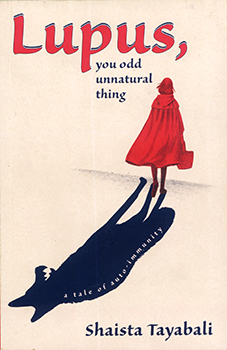
Extracts from Shaista Tayabali’s book Lupus, You odd unnatural thing: A tale of auto-immunity, are reprinted here with permission from the author.
When I tell people I am a writer, a poet, they exclaim and appear to be impressed or pleased to have met such a curiosity on an ordinary day.
But then, almost immediately on the heels of their pleasure and surprise, comes this question: "Are you published?” Taxi drivers, delivery men, random persons-on-buses, people who openly declare their utter lack of interest in the act of reading want to know if I’m published. I imagine if my answer was "Yes! I can be found on a bookshelf in your local bookstore” or "Yes! In fact, I am carrying a few copies of my book right here, with me, in my handbag. Cash will be fine,” might elicit the same response as a gritty, "Afraid not yet, but I’m hoping to be” — a swift change of topic.
When I tell people I have lupus (the word means wolf in Latin and is an inflammatory disease caused when the immune system attacks its own tissues), there is a similar Pavlovian set of responses:
1. Blank look.
2. "What’s that? I’ve never heard of it.” (As though their ignorance proves lupus cannot possibly exist. Or perhaps it exists only because I just made it up.)
3. "Lupus… I think I’ve heard of it. What’s it about? What happens to you?”
4. "Oh, I’m sorry to hear that. I know someone who has it.”
This can be subdivided into (a) "I know someone who has it but they’re doing really well now. Have you tried…?” (Insert here all manner of alternative therapies, diet suggestions, exercises) or (b) "I know someone who has it. She’s always struggling, poor thing.”
5. "Well, at least you don’t have cancer/AIDS/ALS (amyotrophic lateral sclerosis)” (or whichever disease this person finds particularly terrifying).
6. Swift change of topic.
And once, in a car, so I couldn’t run away:
7. "What’s your prognosis? Can you die from it? Do you know how long you’ve got?”
If my fellow in conversation is also a fellow sufferer, they will ask a question of genuine interest, such as "How long have you had it? When/how did it start?” In other words, my origin story. Lupus gives us two lives. The one we had before we fell ill/were diagnosed and the one forever after.
Unless, of course, lupus was there with you at your birth. And maybe even before. My mother developed a rash when she was pregnant with me, her face flushed into a red balloon, and her gynecologist suggested she start eating boiled, bland food because the rashes were unpredictable. My mother remembers this pregnancy as the troublesome one, the one about denial and discomfort, but photographs of her during this pregnancy reveal her joy. Those were the days before ultrasound scans and yet she says she knew I’d be a girl, because she longed for a daughter. Although I cast spells of mysterious rashes and swellings, I grew and survived and began to be a person who needed a name, so I could begin my story.
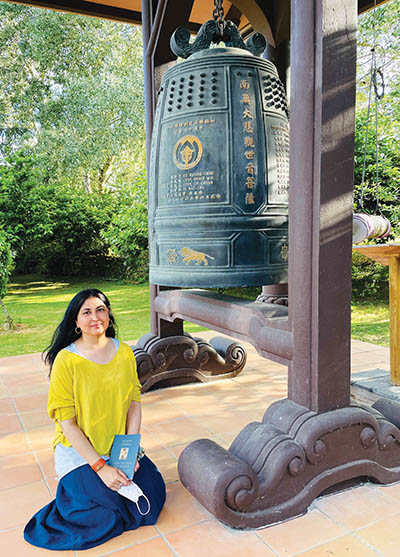
Shaista Tayabali on her recent visit to Plum Village hermitage in Bordeaux,
France set up by Vietnamese Zen master Thich Nhat Hanh
Here to be healed
The whole encounter is called an examination and must be treated with the seriousness reserved for examinations. A patient must always be on guard, prepared to answer questions, when often all we want to do is curl into ourselves, shut down unnecessary
avenues of energy expenditure and be quiet enough to heal. But we are not in a place conducive to self-healing. We are here to be healed. External healing begins with what we tell doctors, who expect us to follow this principle: what you reveal, we can heal.
Hospitals require us to talk on command. Be examined, questioned and then re-questioned. And then again, and again. Until you know you have tripped yourself up and your memories are lapping over each other and accuracy fled somewhere between the first nurse who took a brief history and this latest medical student who is prepared to give you more time than you knew a doctor was capable of sharing. They are genuinely curious, asking the sort of questions you will later dream your consultant would ask, and you sit in a stupor, because you had only just brought your narrative down to a nifty bullet pointed exercise in brevity. And you did this through trial and error… because unlike medical students who learn how to take a case history, and how to deliver a case history, we, patients, are fumbling around in the murky murk of our own re-tellings.
I never know which snippet from my oral memoir will interest my audience. Sometimes it is the revelation that I am a poet. Even "writer” may spark an awakening in the indifferent eyes gathering me in. Sometimes the mention of "India,” or more specifically "Bombay” — "Oh, you don’t call it Mumbai?” — other times, nothing. No hint of applause. Deflated, the poet-storyteller wishes she could wave away her ungrateful listeners and contemplate a fresh approach. But now comes insult to injury. Lift up your top, pull down your jeans, open your eyes wide, stick out your tongue. Say "Aaah.” After all those linguistic gymnastics, say "Aah.” How old am I again? In hospital, before a doctor, you are not in control of anything, not even your age.
"Tell me your story, in your own words,” the doctor invites. Tell you who I am? Who am I? I end up looking into the doctor’s face for the answer to that question. Why wouldn’t I? Doctors hold mysterious powers, we are told; we are sent to their headquarters and instructed to wait for them. They hold the cards with the questions and hold, or withhold, the answers. The computer faces the doctor. Occasionally, when in a charitable mood, a doctor might turn the screen at a slight angle to share something with me — but even with their best intention, I do not possess the sharp eyesight necessary to read either at the distance or the speed before the screen is whisked away from any visible angle. What does it say??? I want to shriek, in full on banshee mode… but I maintain the norms. Imagine the speed at which I’d be committed to psychiatry if I gave in to that impulse. As it is, my face is constantly being read by others. For what? I cannot tell.
Doctors are the power brokers of my life.

Waiting rooms
Our appetite for lawyers and doctors on a TV show or in a movie seems endless.
How doctors think, and how doctors feel, is a source of constant fascination played out in documentaries, reality TV, bestselling books. The theatricality of the courtroom is mirrored in the emergency room. Surgeries are called theaters because once upon a time they offered spectacles. Perhaps they still do. Despite the performative streak required of me when relating my medical history, I rarely recognize myself in hospital TV shows. Or movies featuring a hospital episode as the dramatic interlude. Drama is not my experience. Waiting rooms are my experience. Hours of loneliness to fill, in a ward, on a bed.
The irony is that patients make for excellent drama on a TV show, but only as accents in the lives of the heroic beings in white coats and blue or green scrubs. There is a reason that a panoply of shows called "Patients” or "Waiting Rooms” doesn’t exist.
We are not heroes. We are not the ones conducting the diagnostics or the investigations. Even when a doctor is an anti-hero, he is still the hero...
The book is available with the author, 14, Hauxton Road, Little Shelford, Cambridge, CB22 5HJ. UK; website: www.lupusinflight.com; email: shaistatayabali@gmail.com. Pp: 199. Price: Rs 399.