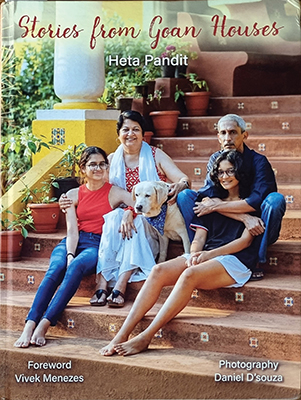
Stories from Goan Houses by Heta Pandit. Published in 2022 by the author, The Heritage Network, Maia Heritage House, 1/98, Grande Morod Saligao, Bardez, Goa 403511; website: www.hetapandit.com; email: heta.pandit@gmail.com. Pp: 201. Price: Rs 2,499.
It’s hard to explain why it should be so, but Goa casts a spell that lingers in one’s imagination. It’s something as personal as that first kiss on a rainy afternoon in spring. The air is filled with the scent of mango blossoms and birdsong.
For me certainly, it’s the memory of Lucio Miranda, architect and singer weaving his magic on a guitar one evening on the beach. The sadness of a Portuguese Fado (folk song) when sung by a Lucio evokes the search for meaning in a rhapsody of sounds.
Equally there is a sense of ownership that affects every person who makes Goa his or her home. What the Spanish might call the conquistador complex. Or what the early Portuguese in South America called "Bandeirante” or Flag Bearers of their conquests.
Heta Pandit is in a sense a Bandeirante for a Goan way of life that is not easily apparent to the casual visitor. She has created a visual record of the mansions of the families who have had connections with Goa through the different periods of its history. Or those who continue to keep those traditions alive with the stories that she has managed to collect by a process of discovering and inventorying the objects that she and her team have garnered.
Easily, the best story that Pandit tells is of her own life, in the introduction. She’s worn many hats and under each of them there hides a tale. Though it’s not included in the book, one of the most fascinating is about her parents. Or as she explains in a note: "My mother was born a Parsi, to Parsi parents. Her name was Manijeh Rustomjee Pallonjee Patell. My grandmother was Tehmina Rustomjee Pallonjee Patell (née Fouzdar).” Her father, she says, was a Gujarati Hindu who left home at the young age of 11 and was absorbed into a Parsi family. His name was Thakorlal Jhinabhai Baman but in the fullness of time he had identified so closely with his Parsi family, it became Bowman and then Boman.

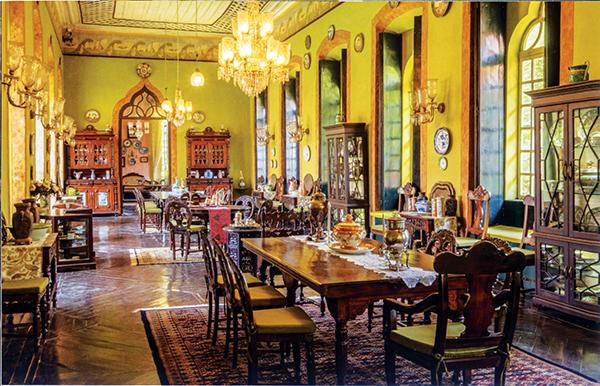
Top: Heta Pandit; above: Figueiredo Mansion in Loutolim, Goa
Pandit goes on to explain: "We were brought up as Parsis. Dastoorji Maneckshaw performed our navjote in the Sayajigunj Agiary. We were too young to know we had broken some rules. I went to school as Heta Boman Patell. When I got married, I became Heta Pandit. The name stuck even after my divorce. I had promised my mother-in-law that I would never ‘return her name,’” she ends her note.
As a child she grew up in Poona, or Pune as it is called now. The family moved to Baroda where they lived in a mixed government colony where Heta imbibed the flavors of their Gujarati neighbor’s lifestyle, while attending a proper English style education at school. She tells us that while the family’s ancestral home was in Siganpor, near Surat, as she adds, her grandmother had her own bungalow in Bandra, and her mother a place at Panchgani in the early 1970s. She so loved Panchgani, she remembers taking the mud from their garden in empty Kraft cheese tins and as she recollects: "When we would get back to the hot and grey dusty landscape of Baroda, we would open these tins, take the scent of the earth up to our nostrils and think of our home in Panchgani.”
If this was part of Heta’s magical growing years one can only marvel at what she did next. After a brief stint at the University of Birmingham, she was able to reunite with her significant other at the time and travel to Tanzania. Marriage and more adventures followed. She worked with Dr Jane Goodall, the ethologist who created a special link with the primates known as Bonobos, checked out the West African countryside, visited Zanzibar, now famous for having sheltered the young Freddie Mercury, before returning to Baroda and a broken marriage.
It was while restoring the family home that Heta began to take a more professional view of documentation of our cultural heritage. She became the honorary secretary of the Indian Heritage Society, Bombay Chapter, under the dynamic leadership of the late Shyam Chainani and was involved in studying the habitats in a number of mega cities, cantonments and hill stations on the west coast.
In another leap of faith, she writes that after the 1993-94 communal riots that shook the once well-integrated city of Bombay and turned it into Mumbai, she fled with her cousin Mahrukh to the hills of Munnar at the Tata Tea Limited estates. As she adds with befitting modesty, "without knowing it we were India’s first women tea estate managers” living in the superb tea-planter’s bungalow with "houseboy, butler and ayah.” For good measure she also tells us, "It had an arbor of passion fruit on the side, honeysuckle over the roof, an eccentric wood fired stove and a fireplace in every room.”
When she relocated in the fullness of time to her own home in Goa in 1995 it did not take long for Heta to turn her now professional heritage hunter’s gaze to the richness that she found all around her. The method of stacking the different stories together reminds the reader of the fabled Goan dessert, Bolo Sans Rival, or cake without a rival. This dessert, the recipe for which everyone will tell you is lost in history, was first made by two sisters who came from the Philippines. The dessert consists of fragile layers of meringue filled with broken pieces of cashew nuts (originally almonds) held together with sweetened buttercream in between. Needless to add, each home owner depicted in Heta’s history believes that his/her story is the only one and totally without rival. The buttercream is provided by the lush and lavishly detailed photography provided by Daniel D’Souza.
At this point, one may be forgiven for invoking a few lines from Inside Goa (1982) by the writer Manohar Malgonkar and superbly illustrated by Mario de Miranda. Partly because it was Malgonkar himself who offered to be my guide to Goa as it was in those pristine days. "Mystiques are not easy to explain, they are stiff with the strands of emotions which always elude analysis,” writes Malgonkar before observing: "A major ingredient of the Goan identity is a nostalgia for the past, but somehow a past cleansed of the taint of subjecthood.”
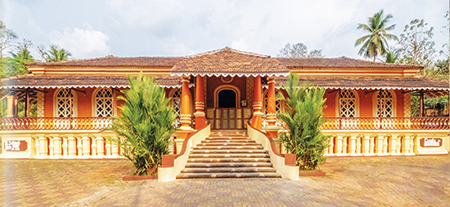
Top: Artefacts in Antao House; above: Angello Bhakar achem Ghor, Curtorim
Casa Mimi Salvador do Mundo
Pandit’s book is a grab-fest of nostalgia. Or to quote from one of its pages that depicts a golden alcove framing an altar that is elaborately carved and decorated, "A house is like a warm embrace.” Since there are so many houses that Pandit embraces, we shall narrow our gaze down to just one of them in her collection — the Figueiredo Mansion in Loutolim.
Pandit introduces us to a grand old lady, the late Maria de Lourdes Figueiredo de Albuquerque, by allowing her to explain her ancestry. "‘I grew up with some very strong powerful women,’” says Maria, the youngest daughter of Vincente Joao de Figueiredo, and "at the peak of her career she was the first and youngest member of the Portuguese Parliament,” notes Heta as Maria continues, "We were Podiars from Sancoale who embraced Christianity in the 17th century and took the surname Figueiredo. One of the descendants, Caetano de Figueiredo built the newer section of the house in the 18th century. Every generation made significant contributions to the house in terms of artefacts and objets d’art.”
The interiors are truly a tribute to the elegance and taste of the owners. The delicately carved wooden backed chairs, the sweep of the diaphanous creamy white curtains at the tall windows, the glass chandeliers clustered from the high ceilings, the chinoiserie and other pieces of tableware laid out to seat at least 50 guests in one sitting, are from a scene in Downton Abbey. One must mention the customized stenciled effects on some of the walls, as also the stained-glass windows, carpets, framed mirrors, the music room with its piano and the ornate private chapel. Where in some of the other houses, such a vast collection of bric-a-brac lends a sense of oppression that underlines the melancholy notes of a Fado, here there is only a celebration of all that is beautiful and filled with light.
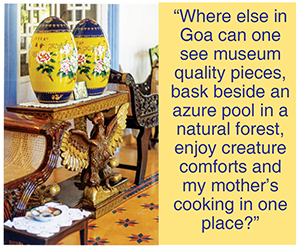
"Where else in Goa can one see museum quality pieces, bask beside an azure pool in a natural forest, enjoy creature comforts and my mother’s cooking in one place, except at the Figueiredo Mansion?” asks Pedro, the current occupant of the family tradition.
For the rest of us, one can only savor the delights through the images that define the Goan style. There are the oyster shell window panes that used to be a specialty of the older houses with their narrow windows; the use of vibrant colors on the walls, the famous balcaos, or covered seating areas that allowed the lush tropical foliage to define the outdoors, with lace-like decorative effects in stucco, wrought iron, or wooden partitions; the floor tiles in repetitive patterns, the ornate tropical woods carved into curved back sofas and tables with decorated floral edges and heavy pedestalled feet, not to mention the long armed verandah easy chairs of rattan with long folding arm-rests, popularly known as Bombay fornicators.
Memories of a rich and varied history scented with the loot of tropical armadas arriving from distant lands bring back the glory of Goa’s fabled past.
GEETA DOCTOR
Doctor, a longtime contributor to Parsiana, is a writer and critic.