The Parsis took up arms for the Portuguese
H. E. Eduljee
Extracts from Parsis and the Portuguese in the 17th century Gujarat by H. E. Eduljee, reprinted with permission, from Journal of the K. R. Cama Oriental Institute 1987. The extracts focus on the appeals made to the Portuguese to erect dakhmas closer to the vicinity of their villages and of the military assistance extended to the Portuguese by the Parsis.
When the Portuguese reached India in 1498, they found Gujarat was an important link in the trade between Arabia, India and the East Indies. In order to safeguard their trade they established naval bases along the west coast, and in 1534 they were in Bassein and its district, which included Thana and Bombay; in 1558 they occupied Daman. Daman was the headquarters of the district which included the villages which had a considerable population of Parsis; and they thus came in close contact with them.
The first Europeans to mention the Parsis are a French missionary, Jordanus, in 1322, and an Italian monk, Odoric, in 1323. Both noted that the Parsis disposed of their dead by exposure to vultures; according to Jordanus, this was done in "roofless towers;” according to Odoric, in the fields.
Arrival of the Portuguese in India Photo: medium.com


The first Portuguese traveller to have noticed the Parsis of Gujarat was Garcia de Orta who arrived in Goa in 1534, and then visited Gujarat and travelled up to Diu; he also remarked on the Parsis’ use of the dakhma. The mention of dakhmas by the early European travellers is interesting in the light of the documents that form the subject of this note. At the time de Orta arrived in Goa, the Portuguese had just established themselves in Bassein district and came into contact with the Parsis settled in Thana. The Jesuit missionaries tried to force the Parsis to convert to Christianity; the Parsis of Thana escaped south to Kalyan and so avoided conversion. The behavior of the Portuguese in Thana contrasts with those in Daman who proved very helpful to the Parsis there over their problems with dakhmas.
Although the Portuguese had been in contact with the Parsis in Gujarat since the mid-16th century, very few Portuguese documents have been published which throw light on the relationship between the two communities. The most extensive collection was published by Pissurlencar in 1933; it gives letters and despatches concerning the famous Rustamji Manockji of Surat and covers the same period as the documents in this note.
The Patel family of Nargol had in their possession some Portuguese documents relating to the difficulties the Parsis under the jurisdiction of Daman were facing with regard to dakhmas. The collection also included two despatches from Portuguese military officers praising the Parsis for their help in maintaining law and order, and in their battles with the Mahrattas. These documents have been deposited with the Bombay Parsi Punchayet and were, presumably, translated at that time; the Punchayet gave photocopies of the documents and translation to the Patel family. My very grateful thanks are due to Dr D. K. Patel and R. K. Patel for letting me use the photocopies for the purpose of this note.
Seeking a solitary spot
Sometime before 1690 the Parsis of Saronda and Nargol had obtained permission from the Portuguese authorities to erect a dakhma in a remote place outside their villages. Probably a time limit was placed on the construction, because in 1690 they applied for extension of time:
"Very Reverend Father Commissary of the Holy Office.
Say the Parsis of the villages of Saronda and Nargol, that they obtained permission from the Reverend Father Commissaries, your predecessors, to do their sepulchre in a secluded spot, as will be better seen from the despatches which with this they present to your Reverence. Not having been able to complete the said sepulchre then, when they had the said license, as they had not with them the necessary ingredients for it.
I request the Reverend Father, considering the reasons and despatches herewith presented, to grant them the licence to finish the said sepulchre in the place conceded to them in the last despatch, as it is a solitary spot, deserted and far away from the concourse of people.”
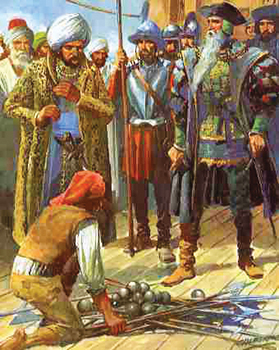
Surrendering of arms to victorious PortuguesePhoto: en.topwar.ru
Portuguese Indian coin 1799 Image: Wikipedia
Portuguese soldier Photo: artstarion.com
"I grant permission to the supplicants, seeing that they had it already from the Reverend Commissaries of the Holy Office, to have a separate place for their sepulchres, and they will not have any other and they will not hold any ceremonies prohibited by the Catholic Church.
Damaun Convent of S. Des 19th September 1690.
Fr. Re. dos Anjos
Commissary of the Holy Office”
The location of the dakhmas was obviously a problem for the Parsis living in the small towns and villages in South Gujarat. Two years after the Parsis of Saronda and Nargol got their extension of time, the Parsis of Jain petitioned the same Frei Rodriguiz dos Anjos, Commissary of the Holy Office, to allot them land for a dakhma:
"Say the Parsis of the village Jain that to bring the corpses of their dead to the cemetery which is in the village Bamoty causes them great inconvenience on account of the great distance that lies between Pragana Sangery and the said cemetery and there being five or six rivers intervening, one that has no causeway which is of the village Nargol; and as obedient vassals of His Majesty, whom God preserve, request your Reverence to grant their petition pointing out a place in the limits of the same village Jain, far away from people so that the supplicants may construct other cemeteries in the manner which your Reverence may order, for which they will be very thankful.”
The petition was granted:
"I give permission to the Parsis, inhabitants of the village Jain, to erect a sepulchre according to their style, considering the inconveniences alleged in their petition to bring the corpses of their defunct to the village Bamoty, which they will erect in a place far away from the population.
Damann, convent of our Lady of Victoria, nineteenth of August one thousand six hundred and ninety two, Frei Rodriguiz dos Anjos, Commissary of the Holy Office.”
The dakhma in Bamoty village apparently serviced several neighboring villages and the Parsis of Tarapur found it as inconvenient as those of Jain. Perhaps emboldened by Jain’s successful petition, they in turn petitioned for a piece of land to construct their own dakhma:
"Petition to Very Reverend Father Commissary of the Holy Office. Say the Parsis inhabitants of this place of Tarapor that they suffer great detriment, as much of troubles as of expenses, to carry the bones of their defunct to the village of Bamoty, of the Pragana of Damao, where they have their cemetery, it being very far distant as it is a journey of three days, having to pass by forests as well as by land, risking their lives as there are many intervening rivers on the way, two of which have no causeway, such as of Daman and Nargol, and on account of the wars affecting this fortress they find themselves unable to pass that road; the more so, as they are soldiers, and serve with much satisfaction in these wars as loyal vassals of His Majesty whom God preserves. They solicit your Reverence to assign a place in the limits of this settlement far from habitations for the supplicants to construct a cemetery in the manner as your Reverence may order, as the Reverend Father Commissary of Daman had conceded to the Parsis of Jain in his dispatch which is attached, for which favor they shall be grateful.”
The petition was granted: "I concede permission to the Parsis of Tarapor, I say, I concede permission to the Parsis of this fortress of Tarapor and its jurisdiction, to construct a sepulchre according to their style in Varmaga lands of mulfad far from the people and villages, for the disposal of their dead in view of the inconvenience alleged.
Tarapor second September one thousand six hundred and ninety three.
Padre Frey Manual da Conceicao of the Holy Office.”
The Parsis of Tarapur then looked around and located a suitable piece of land belonging to one Joao Coutinho, clerk of the fortress of Tarapur and clerk of the court. But a difficulty arose: Coutinho would not sell without the permission of the Commissary of the Holy Office. So another petition went:
"To the Reverend Father, Commissary of the Holy Office. Say the Parsis, inhabitats of this place Tarapor, that in virtue of the permission conceded to them, by the Reverend Fathers Commissaries of the city of Daman, to the Parsis of the jurisdiction, I say, of that jurisdiction, that the supplicants were so well favored by your Reverence as to permit them to make a sepulchre in the confines of mulfad and far away from the populous villages; and because in the said limits Joao Coutinho, clerk of this fortress and court, possesses a piece of land which is solitary from the neighboring villages; and the said Joao Coutinho, not wishing to sell it without the express permission of your reverence, which they pray your reverence to grant to the said Joao Coutinho, so that the supplicants may purchase it for that purpose, for which they will be thankful.”
The ever-obliging Portuguese authorities gave permission to Joao Coutinho to sell his land, and to the Parsis of Tarapur to buy it.
Satisfied soldiers
In their petition the Parsis of Tarapur claim that "they are soldiers, and serve with much satisfaction in these wars as loyal vassals of His Majesty…” Amongst the family papers there are two which give examples which neatly span the period covered by the correspondence given above. The first, dated April 28, 1667, recommends a reward for Vicajee Vora for help in capturing some robbers; the second, dated November 15, 1738, is a dispatch from the Portuguese commander of "the provinces of the North” describing some military action against Mahratta troops, and praising the Parsi contingent for their valor. It is interesting to note that Vora served the Portuguese "with his own people and arms” and volunterred to go to Bharuch with "14 men maintained at his own cost.” This would suggest there was some kind of feudal relationship between the Parsis and the Portuguese authorities.
"Manoel D’Souza Cabral, Cavalier of the order of the Christ, Captain of Artillery, and Governor of this Fortress and city of Damao and its Jurisdiction by his Majesty, etc. I certify that I know Vicajee Vora Parsi Patel of the village of Jain during all the time of my government of the said Fortress and city. He worked with zeal in the service of His Majesty, assisting in all disturbances with his own people and arms. And when there was occasion he volunteered to go to Baroch land of the Mogul, with 14 men maintained at his own cost. And I also certify that I being the Captain General of the field in the war against King Cole, the same Vicajee Vora behaved with the same zeal in the royal service, helping me to capture two robbers who had caused much trouble in our territories. He handed to me the two robbers, and I soon gave orders to decapitate them, which brought peace with credit to Royal Arms, and for which he is worthy to receive the honors which His Majesty may confer for good services rendered. He having asked I wrote this, and I swear by the insignia of the order of Christ which I bear, that everything above is said to be true, with my sign and seal as under given at Damao on the April 28, 1667.
(sd) Manoel D’Souza Cabral”
In May 1737 the Portuguese defeated a Mahratta force at the hill of Aguada. In February 1738 the Mahrattas returned to the hill and strengthened the fortifications there. The Portuguese realized that a strong enemy force at Aguada would be a threat to the port of Bassein, so they decided to attack the Mahrattas and drive them off the hill. Pedro de Mello, "Master of the Camp of the infantry of the new division of the Estate of India and Commander of the troops of the Provinces of the North” led the attack under the overall command of Anthony Cadim Troes, captain-in-chief of the Province of the North.
Pedro de Mello’s dispatch of the sea and land attack on Aguada is graphic and exciting but is not germane to our present purpose. However, at the end of the dispatch de Mello writes:
"Dadji Gesant, captain of the company of Parsis, accompanied me on this occasion obeying all that was commanded, and behaving himself throughout the course of the battle with valor and activity. On this account let him be worthy of all the honor, which His Majesty usually confers on those who serve him in a similar way. And being asked the present (certificate) I ordered it to be passed, and swear by the knighthood of Christ, of which I am a member, that the account above related is true and my signature and seal are below given at Bassein on the November 15, 1738.
(sd) Pedro de Mello”
The Parsis obviously gave help to the Portuguese on other occasions also in their fight against the Mahrattas. Thus, the Viceroy Conde de Vila Verde writes to the famous Rustamji Manockji of Surat: "I shall remember the work which you did in the wars which took place in Bassein, so that when occasion arises I shall use the information to your advantage…” The date of this letter is September 16, 1693; it was written a fortnight after the Parsis of Tarapur (which is not far from Bassein) received permission to construct a dakhma.
A systematic and thorough search through the Portuguese archives in India and in Portugal would no doubt bring to light many documents which would throw light on the life of Parsis in North Maharashtra and in Gujarat during the 17th and 18th centuries.