"It was the worst of times. The Covid pandemic started in December 2019. In India, by early 2020, hospitals and Intensive Care Units (ICUs) were packed with patients, everyone on ventilators. There was death all over the place. Fathers, mothers, children, brothers, sisters, were deprived of both parents — all totally bereft of help. It was a ghastly situation. Havoc was created as people lost their jobs and daily workers were compelled to return to their villages, walking for thousands of kilometers, children on shoulders, often spreading the virus as they went along,” said Dr Farokh Udwadia at The K. R. Cama Oriental (KRCOI) Institute on February 17, 2023 at the launch of his book, Snippets in the Time of Covid, published by the Institute.
Dr Nawaz Mody, KRCOI trustee and honorary secretary, introduced Homa Petit, outstanding lawyer, director of several companies who, in addition to recently taking over as president of the KRCOI on the sad demise of Muncherji Cama, has provided invaluable service to the community in his involvement with The B. D. Petit Parsee General Hospital, J. N. Petit Library and The Bai Sakarbai Dinshaw Petit Hospital for Animals.
Petit introduced Udwadia as a "colossus of a man” — an outstanding, caring and humanitarian doctor who plays the violin, writes extensively on medical and historical matters, a voracious reader of literature and poetry who has even written a play, Oganga, based on the life and work of the missionary Dr Albert Schweitzer which was performed at the National Centre for the Performing Arts on July 10, 2022.
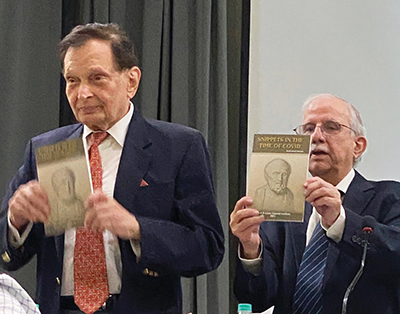
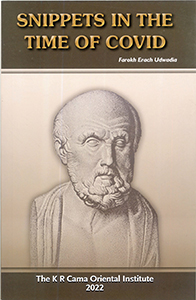
Dr Farokh Udwadia and Homa Petit at the launch of the former’s book (r)
Udwadia said one of the results of the pandemic was that, on account of his age, he was forbidden to come to the Breach Candy Hospital; the management had reportedly ruled that anyone over 75 years of age was not permitted to work at the Hospital as they might contract the virus. Udwadia wryly remarked that this was for him the unkindest cut of all, as he believed "the time you die and how you die is already written down.” But he obediently stayed at home and spent his time reading and playing the violin. He missed his work at the Hospital, his rounds with his assistants and caring for patients, especially those who were critically ill. Most of all he missed "the usual Friday 9 a.m. meeting I used to have in the Hospital where cases were presented before the students and the doctors and discussed” with them, after which he would give a short talk about history or medical history or recite a poem. The event ended with refreshments and a cup of coffee, which, he mentioned as an aside, was served to him first!
His grandson Cyrus, who is technically savvy, suggested that in this time of confinement he should communicate with the external world through video talks, which he thought was a good idea; so he delivered short talks relating to medical and related matters on 15 Fridays. These were unrehearsed and without prior preparation, and he has not revised them before publication barring one error which was pointed out to him and which he thought was important. He spoke on several subjects — the Spanish flu of 1918-19, the Great Plague which lasted for five years, the history of medicine in ancient Greece, Egypt and Rome, the story of anesthesia, the discovery of penicillin, the relationship between war and medicine and especially between music and medicine, the last being a subject very close to his heart.
Udwadia reminded his audience about the Spanish flu where 500 million, a third of the global population, was infected with the virus and up to 100 million reported dead. "Human memory is short: more people died during the epidemic than during the two World Wars not counting the Russian deaths.” It was a mystery how it started. It is generally believed that there was an outbreak of flu in an American army base. As the war was fought in trenches, the virulent virus spread like wild fire. The conditions were ripe: people living in close quarters and unhygienic conditions with filth all around them. This could have found a parallel in the recent Covid pandemic in the slums of India. But there were other parallels as well. Though patients in both cases suffered from pneumonia, in 1918 some patients suffered from acute water in the lungs (pulmonary edema) which would kill an individual within 24 hours. Once again doctors were initially at a loss as to how to handle the pandemic. A high dosage of aspirin was prescribed which turned out to be a killer and exacerbated the water in the lungs. From three to four percent of the patients could have died because of the aspirin itself. Following a study in 2003-05 of a frozen section of lungs of those who had died in the pandemic of 1918-19, the flu was attributed to the H1N1 virus which is acquired from birds and domestic animals.
Pandemics have been with us for a long time. The Black Death plague epidemic during the 14th century traced its origins to China and spread from there on to Crimea, Sicily and most of the countries of the world.
Udwadia explained how the precautions for avoiding the spread of these diseases were almost the same as those followed during the present pandemic: cities were quarantined; houses with infected patients were locked; when all the plague victims in a house were dead, the house was set on fire. The doctors used gowns with large beaks in the headdress which were stuffed with aromatic oils and herbs. These were quite unlike the more sophisticated PPE (personal protective equipment) used by doctors and nurses today.
Yet Covid-19 was also "the best of times.” The exact genomic structure of the Covid virus was established within a few weeks, vaccines which would have taken years to prepare were available in a few months; "ordinary people, though bereaved and desolate, helped one another, comforted one another…Sang from open windows to support those locked up within their homes, either sick or isolated.” Catastrophes help humans to rise above themselves as they realize life is fragile and death is always standing by. The pandemic brought to the forefront the heroism of the medical staff who bravely continued to serve in very trying times.
Referring to the Great Plague Udwadia noted even that had a positive outcome: the feudal system was destroyed. With the population being decimated, the knights and lords did not have a sufficient number of serfs to toil for them.
The doctor cautioned that there will be future pandemics in times to come, but humankind will survive. For "hope springs eternal in the human breast” and "if winter comes, can spring be far behind?” FIRDAUS GANDAVIA
Gandavia holds a doctorate in English literature and is a retired chartered accountant. He is a compulsive reader of fiction.