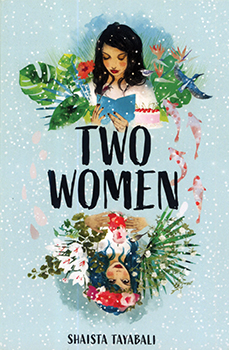
Two Women by Shaista Tayabali. Published in 2022 by the author, 14, Hauxton Road, Little Shelford, Cambridge, CB22 5HJ, United Kindgom. Pp: 87. Price: £ 7.99.
Two Women, a book of poems, has been dedicated by Shaista Tayabali (pictured) to her mother Perveen (née Nadirshaw) — both she and her mother are "balanced bird wings.” However, the poems are not in any way limited to the bond between mother and daughter. The title, Two Women, is appropriate on different levels. Since the age of 18, Shaista has been suffering from lupus. It is an auto-immune disease where the immune system attacks its own tissues; there is no cure for this condition. At one level, the  Two Women represent Tayabali’s own plight — the poet living with and fighting against lupus at one and the same time: "The one with all the hope, all the vision,” as well as the one who "does everything to fight back.” The Two Women may also refer to the dual roles that women have to play throughout their lives: as an epigraph, she quotes a very relevant extract from Pulitzer Prize winning American author Alice Walker’s "A Woman is Not a Potted Plant.” She is not rooted and confined to her house; she is "wilderness / unbound.”
Shaista has also written a book about her condition, Lupus, you odd unnatural thing (see "Living with lupus,” Books, Parsiana, July 21-August 6, 2022). Lupus, is derived from the Latin word for "wolf.” The image on the cover of the book is that of Red Riding Hood with the shadow of the wolf close behind her. Having illustrated this volume of poetry herself, she uses the same violent image in her poem, Shadows in the Stone, where the "wolf shadow snarls.”
However, not all the poems are about lupus and Shaista skillfully encompasses several other themes as well. In My Mother’s Palette, she gently criticizes the people who think that all Indians eat only curry. She describes the various dishes her mother prepares, not just the variety of items, but their artistic presentation in hues of ochre, green and purple. On account of her illness, Shaista must occasionally make do with the more boring though healthy food; but she cleverly puns on the word "palette” by stating "(her) heart belongs elsewhere, / on someone else’s palate.” Shaista’s strong and vibrant imagery not only whets the appetite but also creates a wonderful and colorful portrait of a meal reminding us that the Tayabalis — father Dr Chotu, mother and daughter — are artists in their own right.
In The Reader, she thinks back about all the authors who influenced her. Why does one read and write?
"We write to know we are not alone,
We read to know how others lived
And won their war through life and love.”
She ends with appreciation for all those writers who preceded her and the realization that she would never be able to "stand apart” from them.
That Shaista is extremely close to her nieces, Eva and Ellie, is evident in Bedsong where she is hurrying home to meet them before they go to bed. She is so impatient that:
"The shortest journey stretches too long,
when you are counting your way home.”
She wonders if Eva and Ellie will scent her with lavender and "use my limbs as props for whims?” This shows another aspect of Shaista’s work where she can paint a simple picture of maternal love and domestic life with ease and grace.
In Hidden Traumas, she regrets how with age we change our shape as "bellies loosen,” and "waists / thicken.” Once we were thin but now we have become like airplanes which find it difficult to get off the ground. The poem also refers to a woman’s body during pregnancy. The "curves” of her body (which she returns to in another poem) foretell the "shape of the event;” the title Hidden Traumas suggests that this could be a "phantom” and imagined pregnancy rather than a real one. Like the artist she is — as stated earlier, she has illustrated the book herself — she plays around with the length of lines and creates spaces within the poem to make the matter of the poem match the form.
But not all the poems are in a lighter vein. Banaz, is a tribute to Banaz Mahmod, a 20-year-old Iraqi Kurdish woman who lived in England and who was murdered on the orders of her family because she ended an abusive marriage which was forced on her and started a relationship with someone of her own choice. Shaista does not care
"Whose father, did what, when,
With whose aid.”
 But it is Mahmod who continues to haunt her even today — not merely as a ghost as there was "nothing unsubstantial” about her life — and the unfortunate victim continues to swim "in the river of my thoughts.”
The similar playfulness with form and content which we encountered in Hidden Traumas can be seen in Tattoo. Here the subject is more grim as it deals with Shaista’s illness. She is lying in bed probably in a hospital ward taking a drip, waiting for a long time for the first drop to fall down the tube which is attached to her body. The title of the poem refers to the patient next to her who is in the same situation and whose needle ends in the tattoo of a Medusa on his arm. Shaista uses the same visual device with the word "drip” which enters her body to destroy the "free B cells.”
One thing is for certain, that though several of the poems deal with lupus and Shaista’s medical condition there is no trace of self-pity or melodrama. In fact, that is why the grief and the pathos of the situation she describes comes out the stronger. She seems to be able to look at the lighter side of things.
In Self-Portrait, she paints a picture of herself ravaged by lupus. The images she uses are violent and disquieting. The hair is "taffy, black molasses” before it falls. If the skin is pink, it is because it is flushed on account of fever and if the cheeks look healthy like marshmallows, it is because they have been filled with steroids. She does not see very well as her vision has been affected by tubes and bubbles and blood. "The body ballet depends on the day” — sometimes she feels like a corpse and on other days like a leaping salmon. But whatever the condition, whether she is "Slumped on the desk…tucked up in bed…hooked to the needles,” she is always "scribing.” Shaista, may you long continue to scribe. FIRDAUS GANDAVIA
Gandavia holds a doctorate in English literature and is a retired chartered accountant. He is a compulsive reader of fiction.