Confronted by nearly 20,000 vehicles and one lakh Maratha agitators who stormed into South Bombay demanding reservation under the Other Backward Class category, "for four days the entire police force was working day and night. The main job for the traffic police was to ensure motorists reach their destination safely,” stated Assistant Commissioner of Police (ACP) Cyrus Irani when responding to Parsiana’s queries on September 6, 2025, four days after the agitators were compelled to vacate the city as per the directives of the Bombay High Court.
Describing the situation as "a big challenge,” Irani revealed that they had been told to expect 1,000 additional vehicles and 5,000 protestors. They were not prepared for the influx that paralyzed South Bombay. As the main arterial roads were taken over by the agitators, motorists had to be redirected to alternate routes. The ground policemen were informed about the actual position across different areas by the Control Room at the Traffic Police Headquarters at Worli where nearly 25 policemen are assigned specialized duties for 12 hours at a time to monitor the movement of vehicles in the city. Since surveillance by the Control Room falls under Irani’s domain, "In the event of an emergency I have to take a decision regarding diversion of traffic,” he mentioned.
During the Maratha sit-in, additional help and equipment like cranes and barricades were provided to the policemen manning the roads. "After the High Court order (instructing officials to expel the agitators), we cleared South Mumbai in a few hours,” recalled Irani, conceding that the simultaneous presentation of the Government Resolution to their leader Manoj Jarange Patil facilitated the task.
Above: Maratha agitation bringing traffic to a halt outside
Brihanmumbai Municipal Corporation headquarters; inset: ACP Cyrus Irani
Barely had the dust settled when the traffic police were required to be on duty to control the crowds and processions for the Ganpati immersion and Eid-e-Milad on the first weekend of September. Required to be on vigil for nearly 24 hours at a stretch for Ganesh immersion, Irani regretted he would not be able to accede to our interview request immediately. Currently the only Zoroastrian policeman in Maharashtra and reportedly in India, he reminded us that at every festival the police are on the roads.
While a normal police shift lasts for 12 hours, "16 to 18-hour duty is routine on big days. If I don’t (put in long hours), how can I expect it from my juniors? You should be a good leader for juniors to respect and follow you,” stated Irani who has a legion of policemen working under him from the rank of senior police inspectors, police inspectors, assistant police inspectors, police sub inspectors and others in lower ranks.
According to the organization chart depicted on the website of Mumbai Traffic Police, heading the department is the joint commissioner of police under whom comes the additional commissioner of police, four deputy commissioners of police and eight ACPs. Irani’s portfolio as ACP being planning and administration, he reports directly to the joint commissioner of police.
Expecting the second week of September to be less demanding on his time, Irani had agreed to meet us briefly at his sixth floor office at the Traffic Police Headquarters on September 10. He had not though anticipated that all the top brass from the traffic police would be summoned to a nearly three-hour ad hoc meeting that afternoon. The purpose of the meeting? Plans had to be drawn to ease traffic flow ahead of the Mount Mary Fair in Bandra that was four days away and the Navratri festival that would commence within 12 days and continue until October 2.
Irani (r) awarded the President’s Police Medal
by then Maharashtra governor Ch Vidyasagar Rao
Irani referred to the statistics on his desk to indicate the quantum of vehicles for which the traffic police is responsible daily: over 48 lakh Mumbai vehicles plus four lakh floating vehicles from the Mumbai Metropolitan Region. Adding to the woes of traffic police are the constant infrastructure projects in the city — whether in the form of work on the Coastal Road or laying of the Metro rail lines or rebuilding bridges — when the entire stretch or only half the road width is open to vehicular traffic. Currently in use is the Area Traffic Signal Control system that collects data based on which optimal signal timings are decided. Irani looks forward to the introduction of the Integrated Traffic Management System signals which will use technology to intelligently monitor, manage and provide real-time traffic information to authorities and drivers.
CCTV (closed-circuit television) cameras mounted on traffic signals or cantilevers can determine 21 different types of offences like speeding, jumping a signal, crossing lanes, etc. Traffic offences which are now penalized with e-challans issued on the vehicle’s registered mobile number stipulating the fine payable are considered convenient by those who are tech-savvy and a nuisance by others who lack the wherewithal. Specifies Irani, "The fines don’t necessarily have to be paid online. They can be paid at any traffic police chowky.” He also clarifies the misconception that those who wish to challenge the fine at an adalat that meets periodically have to engage a lawyer. This is not so. He attests that Parsis are viewed as law abiding citizens by the police: "jooth boléga nahi; kanoon todéga nahi (will not lie; will not break law) is the impression held.”
Irani has been working for the police for 32 years, recruited directly as a police sub inspector after he cleared the Maharashtra Public Service Commission (MPSC) examination and a year’s rigorous training at the Maharashtra Police Academy in Nasik. Besides the Traffic Control department he has served the Subsidiary Intelligence Bureau, the Special Protection Unit and the Criminal Investigation Department (see "President’s Police Medal,” Parsiana, June 7, 2018).
His role in successfully handling varied assignments has been recorded: restoring normalcy to Killari village (district Latur) following a massive earthquake; quelling an agitation in Hingoli district against the change in the name of Marathwada University; taking charge of the newly formed Sir J. J. Marg Police Station after the 1993 communal riots; controlling the tense situation in the communally sensitive area of Null Bazar and bridging the gap through the Mohalla Ekta Committee; intercepting a call that indicated a foreign flag ship was carrying arms and ammunition on board and defusing the situation within a week. The dedication and success stories of policemen are routinely recognized with mention in their Service Book, appreciation letters and commendation certificates. Few, like Irani, are privileged to earn the President’s Police Medal for Meritorious Service and the Director General insignia.
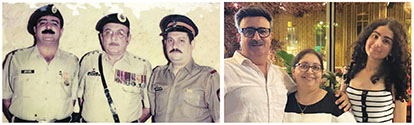
Above, from l: ACPs Cyrus, Homi and Kayomerz Irani; Cyrus, Delnaaz and Benaisha Irani
An alumnus of St Paul’s High School and Lala Lajpatrai College, after completing his commerce graduation Irani joined The Zoroastrian Co-operative Bank Ltd. "Impressed by the uniformed attire of their maternal uncle Homi Irani who retired as ACP, hearing his stories and the respect he commanded,” Cyrus and his elder brother Kayomerz who earlier worked at Mantralaya were inspired to join the police force. Kayomerz retired last December as ACP on completing 58 years of age while Cyrus’s tenure will continue until 2029. Their father Boman was an electronic engineer with the Bhabha Atomic Research Centre, mother Piroja retired as office superintendent from the State Excise department. Yet another maternal uncle Khurshed Irani too retired as superintendent of excise. Due to Cyrus’s unpredictable work hours, wife Delnaaz opted to be a homemaker. Their daughter Benaisha is in her first year of junior college, studying science at K. C. College and aspiring to pursue medicine.
Describing himself as "a very religious person to whom prayers and rituals are very important,” Cyrus revealed that he visits the fire temple daily and starts his workday with a prayer. "On several occasions I have been called upon” to assist Parsis in difficult situations, he said but rather than elaborate on that he preferred to dwell on his role at the time of "transferring the holy fire from Tavri to Mumbai before it was enthroned at the Jokhi Agiary in Godrej Baug. I was the pilot officer and I led the convoy of 43 motor vehicles.”
Not many may know that Bombay’s first Indian Commissioner of Police after India gained independence was J. S. Bharucha who served for two years. There were many others who have shone in police service (see "Prolific policemen”). When invited to community events, Cyrus always tries to enthuse Parsis to join the police force but feels that they don’t want to move out of their comfort zone. A sound knowledge of Marathi is a prerequisite to clear the preliminary and main MPSC examinations that are known to be tough. "If you can learn French and German, why not Marathi?” Cyrus rhetorically enquires. "You have to respect and learn your local language.”
At the Traffic Police Headquarters, the circulars and signage are mainly in Marathi. A plaque in English bearing the thoughts of law enforcer and leading figure in the department of criminal justice in the US August Vollmer stands out in Cyrus’s cabin: "The policeman is denounced by the public, criticized by the preacher, ridiculed by the movies, berated by the newspapers and unsupported by the prosecuting officers and judges… He is exposed to countless temptations and dangers, condemned while he enforces the law and dismissed when he does not. He is supposed to possess the qualifications of a soldier, doctor, priest, lawyer, diplomat and educator with remuneration less than that of a daily laborer.”
Unperturbed by public opinion, to Cyrus, the most rewarding aspect of his job is that "you are serving the country and you get the opportunity to serve people and help them. Each day in the police is a new day.”
Prolific policemen
Besides Bharucha, the two other Parsi Commissioners of Police in Bombay were K. D. Bilimoria who also served for two years while K. J. Nanavatty’s tenure lasted for only a month, as per details shared by the Mumbai Police. The five who had served as Deputy Police Commissioners (in alphabetical order) were Jal Contractor, Dady H. Crawford, Jal Bejon Jal, Namdar Kermani and B. A. Minocher Homji. Fourteen retired as ACP (in alphabetical order): Keki Balsara, M. H. Balsara, Cooversha Bhesadia, Shiavax Bodhanwala, Naval Driver, Meherji Framroze, Feroze Ganjia, Homi Irani, Kayomerz Irani, Minoo Irani, Nauzer Maneckshaw, Kersasp Palkhiwala, Sam Patel and Jehangir Suraliwala.