A K. R. Cama Oriental Institute seminar
focusses on who built the forts of Maharashtra and why and how
How thick should the walls of a fort be? How tall? What should they be made of? Is a stone wall stronger than a mud wall cased with stone? How many layers of fortifications should there be? How should a fort be shaped? Round? Square? Diamond? Star? Where should a fort be located? Should the enemy storm the fort, lay siege or bribe the defenders? Were forts built to protect the citizenry or to defend territory? And when and why did forts and fortifications become redundant?
These were some of the issues raised at the February 16 and 17, 2019, K. R. Cama Oriental Institute seminar on "The Forts of Maharashtra.” The seminar was not only about the physical structures but "the style of architecture, the means of offense and defense and finally the people and their lives and livelihoods within the structure” and their historical role, states the 96-page booklet published for the meet. "India has a grand history of fortification,” notes the write-up. "Of all the regions... there is none that can boast of more forts than Maharashtra,” They date from the sixth century but they proliferated from medieval times across the hills and plains of the state. "The wide variety... range from the medieval forts of the Deccan, island forts, including the Bombay Fort and the Portuguese forts.”
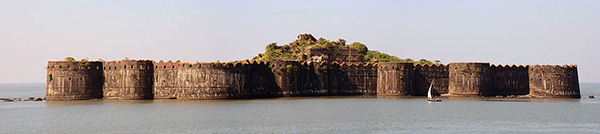
Murud Janjira Fort (Photo: Shomdev Pal/Wikipedia)
Panoramic view from a building in Vasai Fort (Photo: Gladson777/Wikipedia
Church at Vasai Fort (Photo: Gladson777/Wikipedia
Spider, baby caterpillars feeding, African Hoopoe at Vasai Fort (Photos: Gladson Machado/Wikipedia);
Kalak Bangadi, third largest Indian cannon at Janjira Fort (Photo: Sid the cool 007/Wikipedia)
Capture of Daulatabad Fort in 1633 (Photo: http://collectionsonline.lacma.org/Wikipedia)
After the invention of cannons, the shape of forts changed, said Dr Tejas Garge, director of Maharashtra’s Archaeology and Museums directorate in his inaugural address. The walls "were more round” to better withstand the cannon balls; protruding bastions, double battlements and star shaped forts came into existence. Garge spoke on "Cannons and fortifications: An overview in the global context.” Prior to the fourth century (BC) weapons were "not offensive. Societies were peaceful,” he noted. Not many of the cannons prior to the 12th century AD have "survived.” Cannons were often melted down or vandalized to monetize the "value of the metal,” he said. One has, therefore, to rely on paintings, sculptures to know about the shape and structure of the guns. Yet "not even half a dozen books on the study of cannons (exist),” he bemoaned. Cannons, however, often determined who won or lost a war. The early cannons were made of bronze. The Europeans introduced wrought and cast iron cannons in India during the 16th century.
The barrels of the cannons made initially often lost their shape after firing, Garge explained. The gunners had to wait till the metal cooled down before firing again. And there was "no guarantee they would fire straight.” The barrels had to be cleaned after each firing and gunpowder loaded. The Portuguese cannons were smaller but more precise. The diameter of cannon balls varied from 12 cm to 49 cm and were initially made from stone and later metal. If an army ran out of cannon balls they even loaded coins into the muzzle, he remarked.
The Maratha warrior general Shivaji did not lay emphasis on cannons or heavy weaponry. "He relied more on guerrilla warfare,” pointed out Garge. But even Shivaji was unable to capture the sea fort at Janjira built by the Siddis, an ethnic group descended from the Bantu peoples of East Africa.
Garge attributed Babur’s win in the First Battle of Panipat in 1526 to his use of cannons. The battle between the invading forces of Babur and the Lodi Kingdom marked the end of the Delhi Sultanate and the beginning of the Mughal Empire. This was one of the earliest battles involving gunpowder firearms and field artillery, both introduced by the Mughals. Babur’s guns proved decisive in the battle. Ibrahim Lodi lacked any field artillery and the sound of the cannons frightened his elephants, causing them to trample his men. After Panipat, "cannons have become an important component in battles,” remarked Garge.
"Fort architecture evolved in line with the increasing use of batteries… leading to lower and thicker curtain walls and bastions, away from the high, thin walls,” stated independent researcher Raamesh Gowri Raghavan in his paper "The shape of colonialism: The Trace Italienne, gunpowder and the decline of Indian forts.” He said cannons warfare "came to Europe after the later crusades.” Gunpowder could have come to India from Iran or the east via Burma. He noted that cannons were meant "to sow confusion in the enemy than to hit or kill anything.” There were two basic styles of fortifications in Maharashtra, the Saracenic and the Trace Italienne. Trace Italienne is a fortification that evolved during the early period of gunpowder. The design of the fort is pentagonal or hexagonal with bastions at the corners of the walls. Saracenic derives its origins from Indo-Islamic architecture. The Red Fort in Delhi is an example of Saracenic architecture.
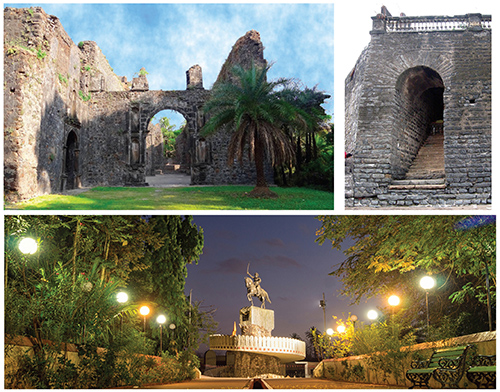
First row, from left: Vasai Fort Photo: Gladson Machado/Wikipedia; Mahim Fort Photo: Nicholas/Wikipedia;
above: Memorial to Chimaji Appa at Vasai Fort Photo: Gladson777/Wikipedia
Statue of Shivaji at Raigad Fort Photo: Chetan Karkhanis/Wikipedia
From l, 1st row: Dr Nawaz Mody, Dr Tejas Garge, Dr Jehangir Sorabjee,
Raamesh Gowri Raghavan, Dr Rashna Poncha;
2nd row: Dr Pushkar Sohoni, Dr Milind Paradkar, Cmde Dr Odakkal Johnson,
Cdr Mohan Narayan (retd), Dr Anita Rane-Kothare
"Aside from defensive architecture, a star fort was also superiorly offensive, allowing cannons to cover all its walls and leave no blindspots. He said in some cases mud walls cased with stone were preferable to stone walls as they absorbed some of the shock. Stone walls could splinter when hit by cannon balls.
In 1803 during the siege of Ahmednagar it was rumored that British governor-general Lord Wellesley "took a fort between breakfast and lunch, not with cannons but cash,” Raghavan stated. He supposedly bribed the opposition to surrender! The battle actually lasted an hour after Wellesley’s cannons created a breach in the fort walls. With the advent of airplanes and their use in warfare, fort walls became redundant and were "consigned to history,” said the researcher concluding his talk.
In his talk on "Early Bombay — The need for fortification of a colonial island,” Dr Jehangir Sorabjee mentioned "no development took place outside of the Fort. Nepean Sea Road (where he resides) was viewed as a "weekend getaway.” He bemoaned the tearing down of the old Fort of Bombay in 1864 under the aegis of The Rampart Removal Committee. "The Fort should have been kept,” he remarked, noting how such fortifications in Europe had been preserved as tourist attractions and historical monuments.
Dr Rashna Poncha, assistant professor of history at Sophia College for Women also bemoaned the loss of the "long forgotten vintage of this city...There is nothing left, not even one wall.” Poncha noted, "The Fort encompassed the entire town of Bombay. It had been constructed by the East India Company in fits and starts as a defense against pirates and enemies from the Deccan or Konkan,” in her paper "Lost sentinel: The story of the Bombay Fort.” While the Fort stood, no one was permitted entry after sunset. Around 14,000 lived within the Fort and 8,00,000 outside. Parsi businessman and philanthropist Sir Jamsetjee Jejeebhoy was influential enough to have the Fort wall moved to accommodate his son’s new home. Following the Great Fire of of 1803 residents were offered compensation, often comprising large tracts of land, to shift outside the Fort.
The moats or ditches running along the wall, however, were used as garbage bins causing disease to spread. The population was increasing, better drainage was required. "There was no option but to remove the walls. The city was converted from a fortified town into the presidency capital. By 1850, the fort was completely congested and space to expand was desperately required. In terms of security, the Fort walls were felt to be superfluous and found burdensome. Various authorities began to suggest the the Fort be demolished.” The walls around 40 ft high and 20 to 50 ft in width were demolished by the mid 1860s.
After the East India Company shifted its headquarters from Surat to Bombay in 1682, "Bombay became one of the first towns to be fortified,” explained Cmde Dr Odakkal Johnson who spoke on "Island batteries at Middle Ground and Oyster Rock.” "But it still remained vulnerable from the sea.” Pirates and others could attack. Hence the concept of coastal batteries. The placement of gun batteries at Oyster and Middle Ground "firmly and silently protected the seaward approaches to the harbor...The structures are significant, both from a tactical as well as strategic point,” he wrote in the seminar booklet. He spoke of their eventual decline as the guns were replaced with missiles. These could be located at various places.
"Bombay still needs defending,” he pointed out, referring to the horrendous November 26, 2008 attacks by the 10 Lashkar-e-Taiba terrorists who came by sea from Pakistan. At least 174 died, including nine terrorists. "Bombay has repeatedly been attacked over the last 30 to 40 years. Despite all this, "Bombay is still one of the best cities in the world,” he remarked.
During the question answer session a delegate inquired if the Rs 4,000 crores (USD 5.8 billion) Shivaji statue should be built on an existing island instead of an artificial one. Already a human life had been lost when boats ferrying Press people and others to a function near the site, hit a rock and capsized. Cdr Mohan Narayan (retd) who was chairing the session replied that Kandheri where Shivaji once had a fort was a more appropriate site. Shivaji had no connection with Bombay, he observed. Plus the waters around the new location were treacherous. If the people navigating the boat made an error, the consequences could be disastrous.
The architecture of forts developed "to counter gunpowder technology,” said Dr Pushkar Sohoni who teaches at the Indian Instutute of Science Education and Research in Poona speaking on the "Forts in the Deccan: changing paradigms of defence.” The initial response was to build "larger and thicker walls” but soon people realized "it was not wise to keep making (them) thicker; there was a limit as to how thick one could make walls.” Triple walls surrounded by moats and ditches were also constructed. But "as artillery and mining techniques improved, it was impossible to match architectural defenses against them.”
Another defense was to place a slope with the higher elevation facing the moat/ditch in front of the walls. In this manner the gunner would find it hard to correctly gauge the height of the wall and cannon could possibly overshoot the wall.
In time settlement patterns changed with "civilian/mercantile and military/administrative units” being segregated in different locations. "In the Deccan, cities such as Hyderabad and Aurangabad were founded in 1591 and 1610 respectively, away from the administrative and garrison strongholds of Daulatabad and Golconda...The new cities were walled only in the late 17th century by the Mughals to control the movement of goods and people and to protect against small bands of robbers and looters.”
Even if an invading army captured the fort or garrison, the civilian population would be spared, ensuring they continued to be a source from which to collect taxes and levies for the new rulers. "Pillage and looting were not the object but the right to collect revenue.” The funding of wars also changed from facing local citizenry to borrowing from banks and wealthy individuals/families. If the invading army lost, the investors lost their investment. New settlements were also set up near water sources eliminating the need to transport water over long distances. This made the cities less vulnerable to having their water supply cut off by the enemy.
Research officer at Bharatiya Vidya Bhavan Dr Milind Paradkar in his paper "The crown jewels of the Maratha Empire — Rajgad and Raigad” stated that "historians and archeologists admit that fort architecture has been well developed since the early ages of mankind… The structural remains found on the banks of rivers like the Sindhu, Euphrates, Tigris and Nile, etc all bear testimony to the fact that military structures were built in initial phases of human civilization… The science of fortification was well developed in India…”
Shivaji "established an independent Maratha kingdom against the backdrop of adverse geographical, territorial and defensive conditions. He was crowned against all odds, when the whole of India was ruled by Muslim rulers… Shivaji’s achievements were possible solely due to the difficult terrain of the Western Ghats and the countless impregnable forts in this mountainous region that formed the core of his kingdom.”
Day 2 proceedings to be carried in a forthcoming issue.