With the opening of the Bhandara Atash Kadeh, the Houston Zarathushtis’ dream of having a
stand-alone place of worship with a perpetual wood-fed flame has become a reality
Porus P. Cooper
Fire, chosen by the Prophet as the outward symbol of his faith, is venerated. It represents the Divine Spark in every man, a spark of the Divine Light.
The Crow Eaters by Bapsi Sidhwa
More than a dozen years after the Houston area Zarathushtis had unveiled their pride and joy — a heritage and cultural center with a prayer room — some began to feel their center needed a companion.
"The argument they were making was that a stand-alone structure would not be confused with a place for parties but be a place of worship with a significance of its own,” said Feroze Bhandara, a businessman and longtime member of the Zoroastrian Association of Houston (ZAH) who has been a benefactor of causes near and far.
The idea gained momentum, and in 2014 the community formally endorsed a separate sacred space, an atash kadeh. The project became a passion for Bhandara, who with his wife Shernaz, would go on to finance the entire two-million-dollar (Rs 13,85,47,000) construction.
Photos: Yezdi Engineer, Percy Katrak and Percy Behramsha, supplied by the Zoroastrian Association of Houston
Assembly outside the Atash Kadeh
Shernaz and Feroze Bhandara inaugurate the premises; priests who performed the inaugural
jashan with Dastur Khurshed Dastoor and Mobed Bomanshah Sanjana (front row, 3rd & 4th from r)
"The atash kadeh came about because somebody from the Mobed Council talked to Sarosh Collector,” Bhandara, 66, recalled in a recent interview, referring to the influential North American Mobeds Council and to a veteran fellow member of ZAH.
"They made the case that we need to have a continuously burning fire and all the other elements so we can do our own navar ceremony, and so on,” he said.
With nearly a week of ceremonies and celebrations around Navroz March 2019 — and with Udvada Vada Dastur Khurshed Dastoor, a constant presence as guide and mentor — the Houston Zarathushtis’ dream of having a place of worship with a perpetual flame became a reality.
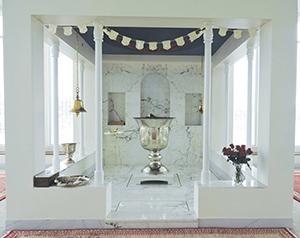
The Bhandara Atash Kadeh, with its sand-hued Texas limestone outer walls, bears a strong architectural resemblance to Zarathushti fire temples in South Asia and Iran. Chicago-based architect Cyrus Rivetna, a sedulous student of these structures worldwide, ensured it would look that way. Inside, there is an Urvis Gah (place for higher liturgical ceremonies) and space for the training of future navars.
But the Atash Kadeh is some steps short of an agiary, and it will be a while before navars are ordained here. In the hierarchy of Zarathushti sacred fires, Dastoor explained later, the Houston flame is akin to a "household fire.” It’s a "purified fire,” he told a questioner.
The Atash Kadeh is not consecrated with the full panoply of traditional rites familiar to Zarathushtis in India, Iran or Pakistan. For now, a mobed does not mark every gah, day and night.
But in the North American context, the Atash Kadeh shows early promise of becoming consecrated in the hearts of local devotees: Hundreds waited in line to bow their heads to the newly installed flame and smear their foreheads with rakhia (ash) after the first ever boi there.
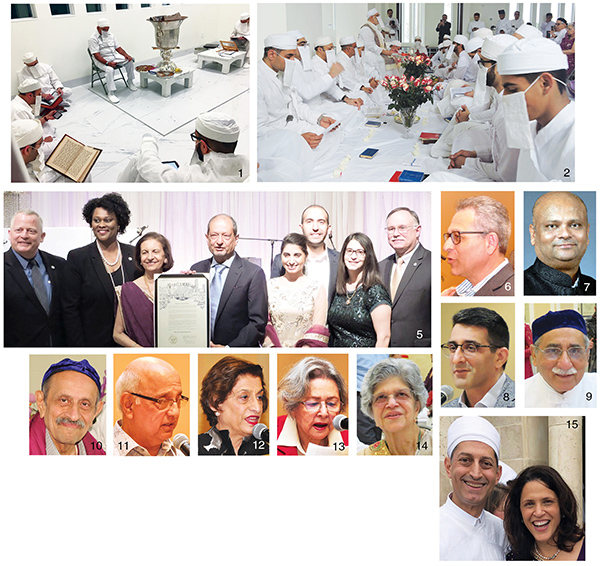
1. Vendidad Sadeh performed by (counterclockwise from top r) Mobeds Maneck Sidhwa, Parvez Gonda,
Poras Balsara, Yazdi Dastur, Kurush Dastur and Jimmy Madon; 2. inaugural jashan;
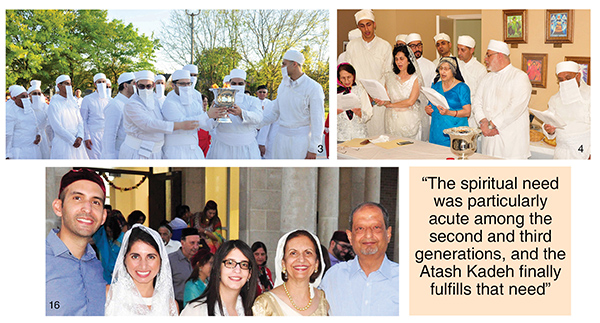
3. sacred fire brought from the center to the Atash Kadeh; 4. devotional song by priests and prayer class teachers;
5. Shernaz and Feroze Bhandara with proclamation for Bhandara Atash Kadeh Day as family and dignitaries look on;
6. Aderbad Tamboli; 7. Dr Anupam Ray; 8 & 9. Cyrus and Rohinton Rivetna; 10. Sarosh Collector; 11. Rohintan Deputy;
12. Aban Rustomji; 13. Bapsi Sidhwa; 14. Roshan Rivetna; 15. Mobed Khushrav & Manek Nariman; 16. Bhandara family
(Seventeen of the 21 mobeds in the community have signed up to share the responsibility of marking the turn of some gahs each day through the week.)
Its 24/7 wood-fed fire makes Houston’s Atash Kadeh unique in North America; California Zarathushtis built an atash kadeh with a continuous fire three years ago, but there the fire is fed by natural gas, a requirement of state ordinances.
Bapsi Sidhwa, the internationally published author of The Crow Eaters, Cracking India and other novels, expressed the feelings aroused in her as she visited the Atash Kadeh days before its ceremonial opening: "Sitting there, I felt a sense of peace and sublimity,” the 84-year-old told Parsiana. She is Bhandara’s sister and, like him, is a resident of the Houston area, far from their ancestral hometown Lahore.
Nazneen Khumbatta, a mother of two, who is a member of the Atash Kadeh board, described how a friend of hers, someone "not known for any great religious fervor,” burst into tears as they stood before the newly lit fire.
Day one
Inaugural activities began on March 20 with community members bringing household rakhia and sandalwood to the Atash Kadeh. By mid-day a long table was piled with both items.
Khumbatta, 56, was an early contributor. About 10.30 that morning, she set off for the Atash Kadeh, a short drive from her home, with her cargo of sandalwood, rakhia — and high expectations.
The challenge for her generation, she said, is how to "inspire the younger generation to keep looking to Zoroastrianism to satisfy their spiritual needs.”
At the Atash Kadeh, her cargo reverently unloaded, she joined others in a cleanup. They vacuumed floors, wiped down the kebla’s marble walls and afarganyu surfaces, and set up trays of divos (tea-light candles) for worshippers to light the next day.
There were hitches. There was not sufficient ash to fill the sarposh, the dish atop the afarganyu, said Khushrav Nariman, who is the mobed representative on the Atash Kadeh’s five-member board. The bed of ash was essential to retain heat in the vessel, Nariman said. But this sarposh — eight to 10 inches deep and about four feet in diameter — was daunting to fill. So they burned quantities of charcoal in a new drum smoker to obtain clean starter ash, which was supplemented by the household ash.
"We do not have plans to consecrate the fire at present, but hope there is a way in the future,” said Nariman, 54, a partner in a consulting firm.
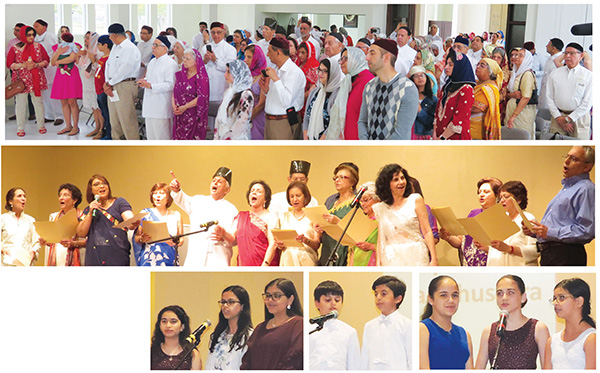
Top row: devotees at the Atash Kadeh; 2nd & 3rd row: devotional songs by elders and youngsters at the function
Clockwise from above: Navroz table; exhibits at "Down Memory Lane"; hearty repast;
demonstration of kusti weaving loom by Freny Nariman as Nazneen Khumbatta (l) and others look on
Day two
Atash Nyaish and baaj prayers were followed by maachi in the old prayer room at the cultural center. Embers from that fire were then taken in a procession to be installed at the Atash Kadeh, across a parking lot.
At the Navroz dinner that followed, Dastoor exhorted the community to embrace the new sacred space. "Use the Atash Kadeh more and more every day,” he said. "Do jashans on every Behram roz and maachis on every occasion. Buy sukhad (sandalwood) at the Atash Kadeh, to help maintain the temple. Cover your heads when you come to the Atash Kadeh. Don’t bring eatables inside. This will increase the aura of this place.”
He also had words of caution: "Don’t rush things.”
In an interview later, he elaborated: "When you build something new, everybody wants to do this and that. You have to go step-by-step. I have told the committee and founders to go slowly. Let us see how this works out. There will be teething problems.
"They wanted a consecrated fire temple; they wanted yazashne; they wanted a Bareshnoom Gah (place for the nine-day purification ritual),” but "the higher liturgical ceremonies are not advisable,” he said. First do afringan, farokhshi, satum, he counseled. Performance of weddings and navjotes also would be fine.
But, he added, even the older generations of mobeds in Houston left India so long ago, they are out of touch with intricate rituals. "So that’s why I said don’t rush into things.”
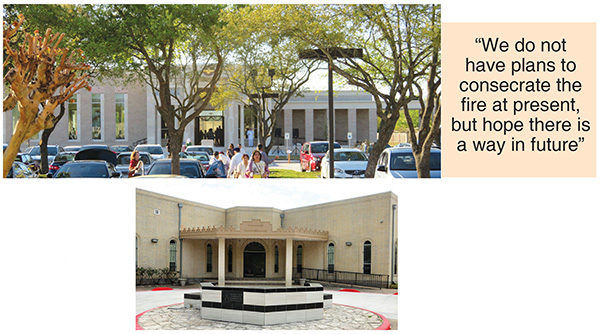
Atash Kadeh (top) with glass portrait of Zarathushtra (below)
heritage and cultural center (above)
Day three
The day began in the overnight hours, with a four-and-a-half-hour recitation of the Vendidad Sadeh by six mobeds — Parvez Gonda and Maneck Sidhwa of Houston; Poras T. Balsara and Yazdi Dastur of Dallas; Kurush Dastur of Washington, DC, and Jimmy Madon of Britain. The Atash Kadeh did not have the necessary aalat to enable a full Vendidad, Dastoor later said. "There is no varasiyo (sacred bull) here,” he noted.
At the cultural center, later in the day, visitors were treated to a special exhibit. "Down Memory Lane” transported them to a Parsi home of a century ago in India. Among the artifacts on display were a Primus stove on the kitchen counter, a bone-china dining set on the dinner table, a rocking chair in the living room, and the Khordeh Avesta in Gujarati and photos of ancestors on the prayer table.
"It’s one way of continuing our traditions, for our children to see this,” said Aban Rustomji, a professional librarian who has nurtured this nook at the Houston center for years in collaboration with the Federation of Zoroastrian Associations of North America (FEZANA).
The special exhibit was flanked by permanent collections of sacred and scholarly books — some rare — and displays celebrating the lives of two titans of Zarathushti scholarship, Dastur (Dr) Maneckji Nusserwanji Dhalla and Dr Kaikhosrov D. Irani.
Outside the library doors, Edul Chikhliwala, 60, described a colorful poster he had created of typical scenes of Parsi daily life from back home.
Later came devotional songs by children, followed by remarks by Bapsi Sidhwa.
She introduced a Feroze Bhandara that her listeners likely didn’t know – the "mischievous and disobedient boy” who was sent off to boarding school.
Sister and brother have a close bond. He shows up as a character in one of her novels. "My brother visits me practically every evening, and he fills my house with flowers,” she said. And she noted with pride that Feroze has been liberal in sharing his prosperity with the community.
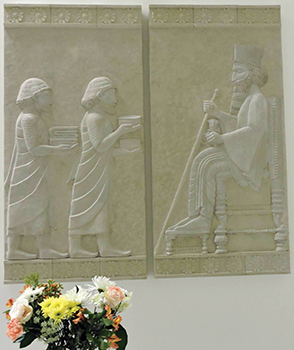
Persian relief engraved on the wall
Day four
A morning jashan was followed by the first ever boi at the Atash Kadeh, officiated by Houston Mobed Bomanshah Sanjana.
At a celebratory dinner that evening, Dastoor traced the Zoroastrian story from the mists of antiquity, noting that the current Prime Minister of India bears "a soft corner for Parsis.” Perhaps again with an eye to audiences in India, where a debate rages over the religious propriety of organ donation, he urged Parsis to stop balking at it. If it is okay to receive organs, he asked, why should it be un-Zoroastrian to gift them?
He was preceded by local dignitaries, including Congressman Al Green and the Consul General of India in Houston, Dr Anupam Ray. Each in his own way knew just what would thrill the crowd.
Ray was cheered lustily when he recited the honor roll of Indian Parsi luminaries — Field Marshal Sam Manekshaw, Jamsetji Tata, Dadabhai Naoroji, Dr Homi Bhabha. When cries of "Visas! Visas!” rose from the substantial contingent of Pakistani Zarathushtis present, he drew more cheers by vowing to sympathetically consider their applications for visas to travel to India.
Feroze Bhandara spoke. Bhandara is a builder and real estate developer. His business acumen and drive have earned him a seat at the table of the Houston power structure. He serves on public-safety and other boards. His late father owned Pakistan’s iconic Murree Brewery, now with extended family.
A compact, soft-spoken man, he exudes authority with a hint of shyness. He was laconic in his previous public remarks. Now he delivered an eloquent address.
"The spiritual need was particularly acute among the second and third generations, and the Atash Kadeh finally fulfills that need,” he said. He expressed understanding for the different ways in which Zarathushtis practice their faith elsewhere, but said they have to be "inclusive” to thrive in North America.
"Our younger generations are unable to reconcile Ushta (love) and Asha (truth) with some of the more exclusionary practices of tradition,” he said.
And Collector spoke. In a strong voice that belied the grave illness that has made him frail, he deflected the praise sent his way.
Really, others were more responsible, he said. He singled out a FEZANA white paper written by Roshan and Rohinton Rivetna (parents of architect Cyrus) for planting the atash kadeh idea in people’s minds.
Later, others insisted that Collector — for long a popular religion teacher — did not just inspire the Bhandaras but also was instrumental in winning the community’s backing for the project.
Day five
Dastoor led the parting event — an Avan parav nu jashan. His parting words to devotees were much like his opening remarks: Visit the Atash Kadeh frequently, contribute to its upkeep, treat it with respect, always cover your heads upon entering it.
"You light the holy lamp daily? You offer sandalwood and frankincense to the household fire as your religion prescribes?”
"Oh yes. We are a religious household.”
The Crow Eaters by Bapsi Sidhwa
As Khumbatta sees it, the old cultural center deserves some credit for the new Atash Kadeh.
"If we didn’t have the prayer hall (in the cultural center), we would not have felt the need for an atash kadeh,” she said. The small afarganyu in the prayer hall was not always lit. "How do you pray to an afarganyu that does not have a fire in it?”
According to Arnavaz Hoshang Sethna, when ZAH voted to approve changes in its bylaws to enable the Atash Kadeh, "the general feeling was that by the third generation, the connection with the old country will be lost, and with it will be the practice of our religion.
"A stand-alone building, giving the feeling of an agiary, would be really good for the future generations to continue our faith,” said Sethna, a paralegal and long-time activist whose family hosted prayer classes for years before the cultural center was built.
There was a cloak and dagger quality to that vote. Members were only told that an anonymous donor would fund the entire project on condition that admission to the Atash Kadeh would not be restricted to Zarathushtis, that it would be "inclusive.” The terms were approved by 87 percent of those voting, and the Bhandaras revealed themselves as the donors.
The careful orchestration of the vote perhaps was motivated by Houston’s previous reputation as a bastion of Parsi traditionalism in North America. The outcome of the vote suggests the character of the community has changed.
Even so, a small group yearns to preserve the exclusivist traditions and purity rituals their members grew up with in South Asia. This group continues to fan what seem to be faint hopes of building a rival place of worship on land it has acquired nearby.
But that did not keep one prominent traditionalist, Kaemerz Dotiwala, from attending the inaugural activities. He even joined the hardy few who sat vigil at the overnight recitation of the Vendidad, though this was the Vendidad Sadeh.
While the Atash Kadeh falls short in his mind for not having undergone the rigors of a traditional consecration, Dotiwala said, "I count the structure as a blessing because it brings people to our prayers and religion.”
Dotiwala, 69, who operates an environmental business and is a founding member of ZAH, noted that he continues to be a religion class teacher.
The impression a visitor got was that while there might be doctrinal fissures in the Houston group, as anywhere, there is no irreparable breach.
When there was a dispute over muktad prayers, for instance, the community found a compromise.
Percy Master, 51, a computer engineer whose term as Association secretary ended just prior to the Atash Kadeh’s inauguration, described the accommodation:
A traditionalist mobed who will not admit non-Zarathushtis to his muktad prayers rents a room in the center while a separate set of muktad prayers, with unrestricted entry, are said in the regular prayer room by another mobed. Afterward, Master said, everybody eats together in the lunch room.
The Toddywallas, the Bankwallas, Chaiwallas, Battliwallas, and Junglewallas vied with each other in making the visitors welcome. They were wafted from home to home for breakfast, brunch, lunch, tea, drinks and dinner.
The Crow Eaters by Bapsi Sidhwa
The Bhandaras’ largesse perhaps would not have been enough if Houston were not fertile soil for such a project.
ZAH counts about 400 members, including about 50 children, according to Master. More than one resident used the word "vibrant” to describe the community.
Scores of people put in volunteer efforts, some over years, to bring the Atash Kadeh to fruition. Before that was the construction of the cultural center, including multiple expansions. In 2020 Houston will be host to the North American Zoroastrian Congress, the second time it will host the periodic gathering.
Houston also has been host to a World Zoroastrian Congress, and numerous less high-profile events. The library regularly sponsors scholarly speakers.
Rohintan K. Deputy, 71, a retired Ford Motor Company executive, and his wife Mahrukh spent parts of multiple visits to Bombay to oversee the manufacture of the German Silver afarganyu, the bells to mark boi, and other implements that would be at the heart of the Atash Kadeh.
In Bombay "they had stopped making the traditional design” of afarganyu, Deputy said. A tip from the World Zoroastrian Organisation led him to the shop of Priti and Chandresh Soni. The couple relied on recollections of when Chandresh’s grandfather made traditional afarganyus.
The job of making sacred implements for Zarathushtis turned out to be inclusive in its own way, according to Deputy: "A Gujarati couple took the order; a Maharashtrian gentleman … provided the expertise in metal forming and shaping, and the work of forming and buffing was done by Muslim brothers.”
Aderbad Tamboli, 59, a software engineer and former ZAH president, became a Man for all Seasons, a de facto project manager. When Parsiana first encountered him, he was supervising the installation of a giant portrait of Zarathushtra. The glass portrait is placed so that sunlight streams through it.
The Narimans, Khushrav and Manek, hosted Parsiana during inaugural week. When one or the other of them was not driving to the Atash Kadeh site for some task, they were on the phone trying to resolve some matter concerning it.
Shernaz Bhandara could be seen scrubbing down the kebla walls or watering the lawn.
The day before guests would arrive, Yezdi Engineer stopped by the kebla to install a donation box he had crafted. Then for good measure he dropped some money in it, becoming the first donor to use the box.
Part of the hospitable social ecology might be attributed to the proximity of some who live here. While Houston is a sprawling metropolis, there are clusters of Zarathushtis in leafy suburban towns such as Sugar Land on the city’s periphery.
One Sugar Land resident counted about two dozen Zarathushti families "within bicycling distance” of each other. Feroze Bhandara walks to his sister’s home.
Zarathushtis are part of an unusually large presence of Indians, Pakistanis and other Asians in the Houston area, drawn by opportunities provided by the booming energy industry in this corner of Texas.
In Sugar Land, according to the 2010 census, Asians make up 35 percent of the 118,000 population, second only to whites, who are 44 percent. Nearly seven percent of Houston’s two million population is Asian, a percentage point greater than the national average.
And there appears to be an abundance of entrepreneurship among area Zarathushtis, which some credit with fueling the risk-taking essential to ambitious tasks.
A number of Houston Zarathushtis, such as Bhandara, operate their own businesses. There are accountants, consultants, software engineers, and so on.
And there is Cillie’s, a pastry and snack shop run by Naushad Mehta. One afternoon, half a dozen of his fellow Zarathushtis stood in line as Mehta put an order together, while another few nibbled at snacks and checked mobile phones at a table.
For a moment, a visitor from South Asia could imagine being back in Bombay or Karachi. And if you craved dar ni pori or batasas, Mehta would put you in touch with his mother, Shireen "Cillie” Mehta, who makes them to order.
In the end, Cyrus Rivetna told Parsiana, the Atash Kadeh will be considered a success only if people "activate” it.
The Houston Atash Kadeh is the second Zarathushti edifice designed by Rivetna to come to fruition. Dallas’ cultural center was the first. Rivetna, 47, has made it his mission to promote atash kadehs in North America, sacred spaces set apart from banquet halls and play rooms.
"Our next generation may never ever go to India, Pakistan or Iran. So, all they will know is what they experience here. If they come to a religious center and it is just a cultural hall, they are going to think that the religion is just food, drink and good conversation. And they can get that in other places.”
The Pakistan connection
Feroze Bhandara’s first stop upon emigrating to the United States was California. Some years later he was drawn to Houston, Texas. He was beckoned there by both new business opportunities and old friends he had known from back home in Pakistan.
The Houston area, over the years, has become a Pakistani Parsi stronghold unlike almost anywhere else in North America. Master provided this breakdown of its adult membership by national origin: 200 individuals with roots in India, 140 with links to Pakistan, and about 20 from Iran. He estimated there are about 50 more who are children.
Roshan Rivetna, who has conducted a seminal demographic study of the Zarathushti populations in North America, said her research did not track pockets of the community by national origin, but she couldn’t think of another location with such a large proportion of Zarathushtis from Pakistan.
Pakistan’s Zarathushti population was tiny to begin with compared with India’s. Bhandara estimates that nearly all Pakistani Zarathushtis — about 1,200 — are concentrated now in Karachi. Only about 20 reside in Lahore and 10 in Rawalpindi.
While demographic trends — deaths exceeding births — are to blame for the decline, so is emigration.
Master, who is from Bombay, shared a quip he hears from Pakistani Zarathushti friends: "There are two ways out, going to the West or going upstairs.”
Why Houston has become a favored forwarding address for many from Pakistan is a matter for conjecture. The reasons vary from person to person, though the economic opportunities in this energy hub surely are a big draw.
Dotiwala, from Karachi, was studying in Syracuse, N.Y., when he got an internship in Houston. He joked that he stayed because Houston’s warm and sometimes muggy climate reminded him of Karachi.
Bhandara says the Parsis of Lahore, his hometown, are especially close because they are so few. Everyone knows each other and in many cases is related to each other.
What is driving many Zarathushtis out of Pakistan may be easier to generalize: The political climate there is no longer as warm and friendly to minorities as it was in the early days of the nation even after the trauma of partition.
The turning point, according to Bhandara, came under the regime of Muhammad Zia-ul-Haq, the general who introduced a stern Islamization of the country’s political culture in the 1970s and 1980s.
Minorities began to feel like second-class citizens. A shock to Bhandara’s family business, the Murree Brewery, pre-dated Zia. Prime Minister Zulfikar Ali Bhutto, trying to burnish his Islamic bona fides, banned alcohol. The Brewery suddenly had to find alternative product lines. Then Zia deposed Bhutto and introduced even more draconian laws.
Bhandara’s older brother Minoo, who was operating the Brewery upon the death of their father, did reach a via media with the Zia regime. The Brewery was permitted to resume deliveries of alcoholic beverages to non-Muslims, and Minoo Bhandara, who has since died, for a time was even a minorities representative in parliament.
But the brothers agreed that Feroze’s future lay back in the US, where he had been a student.
"I cannot relate to Pakistan because that Islamic state’s constitution considers me a lesser person,” Feroze Bhandara says.
National origin, however, is not indicative of doctrinal leanings, Master says. "We have liberals and traditionals on both sides,” he said.
The writer is a veteran journalist in the United States.