The advent of spring symbolizes
the victory of good over evil
Davood N. Rahni
Legend has it that once in the distant past Zohak, a mythological, tyrannical, unjust, and cruel predator, ruled over Persia. His absolute power was further corrupted when Eblis (Satan) kissed his shoulders, from which spots emerged two human flesh eating serpents. These snakes demanded to be fed the flesh of a newlywed couple every day or else they would devour him!
Zohak crowned himself and ascended the Persian peacock throne, behaving as though he was immortal. He reigned with an iron fist and imposed heavy taxation over the vast Persian Empire to the detriment of the serfs and common people. His ever expanding territory stretched from the Indus and the Oxus rivers, to the Nile, Tigris and the Euphrates rivers.
Living in fear of the wrath and vengeance of the masses he had oppressed, Zohak suffered from chronic insomnia, anticipating that the populace would at any moment turn against him and bring about his demise. Self-sequestered, he chose to live in a pitch black, damp and malodorous dungeon on Mt Damavand, a volcano that roared and fumed at its fiery summit. As long as his lackeys fed his ugly serpents the freshly killed newlyweds each day, Zohak was spared. However, he was aware that the two serpents could devour him in a flash if they were not fed before midnight.
In fact, whispers of this spread among the masses, serfs and slaves who had taken refuge with Spenta Mainyu, the good spirit and emissary from Ahura Mazda, the Lord of light and wisdom and his sol invictus (unconquered sun) Mithra. Meanwhile, Zohak was under the spell of the impure fire and filth-spitting dragon Ezhdeha drawn from Angra Mainyu, also known as Eblis or Ahriman, who had grafted the serpents onto his shoulders to create misery, famine, disease, pain and suffering to people and to mother earth.
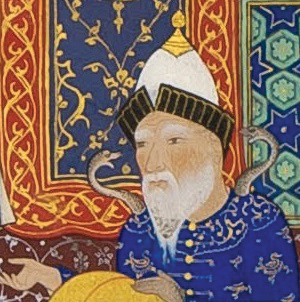
Zohak, the mythological predator Photo: Wikipedia
Injustice will not remain forever. Kaveh the ironsmith, gravely concerned about the well-being of his compatriots, hung his toughened leather apron, the Derafsh Kaviani, over a javelin. After the break of dawn on Yalda (the rebirth of the sun), marshaling his brave diehards, he led them up the treacherous mountain. Inside the cave, with his mighty sword Kaveh beheaded the three culprits in one body. He thus eradicated injustice and reinstated love, equality, inclusivity, harmony, tranquility and peace on earth. Kaveh had in reality repeated what his ancestors Cyrus and Darius, the Achemenids, had done. The much anticipated and ever brightening sun re-emerged out of the dark chilly clouds and shone like a beacon of hope and happiness on the hill. The soil was also purified right till the valley; fresh air spread out all around.
Ecstatic and exhilarated by this brief period of happiness, many did not realize that Ezhdeha, the dragon father of all miseries and the creator of the now vanquished Zohak, was still alive deep in the vertical volcanic shaft of Mt Damavand. The nocturnal dragon would appear unexpectedly in different communities and cause catastrophe by kissing the shoulders of a replacement for Zohak where two new serpents would sprout. Hushang, the newly selected king of the Pishdadian dynasty, followed Ezhdeha back into the cave where he threw a big flint rock at him, killing him. The flint bounced from the corpse and struck another rock. The resulting spark, which seeded a sacred eternal fire revered by all in the valley, still burns today. Hushang himself was slayed in the battle and was later replaced by King Jamshid Kiyani. Jamshid was crowned on Navroz, the spring equinox and the birth of Zarathushtra.
Everyone lived happily. But soon the people became complacent. The Ezhdeha, reincarnated with added heads, reappeared bringing about chaos through his despots, lackeys, charlatans and hooligans. So, Navroz celebrations became the most effective means, year after year, for people to ward off evil spirits, including the Zohaks and Ezhdehas, by sprinkling rue and frankincense over the holy fires. This yields a strongly pungent scent which repels the beasts.
This tale from the Shahnameh, as narrated by Ferdowsi Toosi, the Homer of Iran, retains its wisdom and relevance through tens of thousands of years of Iran’s history, bringing hope of salvation from evil through altruistic acts of courage. Shahnameh, the Book of Persian Kings, an epic poem comprising 30,000 verses and written over the course of 30 years over a thousand years ago, still remains alive in every Iranian’s psyche.
Ferdowsi’s patron King Mah-moud, who had promised the poet a golden coin for every verse, broke his promise. The impoverished Ferdowsi, having lived in the rich paradisi (paradise is the meaning of his name) style of his own imagination, never saw the coins sent by the repentant King; they arrived after the poet had died. The poet’s village is still called Fredows aka Pardis.
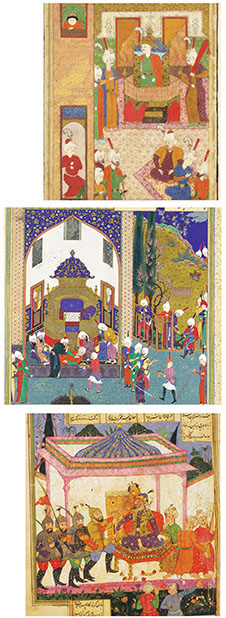
Persian paintings: (top) Zohak on the throne;
(middle) Zohak awakening in terror from
a nightmare at the birth of Faridoon;
(bottom): Faridoon defeats Zohak Photos: Wikipedia
Anchored securely in the triad of good thoughts, good words and good deeds, everyone reaffirms their commitment to these tenets by practicing the virtues of altruism, philanthropy, benevolence and, above all, to advancing humanism as the goal of life.
This belief brings to mind the Persian poem by the 13th century Sa’adi: "All humans are members of one frame, Since all at first, from the same essence, came. When by hard fortune one limb is oppressed, The other members lose their desired rest.If thou feel’st not for others’ misery,
A human is no name for thee!”
The Navroz holiday concludes with the Sizdah Bedar Picnic (at Bear Mountain State Park in New York), which falls on the 13th day, aka April fool’s day. Every family spends the entire day outdoors in parks, fields or orchards, where they play, sing, dance, eat and drink. Unmarried celebrants tie blades of grass into knots to wish for a soul mate; elders nostalgically compare the current Navroz with those past while remembering the deceased; and children look forward eagerly to many more Navroz celebrations to follow.
 Davood Rahni is a professor of chemistry at Pace University, New York. He has been published in science, environment, forensic and medicinal journals.