Dhun Baria’s life was like a Bollywood screenplay. Almost unbelievable. A professional qawwali singer; a fanatically devoted daughter; a crusader for reforming the Towers of Silence; a social activist adored by commercial sex workers; a philanthropist who nearly starved but donated lakhs to secular charity.
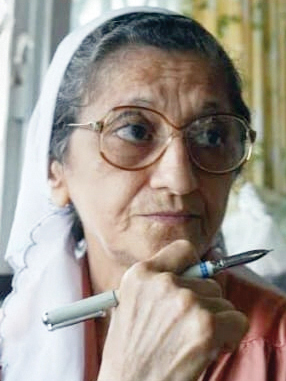
She was attempting the Hindi paper in the prelims before the Secondary School Certificate board exams, a subject in which she excelled among all students in the Parsi charity school, when the principal, grim faced, walked up to her and informed that her father Darabsha had died. She never attended school again. Poverty soon began to gnaw. The mother (Nargisbanu) and daughter contemplated relocating to Surat, their home town, and then dismissed the idea.
Blessed with a melodious, if slightly husky voice, she did odd jobs in the morning and learnt Urdu at night. Singing lessons followed. This was the era of qawwalis in Bombay, with Shakeela Bano Bhopali the undisputed queen of the genre. From taxi drivers to industrialists, Bhopali’s fans thronged the Birla Matoshree Sabhagar to enjoy her inimitable mannerisms; the kajal (kohl) oozing almond eyes darting in her rotund face, the pouting lips, the thrusting torso, the dismissive gestures and that seductive voice flirting with every person in the packed hall. Bhopali was impressed with Dhun’s talent and engaged her to be a part of the troupe.
But Dhun could not tolerate the intrigue and back biting in Bhopali’s troupe and decided to go solo. Of course, she did not have the maestro’s looks or talent. Guts and gusto, gumption and chutzpah she possessed in plenty. She adopted the stage name Mahajabeen (the most beautiful) and became the poor man’s Bhopali with a good fan following. Her performances were vigorous. Her personality capable of dealing with any challenges. If an inebriated fan tried to become personal, her bouncers would politely escort him to a corner where a few blows in the abdomen would make the amour go cold. The audience found her spunkiness a novelty. She did not think much of men and marriage.
A Parsi girl singing qawwali was still taboo. Scathing stares and lewd comments followed. She ignored them. Then one evening, a lout in the Parsi colony at Tardeo where she resided exceeded the limit. She was not the type to quietly sob at night. She walked up to him, extended her full five feet frame, and slapped him so hard across the temple that he fainted. After the slapping, not a whimper was heard. On another occasion, a mobed in the agiary was about to lecture her on the unZoroastrian act of qawwali singing; she put the prayer book aside and whispered a choice abuse. The priest scampered for cover.
The ageing Nargisbanu was the only love of her life. As wrinkles multiplied and Dhun became less lithe to be able to indulge in acrobatics like jumping off the stage into the frenzied audience, she retired to a quiet and intensely introverted life. And then, her mother died.
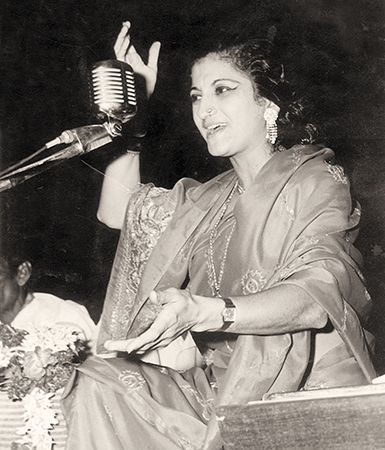
Dhun Baria (top and above), during her singing days
Four months after Nargisbanu’s body was consigned to the Towers of Silence at Doongerwadi, Dhun went to offer prayers near the dakhma on Fravardin mah and Fravardin roz, as many devout Parsis and Iranis (who also place cucumbers and melons there) do. She got a powerful stench. Casually, she asked a nassessalar whether there was any problem with disposal. The fellow laughed uproariously and said flippantly, "I can still identify your mother’s body.” Her anger and anguish knew no bounds. She was well connected with the staff who realized that she spoke the same language. They knew of her reputation as a firebrand. Assiduously, she went about collecting evidence, including a gut-wrenching visit inside the dakhma, when she saw her mother again.
Local television channels received a video tape. Even medical personnel could not bear to see the rotting bodies in varying stages of decay, with skin stuck to the inner walls of the central pit. A couple of channels displayed a few relatively less gruesome pictures. All hell broke loose. The establishment would neither deny nor comment. The fundamentalists were furious. They thought rich and influential reformists had used Dhun to raise the issue in public. The truth was otherwise.
Abusive phone calls followed. "We will bury you alive,” they threatened. She kept silent until a caller said something about her mother. In a cold and chilling voice, she told him, "I know your identity. I will personally emasculate you with a rusty knife, so that you are rendered incapable of having any further incestuous relations with your mother.” The roughneck had never heard such original abuse in Hindi from a senior Parsi woman. Somehow, he knew that she was not fibbing. The calls stopped.
In 2008, during the historic elections for the Bombay Parsi Punchayet (BPP) trustees, she went hammer and tongs at the orthodox camp. She attended and heckled them at election meetings, oblivious of the goons staring at her. "Touch me and I will get your candidate behind bars, I promise,” she said with a diabolic smile. One evening she created such a rumpus that they picked up her chair and carried her out of the hall as she treated the bemused audience to some exotic vocabulary from the by-lanes of Grant Road.
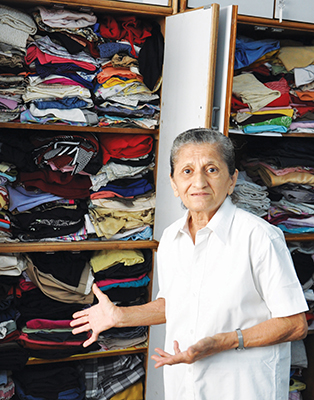
Baria at the office of the charity trust she founded
Thanks to her relentless campaign, the BPP administration reportedly increased the intensity of the solar panels (dehydrating bodies in three days with wisps of smoke emitting, except during the monsoon, of course). The interiors of the dakhmas are frequently cleaned and the remains buried. Dhun nearly wangled a separate prayer hall at Doongerwadi for those opting for cremation, the so-called cremate-ni-bungli, until the trustees characteristically reneged on their promise.
She founded and financed a charitable trust in her mother’s name for secular help to disadvantaged girl students so that they would not have to drop out from school like her; for children of commercial sex workers in Kamathipura, Bombay’s red light district; for AIDS awareness and medical help. She harangued municipal officers to provide her with premises to run computer classes for these children, spending hours every day, in the sweltering heat, using public transport. She lived a frugal life of bare subsistence; her substantial investments were channeled into providing succor to the poor and disabled, so that young girls would not be compelled to sing lewd qawwalis before lecherous audiences, but could blossom with dignity.
Contrary to popular belief, Dhun was not an agnostic. She prayed twice daily at home and frequented agiaries. On the afternoon of Sunday, October 2, 2022, her body was transported from The B. D. Petit Parsee General Hospital to the Worli Prayer Hall where two priests recited the geh sarna prayers. Present were a couple of Parsi neighbors, a professor of botany at a local college, a Gujarati gentleman, Ketan Patel, who had tended her for long, a lad who had braved Covid to serve her till the end, a young girl in white who assisted her in charity matters. The man gently nodded and pressed the switch. Unlike her mother, whose remains were undisposed for months in the dakhma, Dhun’s body slid effortlessly into the red hot electrical furnace and was reduced to ashes within minutes.