The Zoroastrian calendar even today is of significance to quite a few in the community. Though Parsi establishments which published the calendar have lessened, the demand still remains. But all may not be aware of the controversies the community calendars once generated. Some 200 odd years ago, Parsis rioted, murdered, assaulted, and even faced the gallows, over the calendars.
Intercalation is the insertion of an "extra leap day” every four years. This is the reason why there is a difference of one day for every four years between our English and Parsi birthdays. Parsi refugees in India added a "leap day” every four years. However, in Iran, they added a "leap month” of 30 days, every 120 years. Not so surprisingly, this practice fell into disuse.
In 1720, one Irani priest named Velati visited Surat, where this genius, and his equally brilliant hosts, ultraorthodox mobeds of Surat, bored perhaps in the sultry afternoon, were shocked to learn that the Indian and Irani calendars differed by one month. Iran was regarded as the bastion of orthodoxy by these mobeds. So, obviously, the Parsis had to be wrong and must immediately correct their so-called Shahenshahi (imperial) calendar. The equally agitated Shahenshahis told the Suratis to go jump into the nearby Tapti River. On June 6, 1745, the Surat Parsis fired the first salvo by formally adopting the Iranian calendar, calling it "Quadimi” (ancient), or popularly, "Kadmi.”
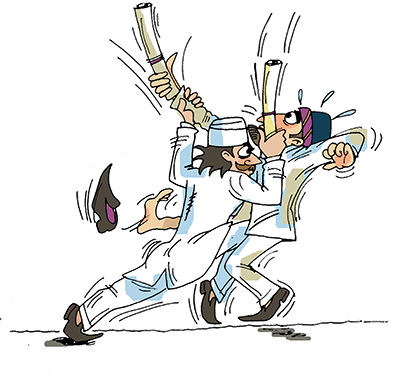
Illustration by Farzana Cooper
Heresy. Blasphemy. Sacrilege. The Shahenshahis, who were in an overwhelming majority, bristled with anger. Kadmis, though in a hopeless minority, were rich and well connected. The Dadyseth, Banaji, Cama and Vatcha families were Kadmi. In 1767, a Bharuch priest was sent to Iran to study intercalation for 12 long years. Upon his return he became the High Priest of the first Kadmi Atash Behram in Bombay — the Dadysett. His son, Mulla Feroze, was the tallest Kadmi theological leader who mentored Mobed Furdoonjee Murzbanjee, founder of the Mumbai Samachar (1822). Murzbanjee, a devout Kadmi, published the vituperative "calendar” debates in his newspaper. Initially he gave fair space to both opposing sides. However, later, he declined publishing some inflammatory articles from the Shahenshahi side.
The calendar controversy reached its climax by 1826-1827. The miffed majority started their own mouthpiece, Akhbar-é-Kabis (calendar newspaper) which castigated the Kadmis. English newspapers like the Bombay Courier and the Bombay Gazette, joined the fray. Dirty linen was washed in the mainstream media. Sounds familiar, doesn’t it? However, the Mumbai Samachar enjoyed such credibility that the Shahenshahis began to threaten Murzbanjee with dire personal consequences if he did not publish their views in his newspaper. In a much quoted reply, Murzbanjee, an ordained priest, displayed the padaan (mouthguard of the mobeds) and said, "Threaten me not. Even if you ruin me, God has given me this padaan, to earn my daily bread.”
In 1830, the wheels of fate turned adverse for this enterprising but mercurial editor. The Shahenshahis hatched an economic conspiracy to pressure him. In the same year, Murzbanjee lost his guru, Mulla Feroze; as also a ship trading with China on the high seas. His assets were sold by his creditors. Finally, to escape civil prison as an insolvent judgment debtor, he fled to the Portuguese territory of Daman where he died heartbroken. He was 59.
The calendar controversy did not limit itself to verbal warfare. And it was not restricted to just giving opponents a black eye. Several were murdered, assaulted, maimed. In 1846, a mobed named Jamshed Deo knifed Furdoonjee’s eldest son, Kavasji, causing serious injury. For decades, marriages between members of the two sects became taboo. Bharuch and Surat were Kadmi strongholds.
Jamshed Zaahia, a Shahenshahi weaver in Bharuch, who wrote poetry in his spare time, rose to prominence. He sponsored an agiary on Palia Street in Surat, which bears his name. His son was a kind, well liked man.
A pregnant Kadmi lady complained that Jamshed’s son, Homa, had kicked her in the abdomen, resulting in a miscarriage. A trial ensued before the Nawab of Bharuch, and subsequently, before a British Court in Bombay. The accused pleaded not guilty and contended that he was an unfortunate victim of the calendar controversy. One Wadia testified as an eye-witness against the accused. The latter was sentenced to hang from the neck until he died. The sentence was executed in a corner of Bazargate Street in the Fort, where today a major fire brigade station is situated. According to the Shahenshahi calendar, the day of his hanging was roz Govad, mah Dae.
Minutes before his public hanging, Homa proclaimed his innocence and solemnly predicted that the false witness and the complainant would die on the fourth day after his death (the chahrum — when mourning Parsis cease to be vegetarian). His prediction reportedly came true. Overnight, Homa Jamshed became a patron saint for the victims of false accusations. Behdin Homa, Behdin Jamshed is remembered till this day by devout Parsis. His death anniversary is marked by a baj offered at agiaries. The cynical may, of course, question whether Homa’s episode has been whitewashed over the years by the Shahenshahis who reportedly constituted 90% of the community in the 1970s.
To distinguish themselves, Kadmi priests recite some prayers with slight differences in pronunciation. Some rituals too are different. Most Parsis are oblivious of this distinction. Our good friend, the late Muncherji Cama of Mumbai Samachar, as a boy of 10, in Bharda New High School was always asking fellow Parsis whether they were Shahenshahis or Kadmis; he received blank looks. By then, Kadmis were already country cousins who read their prayers from a Kadmi version of the Khordeh Avesta.
The irony behind this controversy was that both sides had erroneous calendars. The Iranis forgot to add 30 days after every 120 years; and before you think of any adjectives, the Parsis in India too, after a while, forgot to add one "leap day” every four years. Hence, when the genius Velati made his Eureka discovery, both the calendars were incorrect.
In 1906, a third calendar, the Fasli (harvest) one, was adopted by some progressive souls; and the Faslis became the third sect of the minuscule Parsi community, with March 21, the day of the vernal equinox as their New Year.
The Faslis established their own agiary and were broadly liberal in their socioreligious outlook.
Fifty thousand Parsis. Three calendars. Many lives ruined, injured, dead, all for nothing. When Parsis faithfully hang up the calendar each New Year, few are aware of the past controversy or the blood that was shed.
Berjis Desai, lawyer and author of Oh! Those Parsis, and recently Towers of Silence, is a chronicler of the community.