Entrepreneurship goes beyong making money, stressed three speakers at the World Zarathushti Chamber of Commerce meet in Orlando
Text: Parinaz M. Gandhi Photos: Jasmine D. Driver
"Not every problem has a solution. We have to learn to navigate through a problem,” remarked movement therapist Dilshad Patel at the interactive session on dance/movement. The two-day program planned by the World Zarathushti Chamber of Commerce (WZCC) had scheduled sessions and talks preceding and following the global annual general meeting hosted by the Central Florida Chapter at Marriott’s Residence Inn in Orlando on May 1 and 2, 2019. Patel was among the three speakers who addressed the members on the first day, the other two being Diana Bharucha who conducted a session on social entrepreneurship and Dr Rashna Writer who spoke on "Predicting the Zarathushti Entrepreneurship Future by Creating it.”
Currently pursuing her Masters in Exercise Physiology from the University of Houston- Clear Lake, Patel’s earlier partnership with Rhythm-India resulted in her creating training programs through which she endeavors to spread the joy of movement, exercise and dance. Her Movement Therapy for Sports has touched international players in the fields of cricket, golf and gymnastics, and her Movement for Healthcare reaches out to patients seeking psychological and physical well-being.
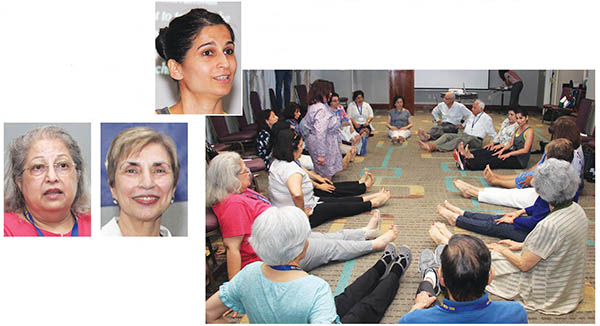
Inset and above: Dilshad Patel conducts an interactive session;
Diana Bharucha (l) and Dr Rashna Writer
The average age of her audience at the WZCC session being over 60, she asked them their reasons for attending the workshop. Whilst some were hoping to learn a few dance steps and others wanted to exercise to get their neurons working or for better body-mind coordination, there were a few who complained of having difficulty whilst walking at length or getting out of breath.
Sitting is now the new smoking, she reminded the audience, urging them to keep moving. The body is a postural container of thoughts and emotions resulting in actions, she stated to emphasize the importance of intent or thought that attracts situations and determines who you are and what you become. Manifestations of stress, trauma, depression can be controlled with movement. Instead of the rounded shoulders and pelvic thrust associated with depression, by consciously straightening the neck and shoulders, monitoring the flow of breath and resorting to therapeutic movements, one’s condition could improve, she believed.
At different points in her session she encouraged the participants to express themselves through movements of their choice. When mirroring the movements of different individuals she conveyed her empathy and willingness to share their individual experience. Therapy implies analyzing the nuts and and bolts of behavior to repair or build afresh, she noted.
In the last few minutes of her session, she taught a few Bollywood dance movements which the participants enthusiastically tried to replicate. Since some in the audience were thirsting for more time with Patel, one more morning session with her was organized on May 3.
Remarkable relief
At her session, Bharucha of Bangalore outlined the activities of Kinder Trust founded by her. An activist for social causes, through this Trust, Bharucha helps those who are less fortunate, physically or mentally challenged, abandoned or destitute women and other patients. Their flood relief operations in collaboration with the WZO (World Zoroastrian Organisation)Trust assisted 1,800 families including two senior Zoroastrian women in the Kerala-Kodaga area and even saved a village from a rat fever epidemic by timely distribution of essential medication.
A qualified fashion designer, running a clothing and garment export business, she simultaneously ran a photo studio, chocolate manufacturing unit and chocolate shop, and a homestay in Coonoor until community welfare projects took precedence over everything else. "WZCC is one of the best things that happened to Kinder Trust. The bonhomie that we share is marvellous,” declared Bharucha, referring to the "strong support” she gained at the WZCC global meet in Bangalore in 2017. Teenpreneurs, an idea that germinated from a garage sale, was a "total sellout.” The children and grandchildren of the WZCC Bangalore Chapter members managed the sale of books, household items, games, jewelry and food during the evening at Kothari Hall. This was intended to give them confidence if they choose to initiate their own business ventures in the future.
Through her audiovisual presentation Bharucha outlined the projects undertaken by Kinder Trust in the remote areas of the Nilgiris. "Off to School” provides transport to children with special needs scattered in different localities. Additionally, medical assistance is offered through specially conducted camps for cancer, dental needs, prosthetic requirements…
Their efforts to protect the environment has led them to support a young Parsi entrepreneur who is producing solar lamps. Rehabilitation programs involve women in tailoring, book binding and bee keeping.
Whilst they have been able to identify volunteers, to centralize and coordinate all their activities from one area, they are currently raising funds to purchase and establish their own center. A fund-raising program was planned with the assistance of Feroza Jassawala of Delhi. "Don’t expect anything from the government,” she has learnt, appreciating that "sometimes funds come from the most unexpected quarters.” Appealing to members and friends for donations, she shared her email contact: dianabharucha@gmail.com
Economic ethics
"As a life-affirming faith, Zoroas-trianism’s economic ethics expects its adherents to lead a life whereby victory of good is promoted” through self-reliance and self-generated business, remarked Writer, a political scientist and analyst based in France, in her evening talk that generated questions from the audience. A senior teaching fellow at the School of Oriental and African Studies where she lectured on Zoroastrianism in the ancient and modern worlds, she is author of The Reshaping of Iran from Zoroastrian to Muslim and has lectured on ancient Iranian history in the UK, USA and the Indian subcontinent.
Referring to different definitions of entrepreneurship that involve taking risks and calculated chances, she stressed that "entrepreneurship is a mindset way before it is a business...
"Zoroastrians from time immemorial have generated wealth for the common good.” Zoroastrians were known to trade with China since the time of the Parthian rulers (247 BC-224 AD). The Sassanid (224-651 AD) merchants were familiar with branding products to indicate quality control. Coming down to the Qajar dynasty (1789-1925), she referred to Jamshid Jamshidian (1851-1933) who has been given credit for introducing the idea of modern banking in Iran.
"We have a proud history of good, honest entrepreneurship,” she declared whilst admitting that the community needs to "accept collective guilt for our part in the opium trade… Our reputation for honesty and reliability is based on our everyday life, on Zoroastrian ethos… We were a welcome addition to the Indian population… to the British Raj. As an honest, prosperous community we contributed to Indian wealth… The community was canny enough to turn into a predominant economic power.” The seed capital for the early enterprises came from the families of entrepreneurs. The Camas, Jejeebhoys, Tatas… all started trusts. (They reflected) a willingness to grasp and create opportunities as they arose and a sense of collective community spirit…
"We need to re-educate ourselves on what makes us distinctively Zoroastrian, explain to the host population who we are and establish credentials in our new home,” Writer addressed those who have settled in America, Europe, Central Asia and are "still in the process of establishing themselves in regions where very few have heard of Zoroastrians and may be even unable to pronounce the word.
"As a Zoroastrian fraternity we should be linked beyond geographical boundaries as an intrinsically innate network… Geography and geopolitics have a greater bandwidth within which Zoroastrians must operate…” Happy that WZCC is beginning to look into the future with long-term plans, she added that these programs should be globally available. "It is one thing to initiate a program and another thing to have the long-term stamina for such projects.” Advocating the need to invest in education, she recommended, "Wherever there is Zoroastrian talent, we should underwrite it...
"Those of us who succeed and create wealth must put some aside to assist those who are not as successful… We should aim to be more than wealth creators… Create opportunities where there are none… Our youth must be trained in adaptability.”
When the editor of FEZANA Journal Dr Dolly Dastoor lamented that "our youth do not identify themselves with the religion,” Writer explained that Zoroastrians from Iran who progressively migrated to India remained distinctively Zoroastrian as there were certain factors that allowed them to do so. Faulting parents and grandparents for having forgotten to impress historical facts on their children, she commented, "India is where we survived. Now the center of gravity has moved to North America… To remain recognizable Zoroastrians you have to take responsibility and move forward… The pride of being Zoroastrian is innate in us… We are too small in numbers to be fractured as Parsis and Iranis. We see (the two) coming together in a neutral territory.”
Rustom Engineer of Houston admitted, "In our 20s and 30s we were not focused on our community as we are now.” He pointed out that once the youth become parents their priorities change and they identify with the religion and community. Firoze Bhandara who gifted the atash kadeh to the Zoroastrians in Houston explained that he tried to provide a physical foundation "to bring meaningful spirituality to the second and third generation.”
A report on the five speeches made on the second day will be carried in a forthcoming issue of Parsiana.