The Jasame Avanghe Mazda prayer, recited as part of the kusti ritual, states: mazishtacha , vahishtacha, sraeshtacha, ya ahurish zarathushtrish — the religion given by Ahura Mazda to Zarathushtra is the greatest, best and the most excellent. A practicing Zoroastrian therefore has no reason to dabble in other faiths. Apostasy of thought is most abhorrent to Zoroastrianism. The ultra-orthodox Khshnoomists, the esoteric interpreters of Zoroastrianism, go far beyond and assert that all souls born to Parsi parents belong to the exalted barjisi jiram or the Jupiterian stock and have made a pact only to adhere to Zoroastrianism and harbor no other religious belief. Hence, extra-religious worship is a material breach of this sacred pact.
Zarathushtra decried the paganism then prevailing which worshipped daevas, alleged to be malevolent and hostile, somewhat like the Scythian gods, and asserted that there was only one God, Ahura Mazda. The Gathas, containing the original teachings of the Prophet, assert that these daevas are to be rejected as false gods who deviated from the moral and ethical teachings of Zoroastrianism.
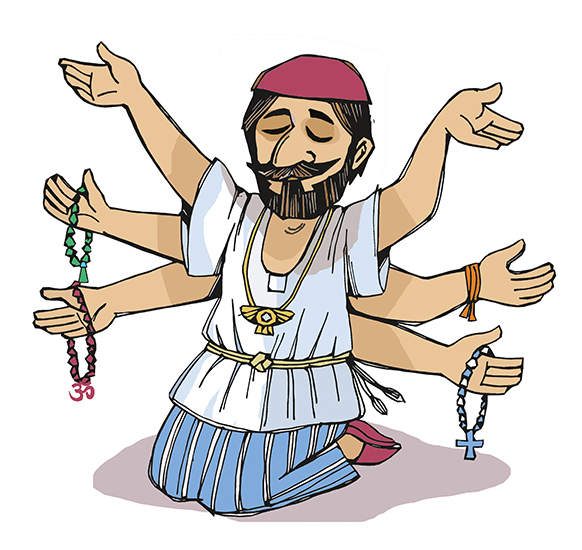
Illustration by Farzana Cooper
According to the mainstream orthodox scholars, Ahura Mazda is indeed the only God but strangely he is not omnipotent or supreme; this is to explain why there is evil despite the presence of a supreme God. According to these scholars, there is a constant conflict between Mazda representing the forces of good against the daevas of evil; a rather elegant way of shirking responsibility for the continuing failure to conquer evil.
The ultra-orthodox Khshnoomists violently disagree with this position. According to them, Ahura Mazda is indeed omnipotent and supreme; evil is to be explained in accordance with the twin principles of karma and reincarnation. Thus unstinted loyalty to Ahura Mazda is a fundamental tenet of the faith; and hence worshipping any other God or faith is heresy.
This proposition was sanctified and legally enforced, as Zoroastrianism was the state religion of Iran for several centuries. However, this feeling of exclusivity was dramatically dissipated with the fall of the Sasanian Empire in 651 AD, with the Arabs becoming the rulers of Persia. In the persecution that followed, the new reality no longer permitted the assertion of such religious supremacy. Also, the belief in the myth of such supremacy was rudely shaken. Solace and relief had to be sought from more efficacious alternative sources. This was the beginning of extra-religious worship.
The Zoroastrian refugees, immigrants/businesspeople were exposed in a dramatic fashion to the great Indian melting pot of so many religious rites, rituals and beliefs. Most were soon ensnared by these. Even the practicing Zoroastrians supplemented their beliefs with adherence to the socioreligious rites and customs of both Islam and Hinduism. When the zealously converting Portuguese landed on Indian shores around 1620 AD, followed by the French and English, Christian practices — attending Sunday mass, taking communion, wearing a cross were adopted by some Parsis. Competition had thus arrived.
The most orthodox of the priestly families in Navsari saw nothing wrong in such extra-religious worship. Upon the birth of a child, a horoscope was prepared according to the principles of Vedic astrology. It was only a matter of time before the planets that presided over these horoscopes came to be propitiated and worshipped. Fasting on certain days, a practice frowned upon by Zoroastrianism, became common in order to make these celestial beings happy. Amulets, blessed by Muslim pirs (holy men) came to be worn, if not conspicuously around the neck, then tucked surreptitiously under the pillow. The Lal Vaids, shamans practicing medicine and clad entirely in red clothes, who carried out occult and tantric rites before funeral pyres, were invariably consulted by Parsi households in Gujarat. Of course, there was also that rare spiritually advanced Zoroastrian priest who cured maladies by reciting the Avesta mantras.
Parsi children were forbidden to step out on the moonless night of Kali Chaudas when these tantric practices were reportedly at a crescendo; or from walking under trees on the outskirts of the town after sunset, as it was considered an invitation to being possessed by the disembodied poltergeists (mischievous ghosts) loitering aimlessly there. Exorcists, both in Hindu Kali temples and Muslim dargahs (shrines), having a Parsi clientele became commonplace. Hepatitis and sunstroke were cured by reciting non-Zoroastrian mantras and following certain magical practices (this columnist can vouch for their efficacy). The once outlawed daevas began to be fervently worshipped, and how!
After coming to India, Parsi weddings came to be performed in accordance with Hindu rites and customs. Women covered the vulnerable third eye, between the eyebrows, with the mark of red vermillion, just like their Hindu counterparts. Their attire and way of life began to be continually influenced by other faiths. Extra-religious worship became endemic. Even the supposedly hardcore orthodox Parsi families did it on the sly.
Such extra-religious worship was not a substitute for Zoroastrian prayers and rituals, which simultaneously thrived. This was the reason why neither the priests nor the authorities like the punchayet cared much about these practices. It was only at the turn of the last century that the orthodox, perhaps feeling increasingly nervous at the accelerating marginalization of Zoroastrianism, began to spew venom and fire against their co-religionists who strayed outside the faith. The spiritual vibrations of our prayers are sufficiently potent, they argued. More efficacious results can be achieved through Zoroastrian prayers rather than by turning to the rites and customs of other religions.
However, the element of magic and color was reportedly missing. Hence these appeals probably fell on deaf ears. That is until one nondescript village Parsi who had studied up to the fourth grade in the Gujarati medium, raised a battle cry against the blasphemous extra-religious worship which, he said, led to the eternal damnation of our pact, violating Jupiterian souls. He would successfully manage to fan many bizarre controversies. To be continued
Berjis Desai, lawyer and author of Oh! Those Parsis, and recently Towers of Silence, is a chronicler of the community.