The World Zoroastrian Organisation Trusts
are working for the welfare of the south Gujarat
city and surrounding areas
Farrokh Jijina
Vansda as a name has a collective memory for the community. The geographical area was the scene of some 77 controversial navjotes that created a rumpus in the 1940s. Reverberations are heard even today. "Vansda na chhé (They are from Vansda)” is a pejorative, hinting that the person being spoken of is the progeny of one of the navjotees, allegedly the offspring of Parsi males who cohabited with local tribal women. The term is also used to describe those who are of a darker complexion. But the area, located in Navsari district, is a fertile ground for sourcing workers for agiaries and doongerwadis in major cities. The only other geographic area associated with 11 "juddin” navjotes is Mazgaon where in 1882 mostly dockworkers were initiated into the faith by Dasturs Kekhushroo JamaspAsa and Jamshed Kukadaru.
So, when the World Zoroastrian Organisation Trusts (WZOT) chairman Dinshaw Tamboly invited Parsiana to view firsthand the welfare work being done in Vansda and other nearby villages and towns, it was a tempting offer. An all male entourage set off in a bus on a 225 km round trip from Navsari to Vansda on September 11, 2022. The group comprised Tamboly, WZOT trustees Farokh Kasad, Aspi Ambapardiwala, Cyrus Vandriwala and Rohinton Contractor, WZOT chief executive officer Yazdi Randelia and Sarosh Daruwalla of Mazda Multimedia who is shooting a film on WZOT’s efforts. A previous visit by Tamboly and Parsiana in 2018 had focused on the Trust’s development efforts around Dadra and Nagar Haveli near Sanjan (see "Fulfilling promises,” Parsiana, January 21, 2019). The focus of the current visit was on the assistance extended to "small businesses and entrepreneurs,” explained Tamboly. The proposed route took us through Vansda and Ahwa talukas (administrative units, smaller than districts) of South Gujarat.
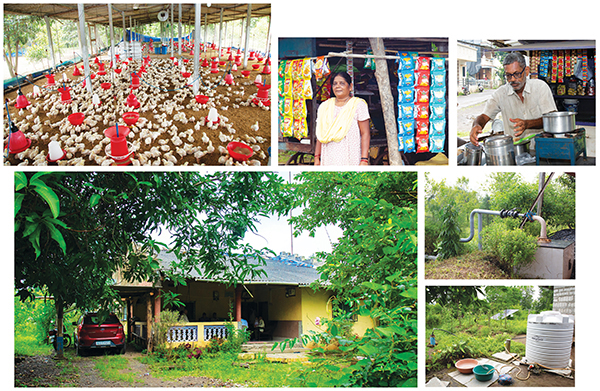
Clockwise, from 1st row, l, Parvez Jivasa’s chicken farm in Choravni; Jasoo Jivasa of Waghai selling knickknacks;
Behram Jivasa’s tea stall in Waghai; utilities provided by World Zoroastrian Organisation Trusts;
refurbished home for the Tangris of Sadad Devi
The Parsis of Sadad Devi
Thirty-nine-year-old Gustad Tangri who lives in Sadad Devi village of Vansda taluka opened a photo studio with WZOT’s assistance in nearby Waghai town a few years ago. His family comprising father Jamshed, mother Alice, wife Shehnaz and daughters Binaisha and Khushnuma is one of the three Parsi families in the village of 321 (2011 census). With the advent of mobile photography, his studio is languishing. "Bau kaam nathi aavtu (Very little work is coming in),” he tells us. People give wedding photography a low priority. He says he has to make much effort to recover costs. The family has had to fall back on agriculture for sustenance. Kasad, an agriculturist and a WZOT trustee for over two decades, advises the Tangris on what they should do. Hand on Jamshed’s shoulder, Tamboly asks him if he is comfortable financially. The senior citizen declines help. "Tamaro bau aabhaar (Thank you so much),” Jamshed and Alice tell the trustees with folded hands. Tamboly narrates how diligently Alice looked after her ailing mother-in-law before they had a pucca (permanent) house built by WZOT. The senior lady was disabled and had to be carried out from the house to take in the sun in the small compound. The Tangris now live in a pucca structure, courtesy Alex Burns, executor of the estate of Dennis William Richards, a UK-based donor who, having heard about the Trusts from a Parsi friend, left them GBP 100,000 (nine million rupees) in his will. "We could build 13 houses,” Tamboly noted. "Chaa pidha vagar no javaay (You cannot go without having tea),” insisted Alice.
The route to Kevdi village is no different from a hundred others in rural Gujarat — some greenery because of the rains, some thatched huts, some children herding cattle. Mani Avari and Jaru Tangri of Kevdi, also in Vansda taluka are sisters-in-law who cannot see eye to eye. A brief stopover at Jaru’s cottage, the otla embellished with an overpowering Asho Farohar, leads to an invitation from Avari to stop by at her cottage next door too. "They had no fresh water… We provided a borewell after building their houses… Since they do not get along, we had to provide two separate connections,” Ambapardiwala pointed out. WZOT also provided solar panels for heating, again separately. Avari and Jaru speak Gujarati in an accent very different from that of Bombay’s Parsis.
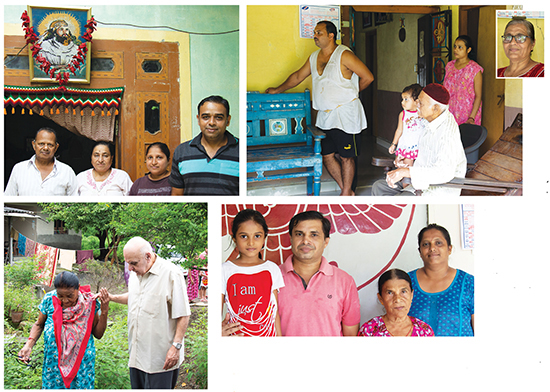
Clockwise from top l: Dali, Kashmira, Yasmeen and Parvez Jivasa of Choravni; Gustad, Binaisha,
Jamshed and Shehnaz Tangri of Sadad Devi, inset: Alice Tangri; Roshan, Jaru, Cyrus and Karishma
Tangri of Kevdi village; Dinshaw Tamboly with Mani Avari, Kevdi village
Parsiana queried Tamboly on how WZOT ascertains their beneficiaries are Parsis. "The answer, dear Watson, is obvious… Each and every family has some member or other who works in our agiaries, atash behrams, doongerwadis… If they are good enough to work at these institutions, they are good enough for our charities,” he said.
The rural housing project of WZOT has converted 315 homes for families like the Tangris into pucca cottages since the inception of the project in 2001. Two new homes were constructed and assistance was provide for renovations to seven in 2021-22, informed Randelia. A maximum of five lakh rupees is provided for each dwelling, with basic stipulations for flooring and material to be used. "We leave the internal design and layout to the beneficiaries,” stated Ambapardiwala.
WZOT comprises three trusts formed between 1991 and 1995: The World Zoroastrian Organisation Trust, The WZO Trust for Women and Children and The WZO Trust Funds that are "focused on providing support to Zoroastrians living in India in diverse areas of human need,” notes their brochure.
"It is (my wife) Bachi’s and my responsibility to leave a strong and efficient succession team to continue steering the three WZO Trusts onwards and upwards,” stated Dinshaw. Trustee "Homiyar Madan has been designated the managing trustee for Bombay and Ambapardiwala for Navsari.”
The occasional car
An hour’s drive away in Choravni village, Dali Jivasa has been diagnosed with kidney failure and is unable to run his flour mill. "Kétlo kharcho thaayéch dialysis par (How much do you spend on dialysis)?” Dinshaw asked the senior citizen who has worked in the Navsari Atash Behram in the past and occasionally in Bombay agiaries. A special allowance that covers the transportation cost to the dialysis center is sanctioned, with paperwork to follow. The cost of Jivasa’s renal treatment is covered under a government welfare scheme. Jivasa makes an appeal for a new roof for his cottage. For that, he would have to make out a case and complete the necessary paper work, Dinshaw told him.
Over lunch, carefully carried from Navsari, eaten on the otla of the Jivasa home, Dinshaw narrates how he and his relative were allegedly attacked by local adivasis who were not happy about their prosperity after WZOT built them a pucca house in 2007. Their abode was reportedly attacked and in the skirmish, Dali’s wife Kashmira was said to have received a black eye. After asking about their two grandsons, who are studying in classes 11 and 12 in Bombay’s The Byramjee Jeejeebhoy Parsee Charitable Institution, he ribs them about the shenanigans of young boys at the Gamadia Hostel in Bombay, where the students stay.
Dali and Kashmira’s son Parvez has opened a poultry farm a short distance from their home with help from WZOT’s self-employment scheme. The 7,000 chicks that he is breeding on two sides of a cul-de-sac that ends in a utility shed will be ready for the market in a few weeks, Parvez stated proudly. "Aapré sukhi chhaiyé (We are content).” From the profits of the poultry business Parvez purchased a car which he plies as a taxi for the locals. Dinshaw observes that he is gratified to see the occasional car parked outside the homes of some beneficiaries when he goes on his rounds of the villages. "It is good to see progress…first they upgrade from cycles to motorcycles and then onwards to cars, sometimes even new ones.”
Nearly 20% of the 128 locations in which WZOT has supported self-employment are in Vansda. Parvez is one of 1,215 community members WZOT has assisted across these rural and urban areas towards being self-employed in professions and businesses of their choice. Ever since the project was introduced in 1995, interest free loans of Rs 22.26 crores have been given, noted Randelia. Defaults are few and far between, confirms Dinshaw.
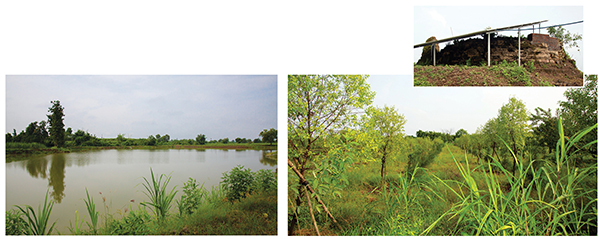
1st row, from l: Shehan Bajina’s fisheries project in Mahuva; plantation at doongerwadi (inset: defunct dakhma);
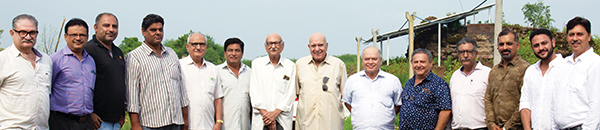
2nd row, from l: Yazdi Randelia, Cyrus Vandriwala, Eric Bacha, Cowas Besania, Rohinton Mogal, Maneck Mogal,
Dr Hoshang Mogal, Tamboly, Farokh Kasad, Hosi Bajina, Aspi Ambapardiwala,
Firdosh Bacha, Shehan Bajina, Rohinton Contractor
The route to Waghai is through a thick forest. We pass alongside and cross over one of the few remaining narrow gauge train tracks in the country that connects Waghai to Bilimora Junction in a three-hour ride. The line was built to transport wood from the forests in Dang district to Bilimora and onwards, narrated Dinshaw. Waghai town is perhaps the only area in the vicinity where they do not support any agriculturists, noted Kasad. Their beneficiaries are all petty traders. We meet Jasoo Jivasa who, with her husband Minoo, runs a stall selling knickknacks, sweets and biscuits outside a school. "We encouraged them to set up the stall here at the crossroads to avail of the student clientele,” stated the trustees. Across the road, Minoo’s brother Behram runs a teashop. Sitting on benches in the tarpaulin covered shop, there is much good natured jesting for Behram, making comparisons to Prime Minister Narendra Modi’s rise from being a chaiwalla (tea seller). The trustees’ intimate knowledge of the families of their beneficiaries is evident in their inquiry of the school studies of Minoo’s seven-year-old or so grandson.
Mahuva is a 30-minute drive away from Navsari. The Mahuva anjuman has repurposed its 14 acres of doongerwadi land into plantations. Hosi Bajina and his co trustees at the anjuman are proud of the 1,000 bawal trees and 700 sandalwood trees that they say will yield returns "in a few years.” Until then, the land between the trees is used to grow sugarcane and earn revenue. WZOT has provided the anjuman with Rs 47 lakhs (USD 57,038) of the total project cost of one crore rupees (USD 121,358). Dinshaw stated that he is appreciative of the transparency and integrity of the anjuman trustees.
Bajina’s son Shehan is a beneficiary of WZOT’s entrepreneurship project. He has availed of a loan for a fisheries project, located a short drive away from the wood plantation. He shows us around, explaining the nitty-gritties of the business, how the fish are fed and how they are kept healthy. "It feels good when the second generation wants to stay close to their land,” stated Dinshaw.
"Quite a few of the beneficiaries have done well… others are still on the bottom rung of the ladder… We have many more miles to go,” noted Dinshaw.
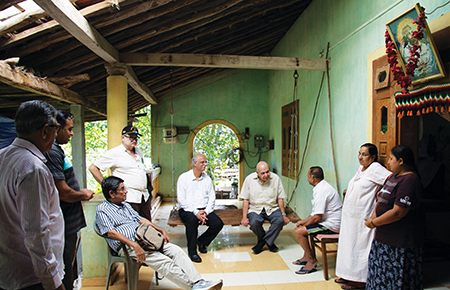
Catching up at the home of Dali Jivasa
Family home of the Tangris of Sadad Devi before rebuilding
A supportive royal
Established in 1781, Vansda was a princely state in British India. Scion of the ruling family, the late "Digveerendrasinhji Solanki was a friend of WZOT… he was keenly interested in the farmers’ rehabilitation project and had accompanied our team on a number of visits to the villages in and around Vansda,” recalled Dinshaw. Solanki affectionately referred to Zoroastrians residing in the villages as his praja (subjects) and knew of them by name as well as the villages in which they lived. "When he learned of the plight of Zoroastrian families and tribals living in and around the village of Sadad Devi at times being affected by panthers devouring their pets and fowls, he, upon our request, raised wild pigs in a section of his palace grounds. These were later released in the forest, whereby the danger to the pets and fowls of the locals was greatly reduced,” stated Dinshaw. "Digveerendrasinhji was a generous host whose hospitality our team made use of at his palace (Digveer Nivas) from time to time to refresh ourselves on our way back to Navsari after a long and tiring day trip to the villages.” The generous ex-royal passed away in 2018.
Solanki’s son (and grandson of Indrasinhji) Jayveerendrasinhji told Parsiana on September 26 that the first agricultural graduate from Vansda state was a Parsi, Fardoonji Patrawala. An agriculturist, Jayveerendrasinhji stated that farming is no longer lucrative for the Zoroastrians residing there. "Holdings are small…most of them have shifted out now to Navsari, Surat and Bombay and other places,” he noted.
Vansda Parsi Zarthosti Anjuman secretary for the last 22 years Darayas Mirza told Parsiana on October 3 that their membership comprises about 132 families. About five or six families live in Vansda city, others are spread out in the outlying villages, he stated. "Most of them are in need of assistance,” he said. The members meet annually at Jamshedi Navroz or on special occasions like grain distribution initiatives of WZOT. Navjotes and weddings are few and far between. Vansda never had a dakhma, Mirza confirmed. An old aramgah serves the community. Pesi Kasad serves as president of the Anjuman.
Controversial ceremonies
The "Vansda navjotes” of 1942 were performed by Dastur Framroze Bode with the help of 10 other priests from Bombay, noted Dastur (Dr) Firoze Kotwal, in response to Parsiana’s request. Social worker Burjorji Bharucha joined Bode in performing these navjotes. "There were in all 77 individuals whose navjotes were performed… Their ages ranged from seven to 60 years and most of them were 40 to 60 years of age,” noted the High Priest. The navjotes were performed over two days. "The first group of navjotes were done at Chikhli in the British Presidency on June 26, and the second group at Bhaamti in the Vansda State on June 27, 1942… The navjotees were described as half-caste Parsis born of non-Parsi mistresses and Parsi men.”
Kotwal noted that "these half-caste Parsis followed raani-paraj (the old customs and traditions of the Hindu faith) and they were originally keen to follow the same customs and traditions of their ancestors, which could suggest that they were possibly coerced into having their navjotes done.
"Then Navsari High Priest Kekobad Meherjirana sent a telegram on June 26 to the ruler of Vansda, Indrasinhji Solanki, against the navjotes, to which the ruler replied the next day, ‘When Parsi priests of Gujarat like your goodself object to this and when the whole Parsi community does not desire to admit such half-caste Parsis born of unmarried non-Parsi mothers, I believe the ceremony could not be considered a genuine one till unanimously settled by leading Parsi priests and Parsis in general.’”
Requisitions and counter requisitions followed, stated Kotwal. About 24,000 Parsis wrote to the Bombay Parsi Punchayet (BPP) asking it to hold a Samast Anjuman meeting to condemn the navjotes. "A counter requisition was signed by 3,000 Parsis with a vested interest in favor of the navjotes.” The BPP trustees refused to convene a meeting on the grounds that such a gathering would create further turmoil and pandemonium between the opposing groups, noted Kotwal.
"The refusal letter of the Punchayet was published in the Jam-e-Jamshed on December 16, 1944… Within a month of receiving the above letter, those who had asked for a Samast Anjuman meeting convened a public meeting at the Cowasji Jehangir Hall on March 16, 1945… Members of the Parsi community responded in overwhelming numbers and the Hall was packed to capacity with the two galleries and the corridors overflowing with community members.
"The meeting was chaired by Sir Byramjee Jeejeebhoy… Dasturs Kaikhusru Kutar and Khurshed Dabu, Dr Jamshed Unvala, Jehangirji Chiniwalla and others condemned the Vansda navjotes in unequivocal terms,” stated Kotwal.
In his tome The History of the Bombay Parsi Punchayet 1860-1960, Sapur Desai writes that the president of the Parsi Punchayet Sir Shapoorji Billimoria attempted to bring together the "two principal parties, Bode and Kutar, to agree to the case law as at present prevalent (the 1908 Davar Beaman judgment that anyone born of a Parsi father is a Parsi) and to admit that it is harmful to admit into the fold persons born out of wedlock with alien women.” The attempt failed. Desai writes that "There were white-turbaned gentry who were against any kind of children, whether born in or out of wedlock with non-Parsi females… They agitated and wanted to hold meetings condemning even the case law.”
As states noted lawyer, columnist and community activist Berjis Desai, "Too many things were then happening on the national front with Independence on the anvil… The Vansda navjotes were quietly forgotten… They were never judicially challenged… No one attempted to excommunicate the navjotees or prevent them from exercising their rights as Parsis… All 77 navjotees and their future generations were deemed Parsi Zoroastrians (see "The Vansda navjotes,” Parsi Controversies, Parsiana, January 7-20, 2022).