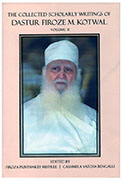
The Collected Scholarly Writings of Dastur Firoze M. Kotwal Volume II edited by Firoza Punthakey Mistree and Cashmira Vatcha Bengalli. Published in 2025 by the author, M-10, Cusrow Baug, Shahid Bhagat Singh Road, Colaba Causeway, Bombay 400001; email: fmkotwal@hotmail.com. Pp: 750. Price: Rs 4,000.
While reviewing Volume I for Parsiana, I had written: "No Zoroastrian high priest in the last few centuries has attained greater scholarly heights than Dastur (Dr) Firoze Kotwal or been embroiled in more religious controversies than him. To his legion of admirers, both Zoroastrian and non-Zoroastrian, he is the preserver of the pristine purity of the faith. To his detractors, he is a cold obscurantist, disconnected with ground realities. It is undisputed, however, that Kotwal has been a colossus on the Zoroastrian firmament for more than six decades.”
Volume II begins with Kotwal’s articles about Parsi priestly history and events leading to the holy Iranshah arriving in Navsari — Kotwal’s and this reviewer’s hometown, popularly known as the dharam ni tékri, a bastion of conservatism, the Vatican of the Parsis.
Firoza Punthakey Mistree and Cashmira Vatcha Bengalli, the editors, observe: "Apart from the Qissa-I Sanjan, a few historical records, extant Zoroastrian manuscripts and old Gujarati documents are the only known primary sources on the early history of the Parsis in Gujarat. Still much of the material remains unexamined.”
The Qissa states that the alat, ritual requisites for consecrating the first atash behram in India, came from Khorasan in Iran. This was much after the fall of the Sasanian Empire in 651 CE, when Yezdigird III, the last ruler was murdered at Merv by a thief. This indicates that even 200 years after the Arab conquest of Iran, Zoroastrians were able to practice their religion in most areas. It was much later that groups began to migrate, to escape growing persecution and heavy taxation.
In "A Historical Overview of the Parsi Settlement in Navsari and its Rise as the Bastion of Zoroastrianism,” Kotwal recounts how the oldest existing fire temple in India, the Vadi Dar-i-Mihr, was established in 1142 CE. Tucked in a narrow lane of Dastur Vad, this heritage temple today looks forlorn and deserted. This reviewer had to search for the fire, until he was pleasantly surprised to meet Dastur Meherji Rana, High Priest of Navsari and his son performing a nirangdin ceremony. Visitors to the Navsari Atash Behram are oblivious of this historic fire temple. All navars in India could only be inducted here, until the last 150 years, when Bombay ended Navsari’s hegemony.
Firoza Punthakey Mistree (l) and
Cashmira Vatcha Bengalli:
committed editors
Kotwal records that 13 years after the invasion by the Islamic ruler Mahmud Begada (against whom the Parsis fought valiantly side by side with the Hindu king whose ancestors had provided them refuge) the Sanjana priests, custodians of the Iranshah, moved the holiest of holies to Bahrot Hills and then to Vansda (where Burjorji Bharucha, Dastur (Dr) Framroze Bode and Dastur Jamshed Kookadaru successfully performed navjotes of 77 Parsi-fathered tribals in 1942), and then to Navsari in 1479 CE.
Three centuries thereafter, over issues related to client grabbing and fees payable for religious ceremonies (politely termed "disputes over ecclesiastical rights” by Kotwal), there was much bad blood (and real blood shed) between the warring Bhagaria priests of Navsari and the Sanjanas, guardians of the Iranshah, which culminated in a court verdict in favor of the Bhagarias. The miffed Sanjanas left Navsari, taking with them Iranshah to Valsad, and onward to the tiny hamlet called Udvada.
The Bhagarias, bereft of the Iranshah, consecrated their own atash behram in Navsari in 1765 CE "under the leadership of Khurshedji Tehmulji Desai” (this reviewer’s direct lineal ancestor) in the same spot that had housed the holiest of holies. Few know about this sacred spot where the original sanctum sanctorum was located, right next to the well, before the kusti area in the present atash behram.
Desai was indeed the benevolent godfather of Navsari in the mid-18th century. Only after he died in 1779 did the Navsari headquarters finally grant permission to the Bombay priests to consecrate the first varasiya (sacred albino bull) to provide the requirements of alat/nirang required in religious ceremonies in Bombay. After Desai’s death, his family claimed ownership of the Navsari Atash Behram. Though he had contributed generously towards its consecration, many others had pitched in as well and clearly the Atash Behram belonged to the entire Anjuman, not just to the Desai family.
During his youth, Kotwal resided in Desai Vad (one house away from this reviewer’s ancestral home) and people would come out on the streets to see his handsome presence.
Kotwal’s articles are well researched, his knowledge immense. In "The History and Development of the Parsi Priesthood in India” he writes about the literary activities of the Parsi priests. The famous Dastur "Neryosang Dhaval (12th century CE) studied Sanskrit under a Hindu pandit in Sanjan and translated important Pahlavi texts into Sanskrit.” It is well known that Vedic Sanskrit and Avesta are sister languages with many similarities.
Kotwal informs that "the oldest existing consecrated fire temple in Bombay, the Banaji Limji Adaran, was sanctified by the Bhagaria priests of Navsari.” But for the last 75 years the panthakies of this well maintained and run fire temple have hailed from Nargol and not Navsari. Established in 1709 CE, this Agiary, located in Fort, is known for its many miracles and the divine presence of guardian angels, of course, for those who believe.
Though Dastur (Dr) Maneckji Dhalla, High Priest of Karachi, was the first reformist priest, Kotwal objectively records his contribution: "Despite Dhalla’s unambiguous claims that he had ‘renounced conventional religion’ and that his ‘fascination for ritualistic religion’ had faded, in reality he held back. Dhalla was a passionate and powerful orator and even today, his writings exert considerable influence, especially with the reformist caucus in the Zoroastrian community.”
For students of the religion, Kotwal’s copious footnotes are very informative: the family tree over generations emanating from the common ancestor of all Parsi priests, Shapur Sheriyar. His son was Ramiyar whose son was Hormazdiyar. Shapur’s other son was Dhaval whose son was Neryosang. These priests have an exalted place in the faith.
In one of his pieces on worship, Kotwal states that Ahuna Vairya is the most secret and powerful prayer in the Zoroastrian faith, adding that it "is recited in Avestan, a language the lay worshipper is not likely to understand.” Prayer, for a Zoroastrian, however, is not primarily a matter of an individual communicating in thought and word with God, but rather is the recitation of words which have "sacred power, the utterance of which bestows blessings. These words or magic utterances have been revered through long centuries of Zoroastrian tradition.”
Dr Mary Boyce, Kotwal’s guide at the School of Oriental and Africa Studies, and a Zoroastrian scholar of orthodox hue, reiterates that reciting the prayer is in itself a ritual.
Kotwal displays his knowledge of diverse topics including the religious apparatus required for the holy fire; preserving a dadgah fire; the Zoroastrian manuscripts in the library at Navsari which is indeed a treasure trove of yet to be read material. Kotwal also demonstrates his methodology of deciphering rare Zoroastrian manuscripts and the requirements for ritual purity. His writings about the Prophet contain details and references which are not easily available. Similarly, his explanation of popular Zoroastrian ceremonies makes for absorbing reading.
Kotwal’s lectures and articles written in journals over a period of time entail repetition, with facts overlapping. It is difficult for students, forget lay leaders, to read every word of these articles replete with minute details and research notes. The editors may do well in future to publish summaries of these articles, excluding such details as are meant only for researchers. This would enable every interested Zoroastrian and non Zoroastrian to savor Kotwal’s vast knowledge.
The Glossary of terms, in small print, runs into a staggering 74 pages, the Bibliography into 12 pages, and the painstakingly prepared Index into 40.
The commitment of the editors in preparing these two volumes with barely an error is commendable. This reviewer hopes that they will publish a shorter easy-to-read version from Kotwal’s collection to cater to a much wider readership.
BERJIS DESAI
Desai is a lawyer in private practice and a part-time writer.