"Ancient Zoroastrian symbols adorn top US government buildings,” read the headline of an email sent to Parsiana by jurist Fali Nariman. He was forwarding us an email he had received from nonagenarian Rusi Sorabji of California.
The first structure referred to in the email was the main post office in New York on which prominently inscribed above the pillars are the words: "Neither snow nor rain nor heat nor gloom of night stays these couriers from the swift completion of their appointed rounds.” The inscription is frequently mistaken as the official motto of the United States Postal Service (USPS). "The sentence is taken from Herodotus’ Histories (Book 8, Ch. 98) and describes the faithful service of the Persian system of mounted postal messengers under Xerxes I of Persia. It was selected by the United States Department of the Treasury in 1912,” according to Wikipedia.
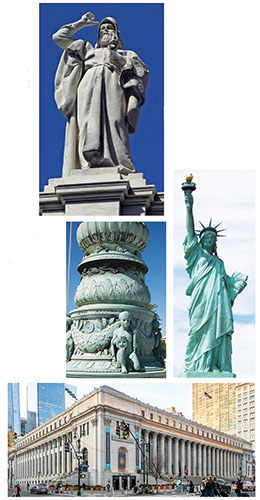
Top: statue of Zoroaster at the Court of the Appellate Division in New York;
2nd row, l: bronze base of the flagpole at the Supreme Court in Washington; r: Statue of Liberty;
above: General Post Office in New York
This monumental facade on Eighth Avenue was conceived as a Corinthian colonnade, composed of 20 columns, 53 feet tall. Originally known as the Pennsylvania Terminal, in 1918, it was renamed the General Post Office Building. The structure was declared a New York City designated landmark in 1966 and was added to the National Register of Historic Places in 1973. In 1982 the building was renamed in honor of James Farley who was the nation’s 53rd Postmaster General, added Wikipedia.
In the Court of the Appellate Division (near Madison Square and East 25th Street) in New York stands a statue of Zoroaster in recognition of Zoroastrian contribution to the development of law. This statue stands alongside other law givers like Moses, Manu, Charlemagne and Alfred the Great.
The front plaza of the Supreme Court Building in Washington has two flagpoles, the bronze base of which is crested with symbolic designs of the scales and sword, the book, the mask and torch, the pen and mace. The fifth tier has four cherubs interspersed with four medallions to represent the elements: air, depicted by an eagle, water by a fish, earth by a lion’s head and fire by a tripod of flame.
The seven spikes on the head of the Statue of Liberty in the New York Harbor have been variously interpreted. While commonly perceived as representing the seven seas or oceans, yet another explanation mentions it represents the rays of the sun. "Seven Zoroastrian rays stretching from her forehead” is one more new perception attributed to the figure!