The Youth and Young Adults Committee ensured the events at the 18th North American Zoroastrian Congress gave a voice to the millennials and Gen Z
Parinaz M. Gandhi
"A dedicated team of 30+ Youth and Young Adults (YaYA)… have come together with one goal in mind: to make youth a priority at the 18th North American Zoroastrian Congress (NAZC),” announced the Congress brochure. The YaYA team had curated a special youth track within the Congress program, selecting speakers and panelists, "many of whom are youth leaders or youth mentors in their communities, to engage with topics that matter most to young Zarathushtis today.”
Among the well-attended youth sessions, conducted on the first day of the Congress, December 29, 2024, was "The Great Zoroastrian Debate” that encouraged divergence of views. Eight provocative statements were read to a panel of six youth on the dais. Some were specific to the practice of the faith in North America, others to age appropriate behavior, and yet others to the observance of customs. While each statement was being read out they stood behind their chairs. If they agreed with a statement, they were expected to take their seats. If not, they were required to keep standing. Thereafter they were given an opportunity to cite their reasons in favor of or against the statement.
Youth and Young Adults committee
Dynamic youth session
The over 250 members seated in the audience too got to express their opinion on the subject through mobile voting. They were asked to scan a QR code that linked them to the session. Their assent or dissent with a statement was instantly registered and the count of those agreeing or disagreeing was promptly flashed on the screen. After each statement was deliberated by the panelists, to determine whether the audience was rigid in its thinking or receptive to new perspectives, they were once again invited to vote on the same topic. This format sought to foster "a culture of openness, understanding and empathy… By engaging in candid discussions and confronting challenging questions head on, we cultivate a greater sense of compassion and mutual respect,” believed the organizers.
As explained the moderator Tanya Hoshi, this session was inspired by the television series Middle Ground that sought to determine whether two different groups of people, opposed in their beliefs, can come together empathetically. While the youth panel at the 18NAZC may not have held conflicting views, the organizers ensured there were an equal number of males and females, millennials (born between the early 1980s and mid 1990s) and Gen Z (born between mid 1990s and the early 2010s), two priests and four members of the laity.
An award winning Canadian filmmaker producing films, web series, digital content and advertisements, Hoshi served as the first chief social media officer of the Federation of Zoroastrian Associations of North America (FEZANA) and is currently the chair of the newly formed Communications Committee. Having contributed to FEZANA’s social media presence online, she informed the audience, "Almost every day we are asked (on social media) ‘How can I be a Zoroastrian?’”
The three other females to join her on the panel were Afriti Chinoy, a fourth year student at the University of Michigan School of Dentistry who after graduation hopes to pursue a residency in oral and maxillofacial surgery while continuing her passion for academics, leadership and research. She has been an active member of the Zoroastrian Association of Michigan for two decades. Dr Kaizeen Mody joined the Houston Methodist Family Medicine Residency Program as teaching faculty and works for underserved communities as a family medicine and obstetrics physician at Vecino Health Centers. Previously active with the Zoroastrian Association of California (ZAC) and now with the Zoroastrian Association of Houston (ZAH), she is a collaborator on genetic population studies on US Parsi Zoroastrians. Daisy Pithawalla recently graduated in business psychology from the University of California at San Diego and plans to attend dental school this year. She has been serving as the youth coordinate on the ZAC executive committee, initiating many youth programs.

From l: Tanya Hoshi, Afriti Chinoy, Dr Kaizeen Mody, Daisy Pithawalla, Burzin Balsara,
Poruz Khambatta, Zubin Mistry Photos: Jasmine D. Driver
Among the male panelists were Ervads Burzin Balsara and Poruz Khambatta. Balsara who recently earned his master’s in mechanical engineering is currently a guidance, navigation and controls engineer at the Johns Hopkins Applied Physics Laboratory where he works on both air and missile defense systems and space exploration. Although now residing in Washington, DC, over the years he has been involved with his home association, the Zoroastrian Association of Northern Texas. Khambatta holds a PhD from Stanford University and a postdoctoral fellowship from the University of California, Los Angeles. A regular participant in events organized by the Zoroastrian Association of Greater New York in his younger days, he has now been giving back to his community though religious and non-religious events, representing Zoroastrianism at interfaith gatherings. Zubin Mistry is a senior project manager at Texas Children’s Hospital with a background in health administration and public health. Earlier a trustee at the Zoroastrian Association of Metropolitan Washington Incorporated, he is now on the ZAH executive committee. Passionate about chocolate making, he launched MCBC (Moderately Cool Baking Company) with his wife Mitra to create art, humor and attitude in every chocolate he makes.
The young brigade realized "we have to let go of some beliefs; find a compromise.” They were willing to set their differences aside and respect each other for, to them, doing good is more important than just being right. The teachings of the religion should be used for the betterment of others, they opined.
Certain statements like "The youth today practice Zoroastrianism appropriately in North America,” saw the audience equally divided with 136 agreeing and 126 disagreeing initially. After hearing the discussions, 154 from the audience agreed and 99 disagreed with the statement.
"Allowing conversions will help the Zoroastrian population grow.” An overwhelming majority of 200+ concurred with the statement. Reasoned the panelists: Why deny others the opportunity to become Zoroastrians? Even as a priest, who are you to decide who can and cannot practice the faith? As long as they are productive members of the community, why can they not be Zoroastrian?
A related statement declared "Only Zoroastrians should be allowed in our consecrated places of worship.” While 67 members of the audience agreed, 176 disagreed. The panelists commented: At consecrated places of worship in India, it is necessary to observe this restriction, not in North America. It is not right to differentiate (between) people. Don’t make them feel they don’t belong. Instead of hiding our history and architecture from the world, we should be open. As long as they are respectful of priests, prayers and culture, not throwing trash or taking selfies, they should be permitted.
"The greatest threat to Zoroastrianism is lack of knowledge about the rituals,” and yet another statement, "Religion is the most important part of my everyday life” also elicited mixed responses. To the panelists and the majority, humanism was more important than religion for they considered religion a way of life rather than the focus.
"Youth struggle to connect with the Zoroastrian religion today more than ever.” This depends on the parents’ ability to impart religion or encourage attendance at religious and cultural events. "I find it easy to date Zoroastrians while living in North America” led one panelist to comment that she had "to import her husband from Pakistan” while another felt that a Congress could be "a great place to meet, mingle and find a partner.”
"North America is the most ideal place for Zoroastrianism to flourish” believed the majority for it offers religious freedom and in the last 50 years, so many centers and atash kadehs have been established.
Identity and ideology
Yet another youth session, "Who are we? Zoroastrians in the western world” sought to unravel the complexities surrounding identity, belonging and the evolving landscape of the Zoroastrian faith.
Moderator Kimiya Shahzadi who is co-chair of the Zoroastrian Youth of North America (ZYNA), a committee of FEZANA, commented, "Last year we had three women as ZYNA co-chairs. It is amazing how the narrative is changing. We need support. We need more Iranian Zoroastrians on our team.”
Additionally serving as the chief social media officer for the North American Mobeds Council and the social committee co-chair of the Zoroastrian Association of Michigan, she is currently training under the Zoroastrian Mobed Council of Iran to become a mobedyar. A dual citizen of Australia and the US, she holds a master’s in clinical behavioral psychology specializing in relationships and publications, and has founded Love Story LLC, a modern Zoroastrian matchmaking service.
While adapting to the American lifestyle, cultural practices may differ from the ones in India but the religious principles are the same with a focus on frashogard, to leave the world better than we found it, remarked Zane Commissariat. "It’s like different outlets of Starbucks; there are bound to be differences,” stated the high school senior conducting research alongside faculty at the University of Southern California, aiming toward a career in public health. Volunteering at free clinics and homeless shelters in LA, as co-founder of Education Equity Project, a student led initiative, he collaborates with non-profits to support educational initiatives for underserved children. Guiding the Teen and Tween Sessions at the last World Zoroastrian Congress and the 18NAZC, he has understood that perceptions may differ because in India and Iran patriarchy prevails, while in North America, the emphasis is on equality. Irrespective of one’s progressive/traditional outlook, "we need to have an ideology to better the world,” he stated.
Born of a Zoroastrian father and a white, Canadian mother, Natalie Kanga mentioned that you "don’t need to have two Zoroastrian parents to be involved in the community. My story is becoming more common in the world. You don’t have a Parsi brain and a white brain. As long as you have a strong foundation in religion, it can adapt to the prevailing political and social conditions.” Pursuing her PhD in psychology, besides serving as a counselor at a Z camp for teens, she helped create a mini-documentary interviewing Persian and Parsi Zoroastrians as she is passionate about bringing the Persian and the Indian Zoroastrian communities together in the San Francisco Bay Area. Urging youngsters to get involved in community activities she also recommended some kind of support for older people by organizing events for them.
Clockwise from above, l: Kimiya Shahzadi, Sharmin Mistry, Ashton Zadeh,
Zane Commissariat, Natalie Kanga Photos: Jasmine D. Driver
"The future of Zoroastrianism is optimistic in North America. We have amazing leaders who have given an opportunity to the youth to join the FEZANA board. The mentorship we get is our biggest strength,” said Sharmin Mistry from Toronto who as assistant secretary from 2022 to 2024 was the youngest member on the FEZANA board. As the Service and Advocacy co-chair at ZYNA she initiated the Attitude of Gratitude donation drive and is currently conducting a pilot project for a Zoroastrian Exchange Program between Parsi and Iranian Zoroastrian teenagers. Having spent the first 22 years of her life in India before migrating to Canada, she has been active with the Zoroastrian Society of Ontario where she got to interact with a lot of Iranians and she feels she has "an extended family to support me. We should be open to different things. Future generations need to be proactive and not feel shy to engage in community activities,” she recommended.
Keen to give the younger generation the resources he didn’t enjoy, Ashton Zadeh from San Francisco Bay Area has written, illustrated and published five children’s books, three of which talk about ancient Iran and Zoroastrianism in a modern art style. For every book sold, a tree is planted and until 2024, over 2,000 trees have been planted across the US and Portugal. As a digital marketing specialist he utilizes storytelling, graphic design and analysis skills to create and manage marketing campaigns. Not born a Zoroastrian, he noticed that while Zoroastrians like to consider themselves as "very progressive, what is said and done is very different.” He referred to being "treated very disrespectfully, more by the youth, before I met very kind people. It took me years to find these people. Most would not have that patience. He urged youngsters to practice humility and show emotional intelligence realizing how our acts can affect other people.” He was sanguine "the community is not going to vanish; it will be more ethnically diverse.”
Bridging the gap
To facilitate collaboration between young Zoroastrians in Iran and around the world, the recently formed Iranian Zoroastrian Youth Network (IZYN) has chosen to "focus on our common values, not our differences. The community needs connectivity, physical or virtual meetings, engaging in joint activities and forming teams where young Zoroastrians can work together on social, economic and intellectual projects.” This was reiterated at the session "Bridging the gap: Preserving Zoroastrian Heritage with Gen Z” moderated by Shiva Ashtari, one of the seven founder members of IZYN. Currently pursuing a master’s degree in industrial and systems engineering at the University of Oklahoma, she had earlier served as board member of the Zoroastrian Students Association in Tehran and ran a business as a florist. Also participating in the session was her husband, Siavash Mandegari, erstwhile chair of the Zoroastrian Students Association in Tehran and presently IZYN coordinator. A PhD student at the University of Oklahoma he is keenly interested in sustainable development research and social systems.
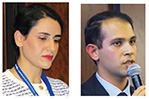
Shiva Ashtari (l) and Siavash Mandegari
Photos: Jasmine D. Driver
IZYN aims to be a bridge between past generations and the future generation which besides being "digitally savvy, is pragmatic, realistic, diverse and inclusive, valuing authenticity, flexibility, independence and self-reliance,” it was mentioned at the session. While experiencing Zoroastrian culture at home, Gen Z is exposed to different cultures at school or work. Hence Christmas is universally celebrated, irrespective of one’s religion. Or Jashne Sepandarmazgan, Mother’s Day for Zoroastrians in Iran is now celebrated by many Muslims as both Mother’s Day and Valentine’s Day.
"IZYN’s strategic approach to bridge the generational gap is by cultivating deep-rooted connections to one’s Zoroastrian heritage with media production, historical exhibition, translation and educational programs. One of their projects, The Yazd Cultural and Heritage Resort, is designed as an ecosystem by Gen Z comprising several microbusinesses like co-working spaces and digital nomad accommodation, virtual tours, cultural and food tourism, solar energy and water management. They are hoping to get support to restore Zoroastrian buildings and reconstruct historical sites for new purposes. Another IZYN project, Raynag Company seeks to support young people in their professional journeys by connecting young Zoroastrians to the global job market and training them to be professionals in their fields.
Other symbolic and social events at the Congress, catering to the youth will be covered in forthcoming issues of Parsiana.