Long-winded explanations about the legalities of the Bombay Parsi Punchayet (BPP) election scheme, delivered in clipped accents by well-meaning but some of the most dreadfully boring speakers to tired Parsis in colonies across Bombay, were cutting no ice. On the other hand, the Committee of United Zoroastrians (CUZ) speakers, all sons of the soil, speaking in Parsi Gujarati, were managing to whip up sentiment against the dangerous reformists of the Committee for Electoral Rights (CER). The dependable Jam-e-Jamshed was backing them. Something had to be done.
The army of CER followers took control of the movement. The Nariman Mehta of Nowroz Baug narrated the story of a young homeless Parsi couple who spent nights in a tempo after they had been shunted out from a sanatorium. Others, including this columnist, spewed fire and brimstone in Gujarati, without any politeness, against all that was wrong with the BPP. Crowds began to swell at CER meetings which became more boisterous and colorful, much to the squirming discomfort of its Altamont Road leadership. Soon the leaders were led by the followers.
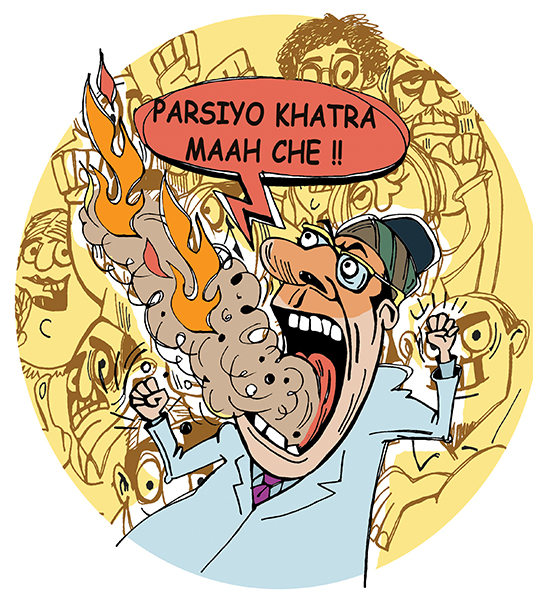
"Parsis are in danger" Illustration by Farzana Cooper
Zal Contractor drove his jeep, packed with CER youngsters, into Parsi baugs where they screamed electioneering slogans against the then BPP chairman B. K. Boman-Behram (BKB) and the good doctor (Nelie Noble). In 1977, after Indira Gandhi lifted the Emergency and called for elections, a no holds barred campaign was unleashed by the opposition, then called the Janata Party. One of their favorite slogans was: Maruti motors ké lafdé mé, public ka paisa hajam; Sanjay Gandhi ka karodon rupiyé ka bhrashtaachar (crores of public money was sunk into Sanjay Gandhi’s Maruti Motors venture). This was altered to: Housing allotments na ghotala ma, Parsi Punchayet na paisa hajam (BPP money was lost in the housing mess). Sanjay’s name was replaced by that of the much maligned BKB.
It was around this time that a shy, frail, young Parsi joined the CER, whose elitist leadership was initially deeply suspicious of his credentials. He spoke little and appeared to be in awe of the blue-blooded Parsis. However, on the last day for registering new graduate voters on the A Register by paying Rs 500 each (equivalent of today’s Rs 15,000), controlled for decades by BPP trustee and Pundolite Noble, this young man walked up to the BPP secretary and said that he wished to file 350 new voters. The secretary laughed and said, "Bawaji, pona paanch vaagé maro baap cheques encash karsé (at 4.45 who will encash 350 cheques)?” The man smiled, opened a briefcase and paid the entire amount in cash to the stunned staffers. At 5 p.m. on the final day, Noble had lost the A register to a man named Dinshaw Mehta. This happened 42 years ago.
In the meantime, court battles continued. For the CER, Dadi Engineer and Rusi Sethna, both solicitors, marshalled resources. Counsel Dara Zaiwalla assisted by a young Edul Bharucha (later an outstanding senior counsel) argued before bewildered judges watching red capped Parsis looking extremely agitated. CUZ litigation was conducted by one of the finest gentlemen, a diehard fundamentalist named Jimmy Shroff of Little and Company. Shroff visited many fire temples every morning before he entered office, post lunch. He was honest and well intentioned. However, he was no match for the many wily players on the CER side. Courts ruled consistently in CER’s favor. Elections were to be held over eight weekends at the ill-fated BPP office building in the Fort.
On the very first day, there was high drama. One burly Parsi nonchalantly walked in and tore down all the CER posters, glaring at its stunned workers. Contractor equally nonchalantly slapped the burly fellow so hard that the latter fell down. Around noon, a few toughies from the Noble cycle shop arrived, with a bunch of voter certificates. Suddenly, a very short man walked in in a sinister fashion and whistled. More than a dozen non-Parsis strolled in. The cycle toughies gasped in disbelief and scooted. A new order had commenced. For multiple reasons, we cannot reveal the identity of the shortie. That evening, the doctor told BKB that the election would be very tight but they would prevail by a wafer thin margin.
Attempts were made to impersonate voters. Police complaints were lodged by CER but ignored, as the Parsi deputy police commissioner was allegedly a CUZ man and a toughie. Later, over shared Sir Ratan Tata Industrial Institute (RTI) snacks, workers from both sides became friends and the rancor diminished. BKB, though the astute politician, was increasingly nervous. Be ready to challenge the results, he told his legal team.
Counting took ages amid a lot of objections, some genuine, most frivolous. Within hours, the CUZ supporters began to dwindle. CER appeared to be winning, they said. Out of 100 seats, we ought to get 60, said the CER leaders.
The only one seat the CUZ managed was won by Dr Sarosh Wadia, a popular homeopath from Colaba. The remaining 99 went to CER. Strangely, the cucumber sandwich brigade was embarrassed at this obscene victory. There was much merrymaking at Contractor’s house that night. Wadia, who had a hearing disability, later confessed that he genuinely thought that he was a CER candidate!
BKB and Noble never contested another election. After much humming and hawing by the ginger group who had publicly declared that they would never be trustees, Indian Administrative Service officer Jamsheed Kanga was elected unopposed as a BPP trustee. Not many years later, businessman Mehta too was elected unopposed as a BPP trustee. That’s another story for another day.
Berjis Desai, lawyer and author of Oh! Those Parsis, and recently Towers of Silence, is a chronicler of the community.