Although it reflects the unique identity of the community,
fewer members are willing to speak and teach Parsi Gujarati
Parinaz Gandhi
When asked to fill in their mother tongue on official documents, Parsis in India are in a dilemma. Should it be Gujarati or English? Outside of Gujarat, try asking "Gujarati aavréch ké (do you know Gujarati)?” Those past their prime will probably say "Bolta aavréch pun vaachta nai (we can converse in Gujarati but cannot read the script). The youngsters are more likely to respond with "We can understand but cannot speak.”
Once the state of Bombay was bifurcated along linguistic lines into Maharashtra and Gujarat in 1960, Parsi students in Bombay opted for English as a medium of instruction. In the decades thereafter, the usage of Gujarati even at home started gradually waning with "sahebji” being replaced by a "hi,” and "su khabar?” with "what’s new?” Though community members continue to sing Chhaiyé Hamé Zarthoshti with gusto, fewer Zoroastrians understand its meaning unless concerted efforts have been made to teach it as an individual or group activity. At major milestones in the family like navjotes and weddings special chalk decorations wish happiness with navjote mubarak and shaadi mubarak in Gujarati.
Aarsi ni Ulthaap performed by Calcutta Parsi Amateur Dramatic Club in 1919
On receiving Aban Mukherji’s article for publication (see "A distinct dialect,” pg 38), Parsiana sought to ascertain whether our language has suffered a setback with increasing migration and globalization. To understand its usage in Bombay, different parts of India and overseas, Parsiana reached out to middle-aged and senior community leaders asking them how frequently they get opportunities to speak in their mother tongue at home and at anjuman/association events, and which are the idiomatic expressions they tend to use most frequently.
Nineteen individuals, 11 from overseas and eight from India, shared their reflections. They varied in length from two-liners to an outpouring of concern for the scant efforts made by Parsis to preserve the Gujarati language, quite unlike the zeal shown by Iranians to ensure that every succeeding generation learns Farsi and/or Dari.
From the Parsi bastion of Bombay, we received responses from four of the seven trustees of the Bombay Parsi Punchayet. Chairman Viraf Mehta stated that with "my parents and colleagues from other anjumans I speak more Gujarati than English. With my brothers, it’s more English but with my Parsi friends it’s a mix of Gujarati and English.”
For co-trustee Anahita Desai, "Sadly, using Gujarati has diminished to a great extent. It is mostly restricted to when I am conversing with elder relatives or the residents of our Senior Citizens Homes or the house helps who have been working for years at Parsi homes or on visits to Gujarat, or telephone conversations with Parsis residing in Gujarat.”
When addressing public events, especially if there are more seniors, or he is in Gujarat, trustee Xerxes Dastur always speaks in "a mix of English and Gujarati.” At home, "I try and converse as far as possible with the kids in Gujarati. It’s a bit of a challenge with my younger son but we keep trying.” Some of his frequently used phrases are: avé java déo (let bygones be bygones); nakthi karo (ignore and move on); aapro ghoro chaalva déo (let us proceed with work).
At home, trustee Adil Malia speaks in Gujarati but often tends to shift to English; typical "bawa communications with bells and whistles.” Having formally learnt Gujarati, he is fluent in the language and when invited to speak at functions, "I embellish my speeches with old Parsi idioms and phrases depending on the event and the context. That naturally tends to catch Parsi audience attention.”
Gathering at the 18th North American Zoroastrian Congress in Houston
Photo: Jasmine D. Driver
Some of his favorite phrases are: aaj ni méhnat, kaal nu fal (unless you work/invest today you cannot reap benefits in the future); namantai na nichanthij motai na unchan par javaee (only with humility can one rise to success); prarthna prayatna no tukko rasto nathi (prayers are not a shortcut to success); jé man thi thai, té sau mann thi nai thai (working with application of one’s mind brings greater success than by using force of 100 tons); jya chalvu hoi tya rokata na, jya rokavanu hoi tya chalta na, jya dorrvu hoi tya chalta na (adopting the correct strategy and pace is crucial so that you don’t halt when you have to move, or proceed when you have to wait, or walk when you need to run).
Currently residing in Bombay but with their roots in Navsari are two community activists, Dinshaw Tamboly, chairman of The WZO (World Zoroastrian Organisation) Trust Funds and author Berjis Desai.
Thanks to his social welfare work over the years in the villages, some of the expressions that Tamboly has picked up and occasionally uses are: masmaran naa dhakara (when someone brags about himself/herself); dor phanas (squint eyed); gadhéré bèsarva maagéch (trying to fool).
Desai remarked, "I am a balanced bilingual. I think in both languages and converse regularly in Gujarati: at home, office and socially, even with non-Gujarati speakers who are able to get the gist. If I were to list Parsi idiomatic expressions, it will require a column. Most will be unprintable anyway.” On further prodding, he shared some: gaando thai né gaam looté (a smart operator pretending to be insane); gadhéra né taav aavé évi vaat naa kar (don’t talk nonsense); mahal joi né apné aapnu jhupdoo nahin todi paadvaanu (keeping up with the Joneses is a dangerous game); masi na lagan ma aavich (asking for too much); sagan no ganthiyo chhè (harbinger of probable misfortune).
Illustration by Farzana Cooper, Parsi Bol
Cosmopolitan cities
"What do we expect in a mobile Parsi population in the capital which is spread out with families being miles apart from other Parsi families?” rhetorically asked Ava Khullar, president of the Delhi Parsi Anjuman. "With WhatsApp messaging replacing oral communication, there is less incentive to speak in Gujarati. Living in cosmopolitan Delhi, and especially with Punjabi in-laws with whom I am very close, usage of Gujarati is rare on a daily basis. It is sad though because these phrases are so delightfully expressive that losing them to posterity as a living lingo will be tragic. But then we Parsis are our worst enemies and revel in destroying our culture and even ourselves.
"When a Gujarati expression comes to mind, it is often lighthearted swear words: muo taddan handamaster chhè (he is so uncouth); ai paagal ni sathé su vaat karu (how does one converse with a mad person)?; dharak dhujara na kar (don’t create undue anxiety); lavaro bakaro kam kar (stop talking nonsense).
"Very few Parsis in Calcutta, and maybe less than 10% of those under 50, speak Gujarati at all,” stated Bahadur Postwalla, trustee of the Calcutta Zoroastrian Community’s Religious and Charity Fund. "Gujarati is not the language spoken at any of our community get-togethers.” When one of their priests gives talks, he uses Gujarati and English.
For the Parsi Gujarati nataks (plays) performed every Navroz at a prominent theater hall in Calcutta, "members of our cast transliterate the script into English and struggle to get the pronunciation right.” The Calcutta Parsi Amateur Dramatic Club enjoys "a Guinness record for being the only club in India that has performed nataks for 116 successive years.” (The Yazdi Karanjia Group started by the Surat based dramatist has been performing Gujarati nataks all over India and even overseas.)
Postwalla’s mother had insisted he learn the Gujarati script explaining that should he leave Calcutta, they could keep in touch by exchanging letters in Gujarati (telephones were then a luxury). Some of the idiomatic expressions that he once used frequently were: aankh chhè ké lakhota (do you have eyes or marbles)?; nahi mama na kana mama (better to have something than nothing); ghora par charya (showing impatience); jhér khavani bhi farsood nathi (so busy that there is no time to even eat poison); kavab ma hadkoo (an unwelcome presence).
Yazdi and Veera Karanjia (3rd and 5th from l) with members of the Group performing a Gujarati natak
Beyond the border
Admitting that he is weak in Gujarati, Dinshaw Avari, chairman of the Karachi Parsi Anjuman Trust Fund, stated that "very seldom do I use Gujarati, that too only with my family, when traveling and don’t want to be understood by others.”
According to Sunnu Golwalla, editor of What’s On, the monthly newsletter of the Karachi Zarthosti Banu Mandal, "Most Zoroastrians in Pakistan converse in Gujarati, often quite animatedly! However, usage varies by city. A phrase like mané maalum chhè (I know) in Karachi will be spoken as maanaay maloom chhè by those from Lahore, with a Punjabi accent and apokoné maalum chhè by those from Quetta. Likewise, mè ghanoo sodhiyo (I searched a lot) by those in Karachi becomes mahè ghanoo doodhiyu by those from Lahore and mè ghanoo gotiyu by those from Quetta.
"Some idiomatic expressions I use are: ghani lumbas naa mar (don’t exaggerate); jara vaar maa tato-vioo thayee jaech (gets impatient so quickly); aatloo maliya chhata nagoona chhè (even after receiving so much they are ungrateful).”
Connection
across continents
From the UK, Malcolm Deboo, president of the Zoroastrian Trust Funds of Europe, responded, "I do converse in Parsi Gujarati and English frequently at home and at the Zoroastrian Centre but don’t tend to use idiomatic expressions.”
In North America, individuals and organizations are struggling to keep Gujarati alive. At the 18th North American Zoroastrian Congress in Houston last December, special efforts were made to stage a Gujarati play one evening. The audience though had mixed reviews for they felt it was linguistically dividing the community.
Ervad Kayomarz Sidhwa, current president of the Federation of Zoroastrian Associations of North America (FEZANA), and six of his predecessors shared their thoughts on the importance of Gujarati.
Having lived in North America for over 30 years, Sidhwa observed, "I find that opportunities to speak Parsi Gujarati come less frequently, yet whenever they do arise, they bring an immediate sense of comfort and connection. It’s a language that carries the rhythm of my childhood, the humor of our elders, and the unique identity of our community. I usually speak it with family members, at Zoroastrian community gatherings, or occasionally with an older friend over the phone and every time, it feels like being at home.
Chalk design agharni mubarak by Prochi Bhada
Chalk design (top) navjote mubarak by Khushnama Mohta;
(above) shaadi mubarak by Benaifer Mehta
"What makes Parsi Gujarati so special is not just the words themselves, but the way we use them — full of wit, affection and often a bit of mischief. Certain idiomatic expressions remain etched in memory and still find their way into conversations, such as bhanyo pun ganyo nai (educated but not wordly wise); rarta né hasaavi aayo (paid more than required); bhéju bau garam chhè (hot-headed). With technology playing a huge part in today’s world, some newer expressions have taken shape like tu tau Google no bi baap chhè (you are more knowledgeable than Google).
"Parsi Gujarati is more than just a dialect, it’s a cultural treasure. Even if used sparingly, its presence reminds us of who we are and where we come from. I truly believe it deserves recognition and preservation, not just as a linguistic curiosity, but to keep alive our unique way of life across generations.”
Having grown up in Bombay, immediate past president of FEZANA, Arzan Wadia stated, "Parsi Gujarati was the first language I learnt and till today it is the language in which I think and count. While I can read it reasonably well, writing it is a struggle. Conversing in Parsi Gujarati breaks the ice in a foreign land much faster than the default English introduction. It also allows us to acknowledge our shared heritage. In community settings, I make it a point to converse in Gujarati, more so because that’s one of the few times I get a chance to do it.
"Parsi Zarathushtis in North America sadly have not put in as much effort to keep their language alive as our Persian counterparts. I see that on every Return To Roots trip that I run or when I interact with the Zoroastrian Youth of North America here. Language is an intangible and integral part of our culture and we need to do more to preserve it.
"Some of the expressions I use are: jé thavanu hosé té thasé (what will be, will be); konna bawa ni Diwali (at whose father’s expense is the wasteful expenditure being incurred)?; bhéja dukhaan naa kar (don’t annoy); Bhaaté gaam thi aayaa soo (do you take me for a simpleton from Bhaate village)?
Born in Bharuch, FEZANA past president Homi Gandhi had to complete his schooling in Gujarati medium when the new government stopped English as the medium of education. "Speaking shoodh (pure) Gujarati, I became a laughing stock in family and friend circles, especially on my visits to Bombay during vacations. But this changed once I joined college and spent the 1960s in the West. When I returned to India at the end of the ’60s my wife kept coaxing me to speak in Gujarati saying ‘Gujarati bhuli gayo (you have forgotten Gujarati)!’
"Now after spending almost half a century outside India, speaking in Gujarati is a luxury. It is mainly used in family conversations or at Gujarati-speaking gatherings. The most frequently used phrases are sahebji (hello) and chalo chalo (hurry up). During conversations if someone repeatedly says ‘sorry, sorry,’ I respond with (the nonsensical rhyme), ‘Sorry, sorry marghi mori, kon na pét ma biladi dori (the chicken is bland; in whose stomach is a cat running)?” After recounting an entire anecdote if he is asked "Pachhi (what follows)?” He tends to reply with another rhyme "pachhi né chhavi (25 and 26)… Other phrases I use are chor kotwal né daaté (the thief admonishes the police); ghee dhorayu to khichdi ma né khichdi ma (surplus wealth will remain in the family); raja, vaja né vandara (king, music and monkey can be branded together as one never knows what their next action will be); chaamra ni jeeb chhè, ém bhi faré né èm bhi faré (the malleable tongue makes contradictory statements).”
Although she made a concerted effort to speak to her children in Parsi Gujarati at home when they were growing up, FEZANA past president Katayun Kapadia observed that now in their 40s, they understand the language but do not speak it fluently. She would impress on them the need to learn it should the need arise to keep a family conversation confidential.
"Within our group of Zarathushti friends who are from Bombay we continue to speak in Parsi Gujarati as it makes us feel more comfortable to express our feelings in our mother tongue.” On ceremonial occasions like navjote, lagan and agharni (seventh month celebration of a pregnancy), Gujarati is the language of choice. "Of course our jokes sound much better when we deliver the punch line in Parsi Gujarati.
Books popularizing Parsi Gujarati
"Some of the phrases that I frequently use are: kèm chhè (how are you)?; tabiyat kèm chaaléch (how is your health keeping)?; majani rèhjé (keep well); hasto ramto rèhjé (keep in good spirits); jaldi aavjé (come soon); bhonu khadhu ké (have you eaten your meal)?; pét bharayu ké (is your stomach full)?; kévi majani laagéj (looking so pretty); taddan anaari chhè (unquestionably stupid).”
"Although we have adopted the Gujarati language after our ancestors came to India, we have altered it with changes in some consonants and vowels to suit our lack of ability to correctly pronounce shoodh Gujarati,” commented FEZANA past president Firdosh Mehta. "This has led to our Gujarati sounding funny to others and capitalizing of Parsi nataks. We have also altered Farsi and Pahlavi words when incorporating them into Parsi Gujarati with herbad becoming ervad, fravahar becoming farohar, yasna becoming ijashni, etc. But that is understandable as our ancestors were in a survival mode and tried retaining whatever they knew of our faith and language.
"Almost every day I use Gujarati with family and friends, face to face and on phone though I have not got around to texting in Gujarati. Some Parsi idiomatic expressions I use are faraghat thai gayo (comfortable in my home attire); ghéla ganda na karo (behave yourself); ghélsuppo naa bun (don’t be stupid).”
"It saddens me to hear children of other south Asian communities speaking in their mother tongue among themselves, but not our children. There are very few families who make a conscious effort to speak only Gujarati at home,” commented Dr Dolly Dastoor, past president of FEZANA and currently editor of its quarterly FEZANA Journal.
"I grew up in Bombay and we spoke Gujarati at home with family, neighbors and friends. Fast forward to 1973 when I arrived in Montreal, Canada where there were only a handful of Parsi families from India who spoke Gujarati. As time went on, less and less Gujarati was spoken with more English words peppering the conversation. When families became blended, even those who originally spoke Gujarati now began to speak only in English with their grandchildren of mixed parentage. When I mention to grandparents to speak to their grandchildren in Gujarati, they tell me ‘hu boluch té samajtaa nathi né maaru mohnu joich (they don’t understand what I am saying and stare at my face).’
"I insist on speaking in Gujarati to my Parsi friends but the response is generally in English! It irks me the most when people born and raised in Bombay, now speak only in English in Canada. When I start speaking in Gujarati to friends visiting from Bombay they give me a puzzled look, stating ‘tamé ajun Gujarati boloch (you still speak Gujarati)?’ and then respond in English! This is a very sad state as it will bring about the demise of our peculiar flowery Parsi Gujarati.
"When we seniors speak in Gujarati peppered with English, the most common expressions we use are arré baapré (oh gosh); gaando thai gayoch (he has gone mad); avé bau dai thai gayoo (the discussion has stretched unduly); bau koilu (not really funny); chalo avé bas (now enough); tabiyat sambhaali né réhjo (look after your health).”
"Language conveys cultural values,” emphasized FEZANA founder president Rohinton Rivetna. "Our Iranian brethren understand the linkage and hence teach their children Dari and/or Farsi. Parsis do not teach Gujarati. Hence the disconnect. Iranians tend to marry within while Parsis do not. There is still time to reform if we set our minds to it.”
While he has picked up a store of Parsi proverbs from his mother they only come to mind when a situation demands it. A few frequently used are: Bawa kah tau jhana tah (hardly any progress made); bawa adam na jamana thi (from ancient times); khudrat, khudrat nu kam karta jaij (nature works in its own ways); sasooji sagan maago (requesting a mother-in-law to pray for beneficent occurrences); ék pagé ubha rahi né javab apjo (for the injustice meted out you will be answerable to the higher power while precariously balancing on one foot); kar né jo, ahi né ahi (you will reap the fruits of your labor in this world); kataryu gap (not mentally sound).
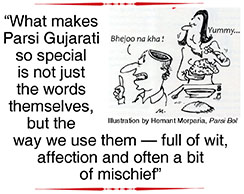
"For the next generation in the USA I’m afraid there is no hope,” regretted Roshan Rivetna, erstwhile editor of FEZANA Journal who "realizing the importance of our inimitable language” had co-authored with Dinaz Rogers My Mother Used to Say in 2015. (Two years earlier, Sooni Taraporevala and Meher Marfatia of Bombay had compiled Parsi Bol: Insults, Endearments and other Parsi Gujarati Phrases.) "While all our Parsi friends from the first generation here in the USA, speak almost exclusively in Gujarati among ourselves, when our children and grandchildren are around we lapse into English.” When her children and grandchildren were little, she consciously conversed with them in Gujarati because of which they manage "bhagoo tootoo (broken) Gujarati.
"Some expressions, that I find myself using are: èskee mèskee (stylish); ghér no gahambar (members of the same family pursuing an activity); kèm patlo favsé (will adjustment be possible)?”
In the absence of its distinctive lingo, will the ethos and eccentricities of the community be transformed? Can the past be restored? A verse by the famed yesteryear Gujarati poet Kavi Ardeshir Faramji Khabardar, shared by Malia, recommends: Aagé kadam aagé kadam aagé kadam yaro, yaro fana na panth par aagé kadam/ bèsi rehnara kaun désé bèsva, ahi har gadi salgi rahya yuddhon nava… (keep making progress for success lies therein; each moment a new and different war is triggered off).