Living space is scarce in a kibbutz but many public facilities are available
Ardeshir Mehta
Ardeshir Mehta’s "My Experience of kibbutz Life in Israel with particular reference to Behram Irani’s doctoral dissertation on communes” offers an insightful look at life in Israeli kibbutzim (plural of kibbutz) from the years 1968 to 1976. A kibbutz is a communal farm or settlement in Israel. Mehta was studying and living in Israel at the time. Parsiana reprints with permission some extracts from Mehta’s memoir forwarded to us by his cousin, the poet Adil Jussawalla.
After my summer vacation was over I went back to the university but as I kept coming back every weekend I was accepted as a sort of "permanent volunteer” by the kibbutz. Nothing was in writing or even in spoken words, but there was an understanding. This type of relationship was unusual in the extreme but nevertheless turned out well. I used to work on some weekends — not all — mostly in the sheep branch, and considered myself a part of the kibbutz, though not a member. Of course, during the week I was at the university, living in the dormitories. During vacations I was at the kibbutz full time and worked six days a week. This arrangement continued for about five years till the day I left Israel on November 8, 1976.
The room in which I lived on the kibbutz was one of four in a prefabricated wooden hut which had been put up during the days in which the kibbutz had been founded (in the early 1950s). It was very small and to save space I had not put in any furniture but had rugs and mattresses on the floor on which my guests and I sat and chatted and where I slept at night. A rule was made that everyone had to remove their shoes before entering and generally speaking people did not protest. The walls of the room had beautiful pictures pinned on them and I also hung up some bookshelves made of raw pinewood supported by ropes. Two closets along one side, with only curtains for doors, contained clothing and other things. I shared the residence room with Lillah and Sandy, girls from America. This sort of living arrangement was not considered abnormal on the kibbutz. In fact, the idea of setting up the room as described was Lillah’s to begin with. Both she and Sandy had very good taste which contributed greatly to making it very pleasant and attractive.
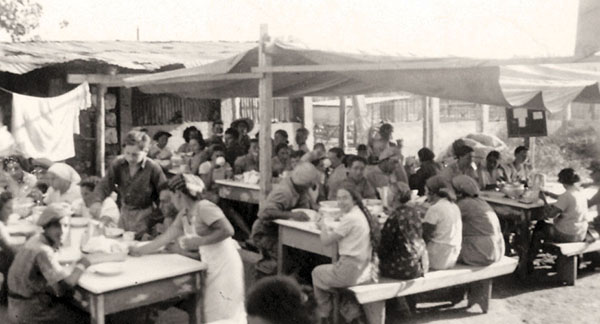
Dining area in a kibbutz, 1953 Photo: Wikipedia
We had no bathroom and all four of the rooms of the hut had only one tap with a sink, out in the open without even a roof over it. We used the public toilets about 50 yards away or, in an emergency, the toilets of the kindergarten next door. We used the public showers. This arrangement was by no means inconvenient, at least for me, except during illness. In fact I can say with confidence that I would not have exchanged my room in the wooden hut for any of the more modern brick and cement apartments allotted to the other people, especially members. In this preference I was not alone. Ben Gurion, the first prime minister of Israel and who was considered in a way to be the "Father of the Nation,” preferred to live in a wooden hut in the kibbutz Sde-Boker. On Kibbutz Na’an also, many of the old members continued to live in wooden huts put up in the early days of the kibbutz and would not under any circumstances move to the modern apartments being built for young members.
The only thing I regret is not having created a garden around the hut, as many had on Na’an. These gardens, as well as the usual kibbutz garden are something to behold. The kibbutz garden, tended by the gardening team, extended around the hut and all the other structures of the kibbutz. Generally the inhabitants did some gardening in the small area close to their living quarters to make the gardens beautiful and to give an individual touch.
Most members kept their homes neat and clean, but the volunteers’ quarters were generally messy. All this was accepted without much fuss. Even among the members, there was a vast difference in how people kept their homes. Some had elegant furniture and music equipment, mostly brought from South Africa. All homes were small and I doubt that any one person had more than about 60 square feet of living space to himself or herself, except under rare circumstances. Living space is at a premium in Israel, not only in the kibbutz. One had to learn to share living space. However, in all my nine years in Israel, I cannot recollect ever having had a roommate.
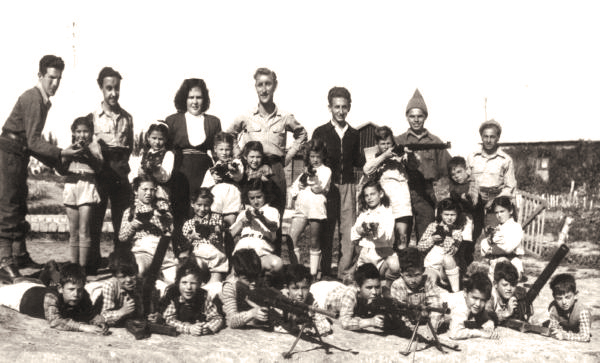
Kibbutz children with members of Israel’s defence forces Photo: Wikipedia
Graves of Paula and David Ben-Gurion Photo: Wikipedia
A dairy barn Photo: Wikipedia
One of the first members of Giv’at Brenner was an aged lady whose husband had passed away and whose son had been killed in one of the wars. She was well known in the kibbutz, huge as it was. She lived on bravely despite the setbacks she had experienced. She told us that in the early days of the kibbutz people did not have many clothes and some arrived with only the garments on their backs. So it had been decided that the clothes of all the members would be pooled and given out to those who needed them. She said, "I had, among my few clothes, a dress which had been given to me by my mother — a beautiful dress, to which I was greatly attached and which I had brought for use on special occasions. I, of course, put this dress in the common pool. It was given to a girl more or less my size. Imagine my shock to see this girl wearing this dress to work the next day and getting it all dirty and torn.” Nevertheless, she said, people enjoyed themselves more in those days — referring to the founding days of the kibbutz. This was in the ’30s. Many old members of different kibbutzim said the same thing — there were hardly any material comforts. People lived in tents, mosquitoes bit everyone, eggs were rationed to one a week, and one could eat chicken only under two conditions: if one was sick or the chicken was sick. Yet the atmosphere in the kibbutzim was robust with comradeship.
The lady once asked me what I thought of kibbutz life. I replied I found it very much to my liking. She said, "Maybe; but I myself think the kibbutz has failed in its mission. We started out with very high ideals but we have come to value the material above the non-material.” I mention this to show how high the hopes of people of the kibbutz were when it started. It is not surprising that all their hopes were not realized. What is surprising is that so many of the ideals have been achieved. But of course to one who had lived through the early days it must have been a bit of a letdown to hear the modern generation speak of stereo sets and blue jeans.
By the time I got to Israel, all kibbutzim — even the so-called "poorest” — had plenty of material comforts and there was no such thing as deprivation. But I could well picture what it must have been like. I had seen slides of Tsor’ah taken at the time of its founding. The entire surroundings looked like a rocky wasteland — which, in fact, it was. There was not a tree in sight. No cultivated fields, no buildings, no roads; the hostile border with Jordan was only a few miles away. Members picked cotton with their hands, and there was no hired labor. Vegetables wouldn’t grow in the calcareous soil. The heat was oppressive in summer and there was no heating in the winter. And yet they all said: "We had more fun in those days.”
Concluded