I read Berjis Desai’s piece "Righteousness vs. ritualism: an eternal controversy — I” (Parsiana, February 21-March 6, 2022), and believe that he would have better served the community had he written an article on "Righteousness and ritualism,” rather than "Righteousness vs ritualism.” Desai, an eminent jurist, has resorted to the use of a logical fallacy. Perhaps, this is not surprising since lawyers are trained to see things as black or white — guilty or not guilty — while the majority of lay people see the world in greater than 50 shades of grey. Arguing for righteousness vs ritualism is a prime example of a false dichotomy.
Righteousness and ritualism are not dichotomous; in fact, they are strongly conjoined. It appears that in Desai’s view they are disparate: one must either lead an ethical life or be steeped in ritual; that, unfortunately, is not how the real world lives. We have people who practice rituals and are highly ethical, and then we have people who do not believe in any rituals who are completely immoral.
Desai has also associated Zoroastrian rituals with paganism. Does he believe that the daily performance of the boi ceremony in agiaries and atash behrams, the daily tying of the kusti by Zoroastrians, the muktads, the jashans, etc, are all pagan practices? Surely, he would not consider his illustrious ancestors, the famous Desai priests of Navsari who practiced the very rituals he condemns and who had passed them down from generation to generation, to be pagans?
I believe that the correlation between ethics and rituals has been best explained by James Boyd and Ron Williams in "Philosophical Issues in Ritual Studies,” published in Proceedings of the Second North American Gatha Conference, 1996, edited by Sarosh J. H. Manekshaw and Pallan R. Ichaporia (It may be downloaded at
www.avesta.org). They have argued that rituals "invite ethical reflection, and it may be that, done rightly, ritual activity is a profoundly ethical deed.” They also add, "Regular repetition of an unchanging practice may be, in complex and indirect ways, an instrument for growth in righteousness.”
Professors Boyd and Williams also discuss many of the objections to rituals raised by Desai. I would recommend that readers download this journal from the site mentioned above and read the article for themselves. Perhaps they can then get an insight on how rituals and ethics do co-exist, and how rituals can be an instrument to help one lead a more moral, ethical and righteous life.
I would also urge the editors of this magazine to encourage more articles that unite our small community, rather than print those that cause divisiveness and bitterness. Listening to different voices from both sides, attempting to find a common middle ground, and then presenting a balanced point of view, would be a far more profitable endeavor.
SAROSH J. H. MANEKSHAW
Carrollton, Texas, USA
sarosh.manekshaw@gmail.com
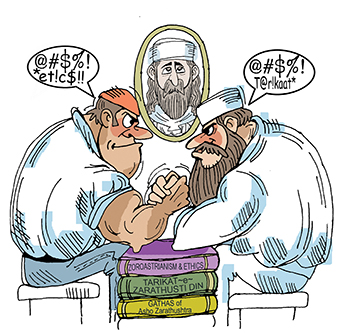
Illustration by Farzana Cooper
Berjis Desai responds:
I have not written that righteousness and ritualism are "disparate,” or that "one must either lead an ethical life or be steeped in rituals.” On the contrary, this column simply presents conflicting views, without any bias. Sarosh Manekshaw further states that I have "associated Zoroastrian rituals with paganism” and that I "condemn rituals.” Both these statements are grossly incorrect. Manekshaw’s angst possibly arises due to my column publicizing certain rituals (like a naked priestly candidate jumping upon nine stones).
Lastly, Manekshaw states: "We have people who practice rituals and are highly ethical, and then we have people who do not believe in any rituals who are completely immoral.” He perhaps forgets that there are also people who do not believe in any rituals, and are yet highly ethical.