A photo exhibition highlighted the achievements of three groups
of Parsi cyclists who collectively travelled 265,000 km around the
world in the first half of the 20th century
Farrokh Jijina
When Kaikee Kharas, Rustam Ghandhi and Rutton Shroff were lost in the snow-clad mountains of Afghanistan in the mid 1930s on a nine-year cycling expedition around the world, they knocked on the door of a shepherd asking for food and shelter. The herdsman shared his humble meal with them and provided them place to sleep in, but was nowhere to be seen next morning. When the trio went looking for him in the snowy wastes, they found him deep in slumber and nearly dead. They had to rub his limbs and revive him.
This was but one anecdote from the exploits of the trio who between 1933 and 1942 cycled 84,000 km over five continents. The photo show "Our saddles, our butts, their world: Global rides on humble bikes by Indians in the 1920s” at the National Centre for the Performing Arts’ (NCPA) Piramal Gallery from May 10-14, 2019 covered three separate journeys completed by seven Parsi cyclists who travelled the world in the first half of the 20th century. They were "the only Indians to do so – through a Europe devastated by two world wars, newly-emerging America, strife torn East Asia, deserts of Sahara and Mesopotamia, rainforests of the Amazon, and the Alps and the Andes,” as noted a write-up on the exhibition.
Former journalist Anoop Babani, who curated the exhibition with his wife Savia Viegas, told Parsiana, "There is so much interest in sport today and these cyclists undertook their journeys when things were so primordial… They only had rudimentary maps and compasses… Their travels need to be celebrated.”
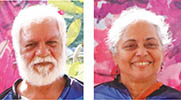
Anoop Babani and Savia Viegas
(Top) (L-r) Rutton Shroff, Rustam Ghandhi, Kaikee Kharas,on a nine-year cycling tour;
(Above) (l-r) Adi Hakim, Jal Bapasola and Rustom Bhumgara on their return
(L-r) Decoration on a cycle used by Rutton Shroff, Rustam Ghandhi, Kaikee Kharas;
Cover of the book by Shroff, Ghandhi and Kharas; Advertisement from Benson Cycles,
the brand used by Adi Hakim, Jal Bapasola and Rustom Bhumgara
(Seated on the floor, from l) Bapasola, Hakim and Bhumgara with the Indian community in Hong Kong;
(Inset) Inspiring memoirs by Hakim, Bapasola and Bhumgara
(Top l-r) Khushroo Suntook, Babani, Viegas, Nandita Anjaria and Mukesh Parpiani;
(Above) Gustav Sztavjanik and Framroze Davar (2nd and 4th from l) felicitated on their return to Bombay
Inaugurated by NCPA chairman Khushroo Suntook, the arrestingly captioned 58 photographs on show were collected from the families of the cyclists. "Most were very forthcoming in sharing stories, documents and images,” appreciated Babani. Besides their travels, the photos included those of receptions given to the men in cities as diverse as Alexandria, Tehran, Shanghai, Hong Kong and Lorenco Marques; extracts from commendations by Jawaharlal Nehru and the Pope; and images of press clippings from cities they travelled through. "I have more images but these are the most striking ones,” stated Babani.
While crossing a flooded river in Portuguese East Africa, Kharas almost lost his life, noted his son Ariez, who spoke to Parsiana on May 15. "For a moment we were too horror struck even to cry out…We were about ready to give them (Kaikee and a native helper) up as lost when to our great delight we saw two heads bob up and down (in) the seething foam,” wrote the co-cyclists in their memoirs Across the highways of the world. They were "being rapidly carried towards the open waters and then, as if by a miracle, we saw them extend their arms and reach for and grasp a protruding thorn bush. They hung on in spite of lacerated palms and fingers until we managed to reach them and pull them to safety.”
In Turkey, the trio of Kharas, Ghandhi and Shroff was suspected of being British spies and held prisoner in a hotel with three armed soldiers stationed outside their door, they wrote. It was some days before they were allowed to move on with soldiers on horseback escorting them. As the horses could climb faster than they could cycle with their heavy loads up steep gradients, "our kind comrades would assist us by affixing their bayonets to their rifles and gently prodding us where we felt it most,” as noted their memoirs.
Crowd funded!
While one would today associate the term "crowd-funding” with an electronic platform, the sextet of Adi Hakim, Jal Bapasola, Rustom Bhumgara, Keki Pochkhanawalla, Nariman Kapadia and Gustad Hathiram funded their cycling trip "by the sale of cards and by (their) own exertions!” The proposed routing of their 1923-28 adventure was explained in the cards which read "Anything that you give us…will be greatly appreciated.” Of the six, only Hakim, Bapasola and Bhumgara completed the 71,000 km round trip. Kapadia aborted his trip in Persia. Pochkhanawalla left the group in London, while Hathiram dumped his cycle in the Hudson River on reaching New York.
Babani noted, "You need to remember they were very young men… a lot of the cyclists had left India with little money in their pockets…some even without informing their parents.” The Shah of Persia, with whom they were granted an audience, wanted to keep some of them in his employ. All six riders were members of the Bombay Weightlifting Club, and employed in the 11th battalion of the 2nd Bombay Pioneers of the British Indian Army, as noted a photograph of the cards they sold. "They were real toughies, you see,” observed Babani. Their Swiss escapade included being rescued by a Saint Bernard dog sent by a monk from an abbey on a hill, when lost in the Alps. The cyclists kept in touch with their families in Bombay via telegrams sent care of the newspaper Bombay Chronicle’s offices.
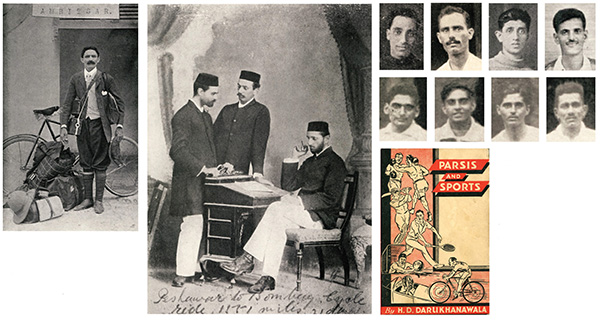
Extreme left: Hormusji Soonavala: started cycling in 1896; center (l-r) J. Bam, C. Mehta and J. Pochkhanawala: cycled from
Peshawar to Bombay; (l-r) 1st row: Cyclists K. C. Daver; C. S. Patel; Burjor Engineer and Behram Irani;
2nd row: Jolly Shroff, Jal Pochkhanawala, Minoo Master and Phiroze Dhondy: winners of the 100 mile race in 1929;
above: impressive tome Photos: Parsis and Sports
Top: Framroze Davar and Gustav Sztavjanik (seated, 4th and 6th from l) in Lagos;
Above: Sztavjanik (l) and Davar in Japan with local ladies; duo in South America
Exhibition photos curated by Anoop Babani
An Indo-Austrian partnership
Of the three journeys, Babani considered the seven-year journey of Framroze Davar and his Austrian cycling mate Gustav Sztavjanik the most rigorous. This duo travelled 1,10,000 km across 52 countries and five continents between 1924 and 1931 (see "Around the world in seven years,” Parsiana, June 21, 2012). Twenty-three of the 58 photos on display at the exhibition are images from Davar’s and Sztavjanik’s sojourn. About seeing a cobra on the handle bars on his bicycle in Africa, Davar is reported to have said, "I was more scared than I would have been had a tiger showed up.”
"Forest fare/ No matter where / Monkey or bat” read the words in a silent movie made after the duo’s return to Bombay. Playing in a continuous loop in a corner of the Gallery were scenes in grainy black and white. The film recreated the duo pitching their tent in a jungle, walking their cycles through waist-deep water or lighting fires to cook meals. Actual footage of a public reception given to the duo by Bombay’s sheriff P. J. Marzban and a felicitation by the Austrian consul at Bombay’s Flying Club were included. As notes H. D. Darukhanawala’s Parsis and Sports, "The two intrepid travelers brought with them to Bombay a collection of rare and interesting objects.” They arrived in the city in March 1931 and were accorded "a very enthusiastic reception” on the Esplanade, and were received by governor Sir Frederick Sykes.
What could have been the cyclists’ inspiration? "Remember that the 1920s was when sporting activity was at its peak in the city. Many American and British cyclists were passing through Bombay. And anyway, the Parsis were close to the British…But all the memorabilia I have gone through suggests that they did it for ‘the Motherland (India),’” noted Babani.
In her study "Disciplining the Body: Parsi Physical Culture Clubs in Bombay City c. 1850-1950,” Namrata Ganneri, Avabai B. Wadia Research Fellow (2013-14) of The K. R. Cama Oriental Institute and lecturer in history at Shreemati Nathibai Damodar Thackersey Women’s University noted that an important reminder of the Parsi connection to cycling is the Parsi Cyclists Club, which is more famous for producing outstanding cricketers. "But true to its name, it actually began as a cycling club, founded by Mancherji Kapadia, Kaikhusroo Mistry and Eruchsha Baria in 1909. While little is known about these three men, we do know that the sport was enthusiastically embraced by the community, so much so that a line drawing of a cyclist adorns the frontispiece of the iconic Parsis and Sports,” she noted.
Writing a chapter "The sporting Parsi” in Parsis and Sports, prolific penman J. R. B. Jeejeebhoy notes that "the Parsis... have won their spurs (in cycling)... both in India and in Europe.” He noted that barrister Rustom Wadia was awarded the Championship by the Wheel Club in 1897 in England for having covered a mile in two minutes and 25 seconds. In February 1930, Cooverjee Patel cycled continuously for 50 hours and 45 minutes on his push-bike, covering 297 miles. This constituted a world record, Jeejeebhoy noted.
With Cyclists Around the World, a book by Hakim, Bapasola and Bhumgara about their travels (see "Fire in your belly,” Books, Parsiana, May 7, 2008) set Babani off on his own journey of discovery. "There was a reference to Davar at the back of the book… when I did further research, I got to know about the nine-year journey of Kharas, Ghandhi and Shroff,” he noted. "And anyway I am a Bombay boy, I have grown up being surrounded by Parsis, I admire Parsis, I worked for ACC (Associated Cement Companies), which was largely staffed by Parsis.” He and his wife now live in Goa.
"There is a lot more that needs to be documented of the journeys of these men,” stated Babani, who explained that he had curated the exhibition from his personal savings. The Piramal Gallery was kind enough to extend a 50% discount on their exhibition charges, he appreciated. "The families of the travelers have diaries, gloves, helmets, riding gear and compasses belonging to the globe-trotters. This photo exhibition is my personal appeal to a business house or an organization to come forward and build a permanent gallery or museum” to perpetuate memory of these men, he stated. "I believe that once a museum is established, it will be easy to approach the government for honoring these cyclists…either (by) a national award posthumously, or including their diaries and books in school curricula as these offer amazing insights into (the) world of a century ago,” Babani ended.