As a person who has been regularly driving on Indian highways for 54 years, I wish to question the irresponsible accusation by some that Dr Anahita Pandole was "overtaking” from the left when the accident occurred ("The lows of high ways,” Editorial Viewpoint, Parsiana, September 21-October 6, 2022). "Overtaking” is when the car finds a slower moving vehicle directly in front of it and breaks its lane to move to the right or to the left to pass it. A different situation arises when a driver who is consistently driving in one lane — be it the left, middle or right — happens to pass by slower cars in the next lane to his/her left or right. This is not overtaking; it is simply a good driver observing lane discipline.
In the absence of either eye-witnesses or CCTV (closed circuit television) evidence, one cannot accuse Pandole of "overtaking from the left” just because the crash occurred while she was in the left lane. She might have been driving consistently (and blamelessly) in the extreme left lane in order to pass overloaded lorries hogging all the other lanes to her right.
Converting lane driving to "overtaking” appears to be a ploy to shrug off responsibility by those guilty of the chronic neglect of road design, construction and maintenance.
PHIROZE B. JAVERI
phiroze.javeri@gmail.com
Congratulations once again on a brilliantly worded and most timely editorial ("The lows of high ways,” Parsiana, September 21-October 6, 2022) on the need to wear seat belts. I welcome your concluding suggestion that it is preferable to take the train — to Udvada or wherever! Nitin Gadkari, minister for Road Transport and Highways in the Government of India, has said that he is working on having a device installed in the rear seat of cars that emits a continuous irritating sound when the seat belt is not fastened — an excellent innovation.
And I loved Berjis Desai’s piece "Not my god” on Behramsha Shroff in the same issue — especially gems like "traffic problems on the Chinvat bridge” and "post-dhansak hallucination” (indulged in by all Parsis of the old school, like myself). I was reminded of dear old Dr Jehangir Wadia whose parodies on Shakespearean plays (like Bholi Gool for Hamlet) — plays in which he himself always took part — and were most hilariously performed! After him, my dear friend Dr Jimmy Sidhwa continued the tradition for a while and greatly amused us all.
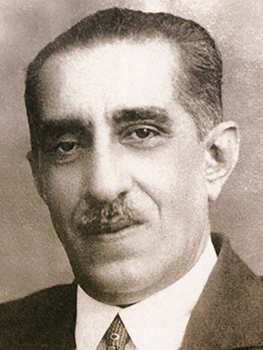
Dr Jehangir Wadia: "top of the pops"
Photo: Courtesy Nawaz B. Mody, Enduring Legacy from Meher Marfatia’s Laughter in the House
But Wadia was simply "the top of the pops.” For instance, when he welcomed on stage a so-called prominent Zoroastrian priest from Iran who had supposedly come for the coronation of the mythical King Harishchandra, Wadia told his assistant to pack up for his long return journey "ék batak nu eeda no poro (an omelette made from a duck’s egg)” and "ék kachhu keru (one raw banana)!” At this generous offer, the Zoroastrian priest from Iran broke into a sad song, only the first few lines of which I recall: "Mumbai to mané ba gumtoo nathi/ Marooch ké jeevooch koi jautu nathi!/ Asodad ma dorya koi nakhthoo nathi,/ Né mobed ni sarum koi rakhtoo nathi!/ Mumbai na Parsio ma malé nahi dum/ Chhé sadu sukalia né bhéja na kum/ Akho daro poree-o né teekia karréch/ Soo énu kapal eh sumji maréch! (I do not like Mumbai/ Nobody bothers whether I am dead or alive/ No one offers money as asodad/ And nobody respects the mobed./ Mumbai’s Parsis have no gumption/ They are simple and mindless/ And ogle at females all day./ What do they think of themselves)?”
Wadia was a genius and those who have not seen him perform on the Parsi stage have missed something precious!
FALI S. NARIMAN
New Delhi
falinariman@gmail.com