A nankhatai band arrived for the navjote which
was performed in the front yard of the family bungalow
Arnie Mehta
Extracts from Arnie Mehta’s account of a happy, carefree and fun-filled childhood in their ancestral home in the village of Davier, written for her family, are reprinted here with permission.
On festive days a group of men would dress in colorful costumes and dance for us before going through the village collecting money. The women did likewise, and all showed a natural sense of rhythm and grace. The best were the Warlis, tribals who came from east of the railway lines. With accompaniment by a wind instrument of their own making, they performed what appeared to be a snake dance. The men and women locked shoulders and danced in perfect step to the same monotonous tune, and yet it was a joy to watch. They were so physically fit and could, with grooming, have been beauty contest winners. The same is true for the fisherwomen, one of whom we referred to as (noted Hollywood star) Jean Simmons!
About a hundred people worked in the fields, orchard, house, the flour mill and tended the horses and cattle. Once a year they and their families were given a feast of rice, dal (lentils) and mutton cooked in the open on a wood fire. I think we enjoyed the day just as much as they did. There would be singing, dancing and sports and no shortage of food. Prizes were awarded for winners of sporting events, and everyone went home with a small gift. The people lived a simple and frugal life in their one-room, thatched roof huts with a sleeping/living area and cooking on a wood fire in a corner. A few pots, whose lids also served as plates, was all they needed. On a visit to the village many years later it was good to see our old domestic help living in greater comfort and prosperity thanks to their progeny working in cities and sending money.
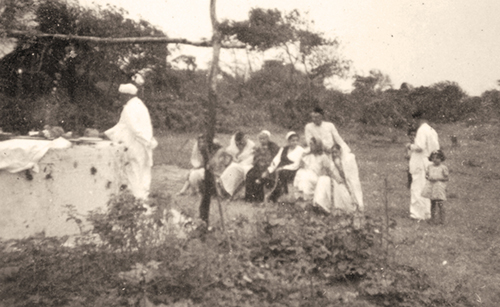
Priest reciting prayers at a well Photo: Sorab Engineer
The front yard was where I had my navjote in 1946, officiated by two priests, brothers, from our local agiary, who prayed beautifully and were a pleasure to hear. Relatives came from Bombay to attend the festivities. Manecksha Bulsara, our family caterer who organized the meals for everyone, was the butt of many a joke which he took in good humor. For a morning navjote, a child must fast from sunrise until the ceremony is completed, so breakfast was given to me in semi darkness by Mehru Mami who cooked me a scrambled egg on a Criterion stove that had been brought into the upstairs bedroom. These slow cooking stoves were ideal for making eggs. But they are no longer in use as who has the time? At daybreak a nankhatai band (motley musicians dressed in white and red playing brass instruments and drums) arrived from Udvada, organized by two friends of Dad, because we of course would never have asked them to come. They also arranged performances of katha kirtan (devotional musical recitations) in the morning and afternoon that were well-received by the cheering audience. It was a perfect day and one that I remember vividly.
In 1942 Maiji, my maternal grandmother who lived in Bombay, along with her sons, our mamas (mother’s brothers), thought that it would be wise to build a house away from the city in case of bombing during World War II. So they bought ocean-front land and employed local carpenters and masons, and used high quality materials to build an excellent house in no time at all. Made with basic tools and equipment, it has stood the test of time, and to this day has never needed major repairs. Meanwhile, family friends, the Engineers, built an almost identical house on an adjoining plot. Through the years countless relatives and friends have stayed to enjoy the ocean, the serenity and peace at Maiji’s bungalow. I remember only one lady who said she missed the noise and bustle of Princess Street where she lived above Parsi Dairy Farm!
In the early ’40s, a fancy dress party was organized at the bungalow, during the time when many cousins had come down from Bombay for the Christmas vacation. My Keku Mama was Santa Claus, and a friend, Kaikhushroo Lala, was the judge for the competition. It was really a most enjoyable day.
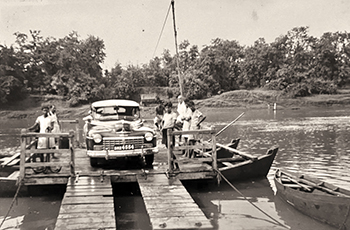
A car being ferried across the river Photo: Sorab Engineer
Next to the bungalow was an older house belonging to Dad’s cousin Vicaji’s family. Whenever his wife Tehmina came from Bombay to stay in her house she would write to Mum, addressed to Patel Castle, asking to have her place cleaned and aired out. We kids would enjoy going over to supervise the cleaning and make a picnic of it. Curtains were hung, the lovely crockery was brought out (in those days only English and Japanese), and beautiful crocheted spreads were draped over the divans. Mum would send our lunch in one of our much-used tiffin boxes, and after eating it was time to chat, read the many magazines lying around, and enjoy the sea breeze. To add to our pleasure, Tehmina Aunty brought toys for us, and we enjoyed the company of her two children Manijeh and Dadi.
Just a few days before writing this I had told Dadiba that whenever I think of their house in Davier, I remember climbing into their attic, seeing dry coconut shells that they must have used as floats. I have always believed that attics are very interesting places to explore. Ours was huge and had natural light coming in from a gap between the roof and the walls, and was a storage place for our year’s supply of onions hanging in braids. There were also things that "might come in use some day,” based on the universal belief when one has space, one must use it. After all, what are attics for, anyway?
How simple were our joys. Going to Umbergaon station two-and-a-half miles to the east in our tonga was fun. We could see our house from the train. The station was quite small and the platform too short to accommodate the entire length of a train, so invariably the ladies’ compartment would be beyond it. Dad would request the guard to please move the train enough for Mum and all of us to get on or off safely. Dad would often take the train to Bombay for a quick trip, and always hurried back to Davier the same evening. If he caught a fast train on the return journey, it would not be scheduled to stop at Umbergaon, so he would request the engine driver to slow the train down just enough for him to jump off!
We were privileged enough to be allowed into the signal room and the booking office because Dad knew everyone, and everyone was his friend. Fast trains and goods trains did not stop here so as little kids we thought it fun to count the bogies as they sped past. Another fun thing, and there were many, was to weigh ourselves on the luggage steelyard to see if we had put on any weight from eating all day long! The waiting room we found was usually empty, and despite playing often on the benches, we were lucky not to have brought back any bedbugs. On one wall of this waiting room were framed photographs of then Prime Minister Pandit Jawaharlal Nehru with excerpts from a speech delivered to the nation in Delhi on June 6 (they forgot to mention the year). Nehru stated "If bribery and corruption are not put down in the near future, it will spell the ruin of India. Cast aside these anti-national and dirty practices. The giver is just as guilty as the receiver.”
One day when I was about six years old, Dad took me to Umbergaon town because he had some business at the courthouse. Davier being too small to have its own court, legal matters of the village were settled in Umbergaon. My two memories from that day are seeing some prisoners in their cells, and going to the court which was a huge chamber (though when one is young, everything looks bigger)! The fan there caught my attention because it was the first time I had seen such a contraption. It was a large, old fashioned punkha with frills of cloth suspended from the ceiling on a rod, and pulled manually by a rope attached to it. The operator of the fan sat in one corner, pulling at the rope in a rhythmic fashion, and it was said that when his arms grew tired of pulling, he attached the string to his toe and continued doing his job in that way.
Many years later we went to Umbergaon seaside especially to see a dead whale that had been washed ashore and half sunk in the sand. Of course the local youngsters had gathered around, most excited. But oh, the smell was terrible! I believe the entire body sank into the sand eventually.
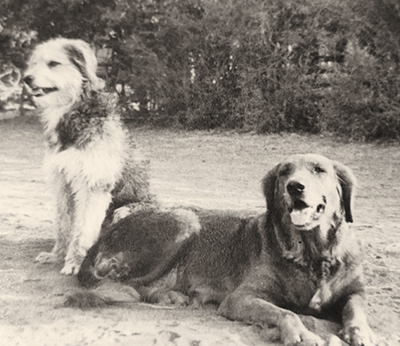
The family dogs, Zumba and Peggy
Those were healthier days! Milk from our buffaloes was aplenty, and we sometimes lined up with mugs in hand to get it directly from the animal, warm and sweet. At Mum’s urging I often gobbled up a freshly laid egg — raw, warm and delicious! With no electrification in town, we had no refrigeration, but milk and cooked food did not spoil easily if placed under a net on the cool dining room window sill. For a brief time we had a refrigerator that ran on kerosene, but it didn’t work for long. Excess milk was added to yoghurt and churned into butter which was then made into ghee. Buttermilk was fed to the chickens, mixed with vegetable peel, raw onions and table scraps.
The chickens were free to run around the back garden but in the evening they were put into baskets especially made for them. Whenever a new chicken was added to the flock, it was slipped into the basket under cover of darkness so that in the morning the others wouldn’t notice that it was new and peck at it. Traditionally, every May we had a special lunch of a whole roast spring chicken each, with accompanying vegetables. They were not very large birds, but a lot tastier than what is available now.
Beyond the mill, going towards Bordi which was the next village, lived the bamboo basket makers, and we ordered many of their products especially during the mango season. Many, many years ago, even our flowers were sold in Bombay through a supplier at Crawford Market. I especially remember the fragrant tuberoses. We also bought wide baskets into which hens were put at night. To store paddy in the godown, a huge strip of bamboo-matting was made, about five feet by 15 feet, tied up at the ends to make a cylinder. A layer of hay was placed at the base before the paddy was thrown in. Finally, the top was sealed off by a layer of cow dung. All this preserved the paddy for planting next year. Concluded