Jiyo Parsi hopes to increase matrimony within the
community with the launch of the Parsi Shaadi App
Parinaz Gandhi
Maara pappa ni chhè motor gaari, Maara mamma ni chhè phool waadi, Maara kaka ni chhè ghora gaari, Taubi rahi gayee hoo kumari. The lyrics of the popular Parsi Gujarati song of yore expressing the distress of a daughter who remained a spinster despite having a father who owned a car, a mother who owned farms and an uncle who owned a horse carriage were recalled by Parzor director Dr Shernaz Cama at the launch of the Parsi Shaadi App at the Banaji Atash Behram Annexe Hall on July 6, 2019. As one of the initiatives of the Jiyo Parsi program supported by the Government of India to increase community numbers, the Parsi Shaadi App developed by the online matrimonial service portal Shaadi.com is endeavoring to supplement the activities of the traditional kaajwali (matchmaking) ladies and matrimonial bureaus to promote marriages within the community.
"We are extremely grateful to all our aunties… who over the years have tried to get community members married,” noted Cama. However, looking at the gravity of the situation where "30-40% of this very tiny community scattered globally remains unmarried,” she felt greater efforts are required to defuse the crisis. "All of us live on our phones. For the young, the phone is almost the palm,” commented Cama when moderating a panel discussion on "A Wholesome Work Life Balance.” She added, "I think the Parsi Shaadi App is a brilliant idea. A lot of people have got married through Shaadi.com though they don’t want to admit it… It gives privacy to our young.”

"We understand matchmaking but not the Parsi community,” admitted Pamit Anand, vice president and business head of People Interactive India Private Limited, that owns and operates Shaadi.com and other portals. According to him, Shaadi.com has made six million matches globally. He referred to the fun they had developing the Parsi Shaadi App which is "the first time Shaadi.com has done for any one community” and hoped "to make it better and more unique.” As a software engineer he said he finds a lot of fulfillment in his work "helping a person find a life partner.”
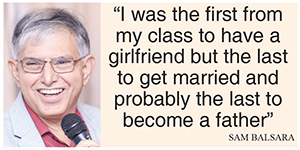
Having come from Bangalore to Bombay to study management at the Jamnalal Bajaj Institute, Sam Balsara, chairman of the Madison World Group that has spearheaded the earlier Jiyo Parsi campaigns, recalled that "I was the first from my class to have a girlfriend but the last to get married and probably the last to become a father. Whilst it was okay to chuckle about this in my time, now it has become a serious demographic issue… The time to act is now. Put in a word, gently, persuasively. The psyche of our young is such that they don’t like to be told what to do, and especially not by their parents… I sincerely hope this digital App will fill a gap” for the singles who can refer to it without anyone knowing. The only one among three brothers to get married, he referred to the isolation of his brothers and a cousin in Bangalore, each living alone without a family.
"Parsis have the same infertility issues as other communities. They are pathologically no different,” asserted gynecologist Dr Anahita Pandole, clarifying that late marriages and delayed conception at around 35 years of age when fertility is dipping compounds problems. As a consultant for the Jiyo Parsi campaign helping couples to conceive, she noticed that all barren couples don’t need IVF (in vitro fertilization) to conceive. "Some needed counseling, some needed guidance, some needed investigation and a study of their reproductive cycles.”
Candidly admitting that balancing a marriage with a job "is not easy, it is difficult,” Mehernaaz Dhondy, editor of Grazia, India, the women’s fashion and celebrity gossip magazine, confirmed that "personal time takes a definite setback.” She also noted that a person being able to focus "100% at work and at home is a myth.” She shared the joys of being with her two children "for two hours at the end of the day.” Since her husband works for Air India and she is often the only one taking charge of her children, she considered that time with the kids "a stress buster,” although she knew well that children could also cause stress. Very clear that "I wanted two children before I was 35,” Dhondy stated that at 30 years of age a woman may not be worried about her ovarian cycle. Fertility problems arise when conception is delayed and then perhaps the couple may be compelled to have only one child. She further referred to the 50-year age difference between her and her father, wishing she could have had more time with him before he passed away two years ago.
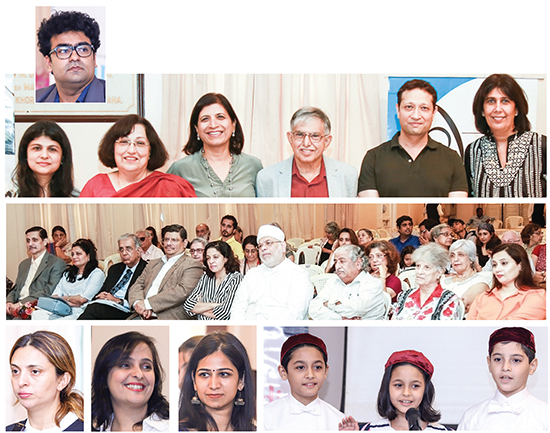
From l, top row: Mehernaaz Dhondy, Dr Shernaz Cama, Dr Pervin Dadachanji, Sam Balsara, Jimmy Mistry,
Dr Anahita Pandole, (inset) Pamit Anand; 2nd row: a section of the audience; 3rd row: Pearl Tirandaz, Pearl Mistry,
Kritika Mudgal, Mazdaa Davar, Mafrin Davar and Ervad Kayomarz Dhabhar
A firm advocate that "everything in life happens at the right time and right place,” Jimmy Mistry, chairman and managing director of the Della Group and former Bombay Parsi Punchayet trustee, mentioned that "in 1998, the first office of Shaadi.com was designed by me.” Observing that "97% present today are not youngsters,” he recommended that a workshop be conducted with 200 youth from the 18 to 28 age group to understand what they want and need. Having married at the age of 21, he refused to empathize with community youth who delay marriage saying "ghér nathi (there is no accommodation available).” Youth from every other community gets residences on their own. "Unfortunately there is no elder in our community and no elder in the family for counseling.” He felt it necessary for community organizations to consult a design thinking site like Ideo, offering solutions to world governments with pathbreaking research on what is going wrong and can be set right.
When Parsi couples have children at a late age, by the time a child reaches adolescence, the mother is at the menopausal stage. "This combination is really bad” for the family then has to deal with "two sets of hormones!” observed chief guest at the evening function, Dr Pervin Dadachanji, a psychiatrist. Earlier in the evening she had given a talk on "Yes We Can: Marriage Myths and Reality” (see "Myths about marriage”). Working mothers looking after their job as also domestic responsibilities plus children, should "give perfectionism a toss, accepting that we cannot do everything perfectly… As mothers we put too much pressure on ourselves. Learn to say ‘no,’” she advised. She also felt that working mothers should not hesitate to ask their mother and mother-in-law for help and urged parents "to bring up their sons to work in the house.”
A short film by Shaadi.com showed advertising professional Vistasp Hodivala and his microbiologist wife, Dr Anahita who met through their marriage portal and now have a 11-year-old son. As Vistasp pointed out, community members tend to be "so choosy that they don’t realize when they turn 40.” While Vistasp expressed "a huge sense of gratitude” to Shaadi.com, Anahita remarked that interacting through Shaadi.com is "not like an arranged marriage” for it gives an individual the option "to select whom you want to meet… Both of us didn’t want the families involved unless we had decided.” Admitting that a marriage can be "difficult,” they nonetheless recommended it saying, "it is worth taking the risk.”
Cama faulted the Parsi parents who emphasize that their children should "complete their education, earn their PhD, get a job” before contemplating marriage. The psyche of the youngsters was equally to blame when at 30 years, a female says, "I am too young to get married” and if unable to find a partner as she gets older, "loneliness sets in and she retreats into a shell.” Cama referred to her 31-year-old son who is yet looking for a perfect match and as pointed out by his cousin, "by the time he is able to tick all the boxes, he will be 80 years old!”
Parsis who reached the venue prior to the start of the function on July 6 were required to fill up an attendance sheet specifying their name, address, contact details, age, irrespective of whether they were seeking a matrimonial partner. The nearly 30 singles who took the trouble to attend were rewarded with a Jiyo Parsi T-shirt. They were also urged by Jiyo Parsi public relations officer Pearl Tirandaz to download the Parsi Shaadi App that is currently accessible only from Android phones and to register on it. While registration can be done by the person seeking matrimony or someone else on his/her behalf, filling of certain fields are mandatory like email address, country/city/state of residence, educational qualification and education field, annual income, height, smoking and drinking habits, marital status that can range from never married to divorced/awaiting divorce/annulled, and finally a brief description of the person. The App is currently in its "Beta phase,” when the software is feature complete but likely to contain a number of known or unknown bugs.
In response to a clarification sought by Parsiana, Anand stated, "The Parsi Shaadi Ap is a freemium service offered to all Parsis from around the world. Every user can register for free on the platform and will have access to around 1,700 existing profiles. That said, in order to interact with the matches on the platform a member will have to opt for the premium service which starts at Rs 4,600 for three months and goes up to Rs 12,000 for 12 months.”
The function commenced with a brief welcome by Jiyo Parsi counsellor Pearl Mistry and the singing of monajats by young children and ended with a vote of thanks by Kritika Mudgal, program coordinator, Parzor Foundation, and refreshments.
Myths about marriage
What are the words one spontaneously associates with marriage? Dadachanji asked the audience, an overwhelming majority of whom were middle-aged parents.
"Compatibility…adjustment…compromise… love… problems at home… arm candy…” were the instant responses. Expecting to hear a higher number of positive associations, Dadachanji proceeded to elaborate on the theme of her talk, "Yes We Can: Marriage Myths and Reality.” A common fallacy is the assumption that "a partner should know what to say or do to make one happy… She/he is not a mind reader. Communication is the key in a relationship,” stressed the psychiatrist. An ‘I message’ conveying how ‘I feel…’ instead of accusations of "You did or didn’t…’ makes it easier for the partner to understand without getting defensive, she added. The second myth claims if you have a difficult marriage, having a child is going to bring you closer. "Sort out your problems and then have kids,” she advised. The fear that differences in personality will ruin a marriage, she quelled by asserting that "Differences should be celebrated. Continue sharing your lives/stories as you did whilst dating.”
Who says happy couples don’t argue? "How you argue is important,” she explained, "without shouting, hitting below the belt or being nasty.” If anyone claims there is "no argument in our marriage, there is something untruthful about that.” Happy couples do everything together, is yet another myth. With varied interests, it is impossible to enjoy doing everything together. Despite the adage "never go to bed angry,” she felt differences may be settled even after one or two days. For conflict resolution to be effective, she stressed there should be no criticism, stonewalling or sulking, defensiveness and contempt. In the current scenario of extramarital relationships, "working on a marriage all the time is important. It is not lack of love but lack of friendship that makes unhappy marriages. We should be able to say that our spouse is our best friend,” she concluded.