The first Kadmi fire temple, a dharamshala and a dakhma in Bombay
were built by the Dadysett family who embraced the new sect
Rustam B. Paymaster
A Short History of The Dadysett Religious and Charitable Trusts with the Scheme for Their Management Sanctioned by the High Court was penned in 1928 by well-known writer Rustam B. Paymaster, editor of Parsee Prakash. A copy of the tract was shared with Parsiana by a reader Diana Rutnagar who is related to the family. We reproduce here excerpts from the treatise.
Dadybhai Nusserwanji (1734-1799), the founder of the Dadysett family, and himself known as Dadysett had carried on extensive trade with China, Bengal and Europe. He owned five large ships for that purpose. He was very enterprising. He used to export cotton and other commodities to the above places and in 1776, at the age of 41, started the first screw (cotton) press in India. It was situated in a commodious building, afterwards known as Sassoon Building, where lately the Bombay Chronicle Press was situated. He amassed a large fortune and was a leading Parsi of his time.
Top: Dadybhai Nusserwanji, founder of the Dadysett family; above: son Ardeshir Dady
Dadysett was the first Parsi in Bombay to observe in 1780 the new Kadmi calendar as advised by Mulla Kaus Rustam Jalal and his son, the famous Mulla Feroze (who had been specially deputed to Persia for studying important religious questions affecting the Parsi community). Dadysett became the leader of the Kadmi Zoroastrian sect. For the use of the members of the Parsi community, and particularly the new Kadmi sect residents in Bombay, and for the support of the Zoroastrian religion, Dadysett erected a fire temple (atash behram) on land admeasuring 6,333 sq yds situated on the north side of the lane named after him and known as Dadysett Agiary Lane. The land was then known by the name of its Portuguese owner, Oart Degar, and the said temple has been since then known as Dadysett’s Atash Behram which had been dedicated on September 20, 1783 to the Parsi community for the purpose of celebrations and divine worship in the manner and according to the customs of the Parsis.
Dadybhai also erected a dakhma or family tower of silence at Chowpatty upon an extensive piece of land admeasuring 37,797 sq yds, which he had specially purchased for the purpose, and caused the same to be consecrated. Before the construction of the dakhma, Dadysett made a petition, dated January 11, 1797 (two years before his death), to Jonathan Duncan, the then governor of Bombay, requesting permission to erect a dakhma for the reception of his body after death. The petition said:
"That the advanced age and infirmity of your petitioner causes him to contemplate with a considerable degree of resignation the close of his arduous worldly labors. Hence, your petitioner is desirous in conformity to the principle of his religion, to provide a suitable receptacle for his remains when that awful period shall arrive. With this view your petitioner has obtained at a considerable expense a sufficient spot of ground at the foot of Malabar Hill in the vicinity of the tomb of one of his castemen Muncha Jivan [Muncherji Jivanji Readymoney (1711-1786). He was erecting in his wadi a separate dakhma, but before it was completed he died, so that when it was ready, it was consecrated exactly a month after, and his body was consigned to it on his masisa day i.e. the day of the next month of his death. In the meantime it was left covered in a chotra putting his gehan on the body (Parsee Prakash, Vol I, pg 67)], for the purpose of erecting, under his own immediate inspection, a humble tomb for his reception after his dissolution shall have taken place.”
The petition was sanctioned on the condition that it is "only a private family tomb.”
The Dadysett dakhma was built and consecrated on April 22, 1798. Dadysett at the same time allotted the income, profits and produce of a garden adjoining the said dakhma and forming the residue of the said land and conveyed it for the purposes of defraying the expenses of religious ceremonies belonging thereto. The said garden was situated on the west side of Chowpatty on Malabar Hill Road. There was a bungalow also on this site. There were four fishponds being part of the foreshore of the sea surrounded by stone walls.
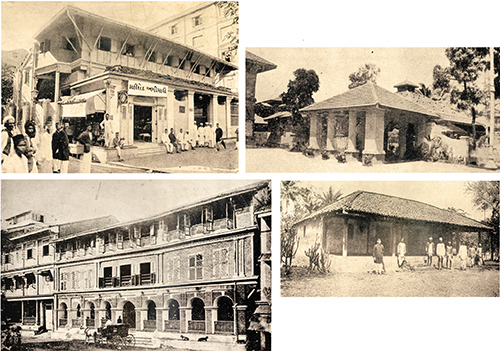
Top left: Dadysett Agiary at Fort; top right: front portal of Dadysett Atash Behram, circa 1783
Above right: Dharamshala at Dantora; above left: the Dadysett family home at Fort’s Cawasji Patel Street
with Humbaiji N. C. Dadysett’s personal horse-carriage outside
Portraits of Cursetjee Ardesher Dadysett (r) and
Nusserwanji Cursetji Dadysett (far r) Photos: Jasmine D. Driver
Dadysett had also erected on the south side of Todd Street [now Ghoga Street connecting Parsi Bazaar Street (now S. A. Brelvi Marg) to Hornby Road (now Dr Dadabhai Naoroji Road)] in the Fort, a second fire temple or agiary, the sacred fire of which was consecrated and dedicated to the use of the Parsi community. After the death of Dadysett, which took place on April 7, 1799, the sacred fire was removed by his son Ardeshir Dady in the year 1803 to a new building erected by him (Ardeshir) on land admeasuring 1,189 sq yds, on the east side of Hornby Road in the immediate vicinity of the said agiary in Todd Street, and known by the name of Dadysett’s Agiary, for the purpose of celebration and divine worship according to the customs of the Parsis. Ardeshir Dady allotted the rents and profits of a house adjoining the Agiary for defraying the expenses thereof.
On the site of this Agiary there was the dwelling house of James Todd which Ardeshir had purchased on behalf of his father on February 11, 1791 at a price of Rs 25,000 (£ 2,500) and a writing was entered into as evidence of the transaction. After this, on the death of Dadysett in 1799, Ardeshir resolved to build an agiary on a large scale and for that purpose he purchased on September 24, 1802 for Rs 12,001 two houses belonging to Nusserwanjee Rustomjee Banaji, and pulling down the said Todd’s house, he built, on the site of all the three houses, the Agiary known after his father. Thus Ardeshir purchased for Rs 37,001 the land on which he built a commodious building where in those days public meetings of the Parsi community were held.
The origin of this Agiary had been given by Ardeshir himself in a letter he wrote to the chairman of the Town Committee of Bombay on August 8, 1805, wherein he stated: "I beg leave to represent that my late honored father purchased the spot of ground in question [originally the plot on the site of which Sir J. J. Parsi Benevolent Institution, 209, Dr Dadabhai Naoroji Road) is now situated] in the year 1787, with a view to erect thereon buildings to charitable uses; but on his application for permission to do so, he was prohibited, the government intimating that the spot of ground would be required by the honorable Company for erecting a hospital or other public purpose… My father being disappointed in his hopes of erecting the building on this spot to the charitable uses he wished for and intended, was reduced to the necessity of appointing another place and places to such purposes some short time before his death and in consequence after his death I appropriated to such use the house which had been purchased from James Todd within the town walls for Rs 30,000, and for which I had been in the monthly receipt of Rs 200 for rent; also two other houses at the back thereof, from Nusserwanji Rustomjee Parsi, for Rs 12,000 for a compound to the use of the said church (Parsee Prakash, Vol 1, pg 96).”
Dadysett died on April 7, 1799 leaving two sons — Hormusji Dady and Ardeshir Dady. Dadysett had made his last will in the Gujarati language dated August 21, 1794 whereby he devised and bequeathed all his houses, gardens, ships, goods, effects and whatever other wealth there might be belonging to him to his son Ardeshir Dady and to the sons of Ardeshir. Ardeshir added to the said properties by erecting a parab or drinking place, near Mahaluxmi Road, and dedicated the same and the oart (garden) in which it was erected, to the use of the Parsi community. Ardeshir maintained this place and built a house in the oart for its keeper.
Ardeshir further added to the aforesaid charitable properties by erecting in 1805 a dharamshala at Dantora, near Bassein, and dedicating the same, with the land admeasuring 22,682 sq yds upon which it stood and the garden and batty fields surrounding the land, to the use of the Parsi community and of the public generally. This is known as Dadysett Dharamshala.
A suit was filed in the Supreme Court by Ardeshir Cursetji Dady, the manager of the Dadysett Atash Behram, against Bai Virbaiji, widow of Dastur Kharshedji Kaikobadji Mulla Feroze, and Dastur Cawasji Shapurji and another for ejecting them from the house in the Atash Behram premises in the occupation of the dasturs of the Kadmi sect. The suit was heard by Chief Justice Sir William Yardley, when it was contended on behalf of the defendants that since the late Dastur Mulla Feroze had spent moneys of his own for the erection of the house the defendants had a right to live in it. This was denied by the plaintiff adding that Dadysett had built the house for the residence of the Kadmi dastur and the mobeds under him and that his son Ardeshir had spent a large sum for rebuilding it. The court after hearing evidence passed a decree on February 23, 1856 in favor of the plaintiff ordering the defendants to deliver him possession of the said house (Parsee Prakash, Vol 1, pg 700).
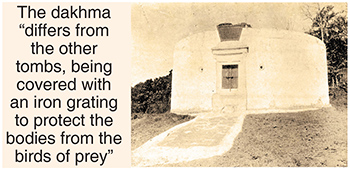
The following report that appeared in The Bombay Courier of April 7, 1798, describes the dakhma built by Dadysett for his and his family’s use:
The public curiosity has lately been attracted by the tomb which Dady Nasservanjee, the head of the Parsi caste, is erecting for himself and his family upon Malabar Hill.
It is not that the structure in itself is exclusively worthy of observation, but as one of the places of sepulture of an extraordinary people, which are seldom now open to access and as offering an exception to the common rites of the caste, it is well entitled to attention.
This, unless as a family tomb, and consequently less than the common receptacles of the dead, only differs from the other tombs of the caste in being covered with an iron grating to protect the bodies deposited there from the birds of prey, and it is this grating which is a departure from the ordinances of the caste, that however vindicated by a solitary example is still beheld as a species of ecclesiastical schism. In its present state it offers to view a plain circular wall, about 40 ft in diameter, with an opening to the east by a small iron door; within is a stone platform built with a small declivity from the wall, towards a circular pit in the center about 10 ft in diameter.
The platform is divided into two concentric ranges, each of which is again divided into about 30 radial compartments adapted to the exposure of as many bodies; the superior row near the wall for adults, the lower near the pit for children; from each of these compartments small channels are hewn in the stone to convey the feculences into the cavity below.
The pit in the center which is substantially built round like the rest of the tomb, with masonry, may be about eight feet deep, and is provided with four copious drains to carry off by the rains of the monsoon the putrid remains of mortality.
Such is the appearance of this building as it is now exposed to public view; a part however no less worthy of attention is concealed with the foundation which was laid with all the ceremonies prescribed by the Parsi law.
It is among the first tenets of the Parsi faith that each of the elements, and in short every part of the creation, are placed under the protection of its guardian genius, who are the objects of their prayers and supplications, according to their rank in the scale of precedence: the genius of the earth, called Spandomad, is among the superior order of spirits, and claims a considerable degree of respect.
Nothing is declared to defile the earth so much as a corpse, hence the most scrupulous ceremonies are devised to avoid such a pollution in the construction of the Parsi tombs. It would be in vain to enter into a detail of the rites necessary upon this occasion; suffice it that metal is conceived a necessary intervening medium; a certain number amounting to some hundreds of iron nails of a prescribed weight and size, are accordingly driven into the earth, in the direction of the eight points of the compass from center to the circumference of the tomb; these nails are then interlaced with a mystical cotton thread of a prescribed length and number of filaments. This done, with much prayer and mystery the foundation is laid, and Spandomad protected from insult.
The tomb is now receiving its last hand, and will be closed in about a fortnight with its usual ceremonies.