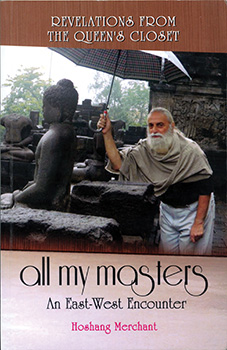
all my masters. An East-West Encounter by Hoshang Merchant. Published in 2019 by Queer Ink Publishing, 304 Quantam Towers, Malad (West), Bombay 400064; email: info@queer-ink.com; website: www.queer-ink.com. Pp: 288. Price: Rs 400.
all my masters is the result of the request of Hoshang Merchant’s editor who asked him for a sequel to the second part of his autobiography, The Secret Writings of Hoshang Merchant (2016). Merchant wondered, "What excitement would there be between old age and death?” and instead decided to write about his teachers to whom he owes a great debt. The word "teachers” is used in the broader sense of all persons who made him think or taught him how to think.
 His first guru was his mother and Merchant paints a charming picture of a woman who came from a rural, land owning family from Bulsar and consequently was given a chicken bone as a pacifier. She regaled her children with stories of the great wealth her family possessed. She was an unusual woman who saw Mahatma Gandhi go to Dandi on his famous Salt March, studied classical Indian music, frequented the Theosophical Society and instilled a love for poetry in the young Hoshang by reciting poems to him.
Equally moving is his tribute to his sister, Whabiz, from whom he was reluctant to be separated. "She led, I followed.” He read whatever she suggested and it was she who introduced him to Anais Nin, a writer and one of the masters who would shape his future significantly. His recollections of Whabiz’s suffering and ultimate death are extremely poignant. What is remarkable is that there is the perfect balance between pathos and objectivity in his writing which never descends into melodrama.
There are charming essays on Ms Frank, his grammar teacher at school "who was born to teach,” never raised her voice, never lost her temper and who never punished a student; Ms Billimoria, his "Rock of Gibraltar, who taught him English, history and dramatics,” and who helped him to cope with a grim domestic situation by inviting Merchant home for tea and taking him to restaurants as well as to The Importance of Being Earnest, his first play.
The next section includes his masters in America. We meet his two professors and father figures: Virgil Lokke, who was his father’s age ("it was love at first sight between the two of us”) and on whose behavior he always based his philosophy of teaching; and Wm. Bache who taught him Shakespeare and with whom he had a more uneven and tempestuous master-student relationship. And of course, there is Anais Nin, on whom he did his PhD and published a book In-Discretions. Particularly interesting is his account of the visit he makes after Nin’s death to her house in the Silver Lake area of Los Angeles and sees in her living room one wall which displayed her books, "in all editions and several languages from ceiling to floor.”
The Europe section contains encounters with film director and writer Pier Paolo Passolini, to whom Merchant had given his "body and mind.” He agrees with philosopher Antonio Gramsci who felt, with the passing of Passolini, "Italy lost one of its last ‘organic intellectuals.’” He also acknowledges poet Ezra Pound as one of his masters. He shows a personal and endearing side of Pound by way of an anecdote where the poet takes the trouble to reply to an eight-year-old who questions him about starting his poem with an "and;” he had been taught at school never to begin a sentence with a conjunction. Pound replied he was "carrying on where Greek author Homer left off.” The youngster was none other than poet and editor William Cookson who remained devoted to Pound.
 Particularly moving is his tribute to Prof S. Viswanathan, his head of department at Hyderabad University who supported him, was extremely sympathetic and even confirmed him in six months instead of the mandatory year. They shared a love of Shakespeare. His respect for this master is overwhelming as he insists on calling him "Sir” throughout the essay. Merchant acknowledges Viswanathan’s kindness when he allowed him a year’s leave to work in Dubai. This enabled Merchant to purchase the flat he occupies.
One occasionally feels a bit cheated. In "The Dalai Lama,” Merchant starts with a meeting with a German, Dieter, whose friend, Helmut, suggested that Merchant visit the Dalai Lama. The introduction is followed by a long description of a visit to Dharamsala and his attempts to study Kathak. His actual meeting with the Dalai Lama is dismissed in a few sentences. Nor do we really get the impression of why the great man was his master or how he had influenced him. The same is the feeling one has when one reads the chapter on the Irish poet W. B. Yeats. If you are expecting to read why Merchant considers Yeats to be his master, you are likely to be disappointed. Merchant was invited to the Yeats Summer School at Sligo, and the article is devoted to the people he met there including an encounter with Irish poet Seamus Heaney who autographed his ticket. Of Yeats’s greatness as a poet there is little mention nor of his influence on Merchant.
Nevertheless, all the encounters make very enjoyable reading. Even if there is not much about Yeats or the Dalai Lama, the chapters are always interesting. Merchant wears his learning lightly. The style is breezy, light, peppered with penetrating and affectionate observation, tempered by his sly wit and occasional piquant remark. This will make the book reach a wider audience: there is something in it for everyone.
FIRDAUS GANDAVIA
Gandavia holds a doctorate in English literature and is a retired chartered accountant. He is a compulsive reader of fiction.