Croatia’s convivial customs, cuisine and
countryside beckon tourists from all over the world
Dilnavaz E. Bhagwagar
Croatia was everything we had heard of and much more. It has the deep blue Adriatic Sea on one side. Mountains covered by vibrant greenery interspersed with white limestone rock separate it from its neighbors Bosnia and Herzegovina on the other side.
Croatians settled here in the year 700 AD. Later it was ruled by the Turkish-founded Ottoman Empire. Croatia became a melting pot for Muslim Ottomans and Croatian Christians. The advancement of the Ottoman Empire in Europe was stopped in 1593 on Croatian soil in the battle of Sisak when Croatia was conquered in turn by the Romans, the Austrians and the Germans. Then came the communist regime, led by Marshal Josip Tito. It was only in 1996 that Croatia became an independent country and opted for democracy. Considering the few years of peace they have had, development has been phenomenal. "All through these many years and many wars, we kept our religion, culture and customs, so we are not really a new country,” our guide said with pride.
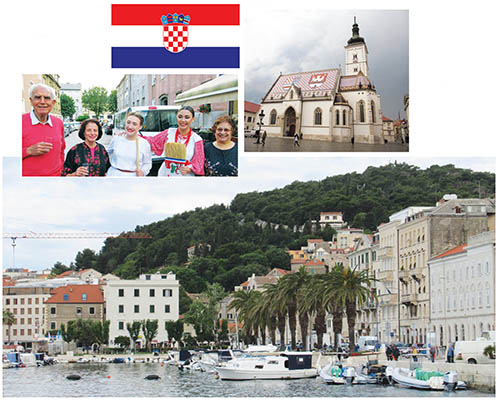
Clockwise from top l: Croatian flag (Photo: Wikipedia);
a Croatian church; scenic beauty of a Croatian town;
members of the tour with locals
Our Emirates flight landed at Zagreb, the capital city of Croatia, by late afternoon. Our first outing was a local folklore, dance and music evening, followed by a traditional Croatian meal. It was a grand beginning to our tour and our introduction to Croatian culture.
The next morning we had a long drive from Zagreb to Split, our next overnight halt. En route we stopped at Plitvice National Park which features in the UNESCO World Heritage List. Plitvice was not our idea of a national park. It was a huge area covering hills, 16 terraced lakes and 120 plunging waterfalls, some as high as 78 m (255 ft). While the scenery and greenery were truly beautiful, a slight drizzle made the walk over rocky paths and bridges a wobbly experience.
After a good lunch, we re-boarded our coach for the five-hour drive to Split. Some announcements and a buzz of conversation later, the coach sank into the silence of an afternoon siesta. Feeling restless and seeing an empty seat next to Hoshang Jalejar, our tour operator, I decided to move there and converse with him. This was our fourth tour with his tour agency Spenta over a period of about 10 years. The first had been to Turkey and Egypt, the second from Srinagar up to the Wagah border and the third trip was to mainland China and Hong Kong. I asked Jalejar how he got into the tourism industry.
"We needed the money,” he replied matter-of-factly. "Like many Parsis, my father married late in life. A qualified and intelligent man, he retired as a mechanical engineer from the Central Railways when I was still in Std XI at the Byramjee Jeejeebhoy Parsee Charitable Institution in Bombay. I needed to support my family financially, in whatever small way I could. All through my college days I studied during the day and worked in the evenings, giving tuitions to school children,” Jalejar said. "On holidays I did market surveys for companies or stood on street corners distributing brochures for them. At that time Lala’s was a well-known name among Parsis, in the tourism industry. They always needed young people as helpers during the school holidays, which coincided with their maximum tour excursions.
"Homi Lala specially liked Boy Scouts and since I was a Scout in my school days, he readily took me on. I worked with them over many holidays. It was there that I learnt how to be responsible, sensible and street smart. And got interested in the travel business,” Jalejar stated.
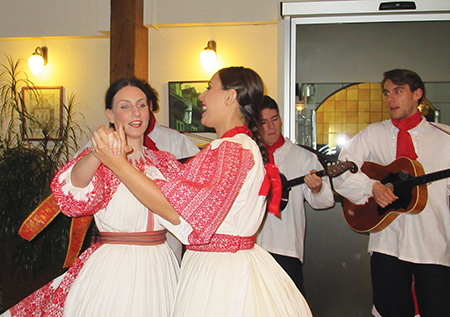
At the folklore, dance and music evening
Tour leader Hoshang Jalejar with wife Tannaz
While studying at the Elphinstone College, Hoshang met Tannaz and there was no looking back for either of them. Tannaz was from the well-known and well off Hirjibedin family who were stevedores, responsible for the loading and unloading of ships in port. They also owned the Kaiser-e-Hind Press and the popular weekly of the same name. "From the time we met, till today, Tannaz has been a continuing source of help and encouragement to me.”
Luckily, that was the time he was offered a job with a reputed travel agent. "I was trained to accompany their tours as MOS (man on the spot) and learned about the travel business,” he said. Did he enjoy the work? "Frankly, I did not,” he replied. "I found so much wrong. False promises, changed itineraries and much more.”
By then Hoshang was quite entrenched in the travel and tourism industry and got a job with TCI (Travel Corporation of India). "It is there that I learnt the nitty-gritty of tourism work and felt I could manage my own agency.”
"Hoshang is both passionate and sincere about his work,” said Tannaz who has her own high profile job with the Egyptian Tourism Office. "Before this first tour of Croatia, we both came and made a survey of all aspects — hotels, sightseeing, costing, weather, travel within the country and much more. We do that very thoroughly for every new destination.”
The cities that we visited in Croatia were Zagreb, Split on the seashore, Dubrovnik on the southernmost tip of the country and Zadar. Croatia is famous for its wines and cheese. Every meal was accompanied by white or red wine, served with cheese as starters.
From Zadar, we made a side trip to Pag Island, known for its scenery and for the local Pag cheese. We were taken on an interesting guided tour of the Gligora cheese factory. The Gligora family has been making quality cheese for the past four generations, using the same traditional recipes, with the latest dairy technology. After donning white coats, caps, gloves and coverings over our shoes, we were taken on a conducted tour of the factory by a pretty and articulate young woman, a daughter-in-law of the Gligora family. We were walked through the production and curing rooms, with a commentary on the varieties of cheese made from cow, goat or sheep milk, or a mixture of all three. We were told how the pastures that the animals feed on determine the aroma and flavor of the cheese. "Paski-Sir is our best known and most highly awarded cheese,” our guide informed us. We were then taken to a cheese and wine tasting room upstairs, with a spectacular view of the island around. Typically, the tour ended in the cheese shop.
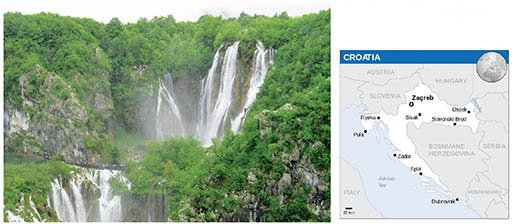
Waterfalls at the Plitvice National Park; right: map of the country Photo: Wikipedia
Top: Stacks of cheese ready to be cured at the Gligora cheese factory on Pag Island;
above: the ready product
Pictorial depiction of the charge of Croatian Count Nikola Subic
Zrinski against the besieging Turks in 1566 Photo: Wikipedia
On walking tours of Split, Dubrovnik and Zadar we visited palaces, forts, cathedrals and clock towers interspersed with ice cream stalls, outdoor cafes and souvenir shops. Handmade lace, embroidered tablecloths, runners and napkins were good buys and will long remind those who bought them of Croatia. Fruit stalls at street corners along the way sold the most delectable plump, red cherries and juicy apricots.
It was a long drive to Zagreb, mostly along the coast. We got there by dinner time. Hotel Puntijar where we stayed on our return to Zagreb was a heritage hotel. The owner himself, dressed in traditional attire, was there to receive us. As a welcome gesture he ceremonially opened bottles of champagne by slashing the corks off with a dramatic swing of his sword! It was something we had never seen before. We then wandered through his private museum, which he was proud to show. The entire Puntijar Hotel from the reception area to the curved staircase and the rooms, featured photographs in carved frames and furniture sourced from old homes.
The next morning we drove from Zagreb through the beautiful green hills and gurgling rivers of Istria, to the small town of Motovun, where we were to go "truffle hunting.” I had no idea what we were in for. I had a vague, misconceived notion that a truffle was a dessert. But why would one go hunting for it? The mystery was unraveled by a member of the Karlic family who took us around. He explained that truffles are a variety of mushrooms. Rare, hard to find, they grow under the ground around oak trees and are not visible to the human eye. There is a special breed of Italian hunting dog, Lagotto Romagnolo, that sniffs the truffles and unearths them by scratching them out with their paws. One must let the dog lead one to the truffle — which looks like a lump of black, hardened poop — but yank aside the canine before he eats up the truffle! Black truffles, like the ones we hunted, grow in the summer months. White truffles, fondly known as "edible gold,” grow in winter. They are far more rare and delicious and can cost up to Euros 3,000 (Rs 2,31,516) a kilo!
After running around the oak trees with the hunting dogs, we were treated to a wine and truffle breakfast. Ninety eggs were broken into a huge cooking vessel, to which was added a slab of butter and some salt. The mixture was stirred on the stove over gentle heat till a scrambled egg consistency was reached, after which black truffles in plenty were grated over the eggs and lo! Fritaja with Black Truffles was ready to serve. The whisper that went around the Parsi group was "Shhh… the eggs would have tasted better with chopped kothmir (coriander), marchu, né leelu lasan (chilly and green garlic).”
Everyone felt sad as the holiday was coming to an end. The last morning was spent in emotional goodbyes, exchange of mobile numbers and addresses, and promises to meet again. Everyone left with a bagful of memories that will last a lifetime, a bus load of new friends and a few special ones.