Nineteenth century scholar, Dhanjibhai Framji’s
books on the ancient Iranian languages are largely unknown today
Murali Ranganathan
In Modern Zerdusthians (published 1852), one of the first contemporary books about Parsis in the 19th century, Henry Briggs notes that "a rising young merchant of Bombay, Seth Dhanjibhai Framji, has devoted upwards of eight years to the compilation of a work on the Zend and Pahlavi dialects, which he is about to publish.” This was the first public notice of a Parsi who hoped to make a contribution to historical scholarship on the religion of the Parsis and its languages.
Born in 1823, Dhanjibhai was the son of Framji Nassarwanjee, one of the leading Parsi sethias of Bombay. The family had been settled in Bombay for a few generations and ran a flourishing agency business. As there were then no institutions in Bombay where the scion of a rich family could be educated, Dhanjibhai would have been educated at home by a variety of tutors, both Indian and European. Though much of his elementary education would have been in Gujarati, the primary language of the Parsis for many centuries past, he would also have learned the English and Persian languages. By his mid-teens, he must have started attending the family office and gradually been exposed to the intricacies of business. Furthermore, he would have had religious tutors to train him in religious practice as well as introduce him to Zoroastrian scriptures. By the time he was a young man Dhanjibhai was fluent in English and had acquired a deep interest in the ancient Iranian languages.
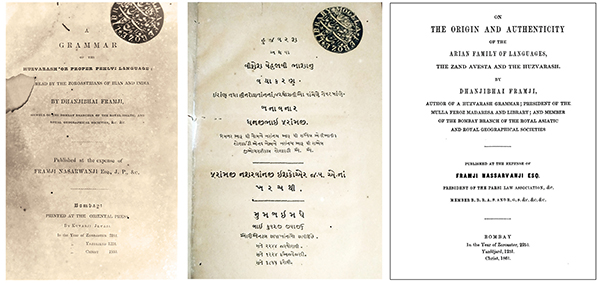
Cover images of Dhanjibhai Framji’s seminal works
Persia had attracted the attention of a large number of researchers working on the interface between history, religion and languages in the early decades of the 19th century. A number of historical sites with inscriptions and imagery had been discovered during this period. Epigraphers based in France and Germany were scrambling to unravel these inscriptions and publish their discoveries. Simultaneously, the religious texts of the Zoroastrians were also becoming accessible. Philologists such as Rasmus Rask (in 1820) and Niels Westergaard (in 1841) undertook the long and arduous journey to Bombay by way of Persia to acquire a large number of manuscripts. The languages and scripts of these Iranian inscriptions and manuscripts were new territory to European scholars who struggled to decipher them in the absence of grammar and dictionaries.
In Bombay, the fledgling scholarly community was centered around the Bombay branch of the Royal Asiatic Society which had been founded in 1804. It consisted of European men with a wide range of backgrounds, none of them academic. In the initial decades, its members were judges, senior civil servants and military officers, but later they were as likely to be Christian missionaries, newspaper editors and businessmen. Styling themselves Orientalists, a few of them had sought to study the Zoroastrian religion and the languages in which its scriptures were written. The chief protagonist was the Scottish missionary John Wilson (1804-1875) who had arrived in India in 1829. Wilson’s primary motivation for the study of religions practiced in Bombay — Hinduism, Islam, Jainism and Zoroastrianism — was to engage in debate with their adherents and emphasize the superiority of the Christian religion over them. He produced numerous texts on these subjects and edited a monthly journal, Oriental Christian Spectator, in which he published them. By 1835, he had been elected as president of the Asiatic Society.
Though he attempted to study the ancient Iranian languages, Wilson does not seem to have had much success. The European members of the Asiatic Society at Bombay, who dabbled in Zoroastrian studies, had realized by the 1840s that scholarship in continental Europe had stolen a march on them in this subject; by the 1850s, the differences were too vast to be bridged. Speaking in 1855 at the Asiatic Society of which he was now honorary president, Wilson was only admitting his own inadequacies when he said that "with a Westergaard and Spiegel engaged in Europe in the deepest researches connected with the Zend and Pahlavi literature we may well in this place make a general pause in our labors as far as its essentials are concerned. We may, however, I conceive, continue, with much advantage, to act as their humble auxiliaries.”
It was in such an environment that Dhanjibhai was taking his first steps in historical research. In January 1845, he joined the Bombay branch of the Royal Asiatic Society as a "subscriber.” Dhanjibhai Framji (spelled Dhunjibhoy Framjee in the records of the Society) was one of the first Indians to take advantage of this special category of membership which was created in the mid-1840s to cater to those individuals who did not want to apply for full membership. The Asiatic Society was then perhaps the only institution in western India which had a substantial library and Dhanjibhai seems to have joined the Society with the intention of making full use of it. Dhanjibhai became a full member of the Asiatic Society in 1850 by which time he had been engaged in his studies for a few years.
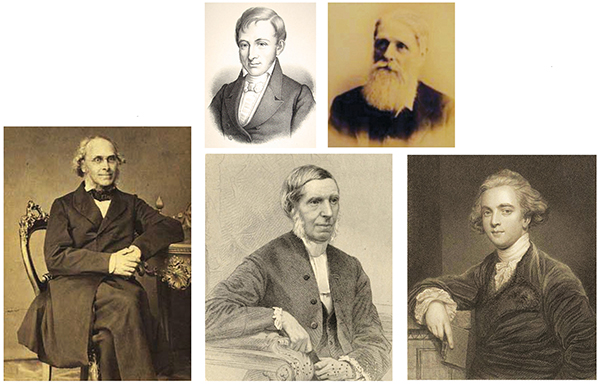
Clockwise from top, l: Rasmus Rask; Edward William West;
Sir William Jones; John Wilson; Niels Westergaard Photos: Wikipedia
Dhanjibhai compiled a pioneering Zend-Gujarati dictionary which "was first begun more with the view of strengthening his own studies, than of publishing it; but the success he has attained in the course of its preparation has induced him not to confine his labors to his own closet.” He presented a specimen of the proposed book to the Bombay Government in early 1851 for its approbation. They in turn passed it on to Wilson who rather patronizingly opined, "I have carefully examined this specimen and I am happy to be able to say it exhibits more decided marks of genuine oriental scholarship than I have observed for a long time in the Parsi community of this place.” Wilson suggested that Dhanjibhai prepare a Zend-English dictionary which would be useful to European scholars. A specimen of the latter work was presented by Dhanjibhai at a meeting of the Asiatic Society held on November 13, 1851 where it was approved.
Dhanjibhai now conceived of a grand publication plan for the dictionary in two volumes (Zend-English and Zend-Gujarati), each priced at Rs 20: "It is intended to supply a desideratum greatly felt by the Parsis both of India and their mother country, Persia, for more than two thousand years, and to some extent by the Continental Orientalists.” A prospectus was circulated and subscribers were invited. Describing his approach in the prospectus, Dhanjibhai notes that "he was obliged to intersperse therein upwards of a thousand notes, with philological and etymological explanations, so as to render the comparison of his humble opinion with that of the Parsi priests and the Continental Orientalists.” Evidently, Dhanjibhai had to subject himself to the criticism of the Parsi community, many of whom expressed severe reservations on the accuracy of the dictionary. Dhanjibhai appealed to the Bombay Parsi Punchayet to arbitrate on the issue but they seem to have held themselves back. Not having met with the encouragement he thought that the work deserved from his compatriots, Dhanjibhai seems to have shelved the book proposal.
In 1855, Dhanjibhai independently published a Gujarati book dealing with the rudiments of the grammar of Pahlavi or Middle Persian. Printed at the expense of his father, it was titled Huzvarash athva vishesh pahlavi bhashanu vyakaran (A Grammar of the Huzvarash or Proper Pahlavi Language). In his introduction to the book, Dhanjibhai traces the history of modern scholarship on this subject and the sources of many misconceptions regarding the ancient Persian languages and the Zoroastrian religious texts and, marshaling evidence from newly unearthed archeological sources and old Pahlavi manuscripts, proceeds to systematically refute them. Doubts had been expressed by many scholars, including William Jones, the founder of the Asiatic Society at Calcutta, about the authenticity of the Pahlavi language which, they conjectured, was a later invention of the Indian Parsis. The most ferocious proponent of this theory in the 1850s was the London-based John Romer, a past president of the Asiatic Society at Bombay. Dhanjibhai was one of the earliest scholars — either Parsi or European — to contest these claims, and refute them with documentary evidence. The conclusions he reaches about the linkages between the Pahlavi and Old Persian languages were arrived at by European scholars only in 1870. The usefulness of this grammar to European scholars can be judged from the fact that the Austrian scholar Freidrich Spiegel did not waste any time in incorporating parts of this text into his German work on the same subject published in 1856.
Dhanjibhai’s scholarship was hardly acknowledged by mainstream scholarship. On the other hand, he had to face repeated discouragement at the Asiatic Society. Projecting his own shortcomings on to Bombay Parsi scholars who were vastly superior to him in this field and whose skills were perhaps comparable to European scholars in these years, Wilson was quick to downplay the book:
"Mr Dhanjibhai Framji’s Pahlavi Grammar in Gujarati, though very brief, is an acceptable offering to oriental literature; and much more so will be the Zend Dictionary which he is about to publish, though, as he is aware, it will be merely a help to our friends in Europe, who are entering so deeply into all questions connected with the Zoroastrian lore (Journal of the Bombay branch of the Royal Asiatic Society, July 1856).”
This disparagement of their efforts would have dampened the enthusiasm of most researchers but Dhanjibhai was however made of sterner stuff. He proceeded to develop his theories on Iranian languages and gave a two-part presentation on the "Authenticity of the Iranian Family of Languages” on October 8 and December 10, 1857 at the Asiatic Society. Astutely presenting his arguments, Dhanjibhai concluded that "some learned Orientalists are very much mistaken in believing that a language so copious and expansive as the Zend could be forged by the modern Parsis.” Sadly, it only evoked a familiar dismissive reaction from Wilson.
"The Rev Dr Wilson, honorary president, at the close of the reading of Mr Dhunjibhoy’s paper, observed that he was sure it would meet with the indulgence of the members of the Society, even though it dealt almost exclusively with European authorities, and added nothing to their representations and reasonings on the matter to which it referred. This he did on the ground that it is desirable that European scholars should know the position which the modern Parsis are desirous of occupying in reference to the history of their own religion and literature. It was not necessary to submit the article to rigid criticism. The questions at which it glanced are all coming to a rapid solution, and they are best in the hands of those who are able and willing to treat them on their own merits (Journal of the Bombay branch of the Royal Asiatic Society, January 1861).”
In effect, Wilson summarily dismissed the scholarship demonstrated in this paper in which substantial new ground had been covered. He would rather have the Parsis act as research specimens than make any contributions to research themselves. Dhanjibhai waited for a few years for the Asiatic Society to publish this paper in their journal but since they seemed to be disinclined, he did it himself. The paper took the form of a substantial book in which he incorporated all that he had to say on the ancient Persian languages, a subject about which nothing definite had been settled in the world of European scholarship. On the origin and authenticity of the Arian Family of Languages, the Zend Avesta and the Huzvarash was published in 1861 and included, besides the paper, all the other writing which Dhanjibhai had done in English.
Without entering into the merits or otherwise of the book here, it must be said that Dhanjibhai was preoccupied with refutation and his own theories are relegated to appendices and prolix notes. This book embodied his complete research until 1860, including his readings of inscriptions which had remained unpublished, and observations on related subjects. It was also the culmination of his research activities as Dhanjibhai seems to have withdrawn from active research after a decade of disappointment and heartburn. He however continued to attend the meetings of the Asiatic Society and was the second Indian to be nominated to its committee of management in 1864.
Dhanjibhai’s career can be usefully contrasted with that of Edward William West (1824-1905), acknowledged as the leading Pahlavi scholar in the latter part of the 19th century. Trained as an engineer, West was in Bombay for over two decades from 1844, and enjoyed a very successful career building the rapidly expanding railway network. He had many opportunities to visit antiquarian sites in and around Bombay and developed an interest in historical research. His paper on the inscriptions in the Kanheri caves presented to the Asiatic Society in April 1860 included illustrations of many inscriptions. In his 1861 book, Dhanjibhai merely observes that it also includes, "a very short Pahlavi inscription, considered by E. W. West to be in the Arabic character, but it is quite evident that the inscription is in the Pahlavi language.” From evidently not having the least familiarity with the Pahlavi language or script in 1860, West soon emerged as a leading scholar in this subject publishing a series of articles in international journals in the next 10 years. The primary texts for his scholarship, as the Dictionary of National Biography (Second supplement, vol 34) notes, were "a copy of the Avesta, or the scriptures of Zoroaster, with a Gujarati translation of the Avesta and,” rather ironically, "Dhanjibhai Framji’s ‘Pahlavi Grammar’ (1855).” In his 1870 paper published in the Journal of the Royal Asiatic Society, considered a landmark in Pahlavi scholarship, West finally concludes that Zend and Pahlavi are not later fabrications, but part of the linguistic tradition of Persia — a conclusion that Dhanjibhai had proved in 1855.
Dhanjibhai was one of the founders of the Mulla Feroze Madrassa which was established in 1854 to teach the Zend, Pahlavi and Persian languages to Parsis. Initially its secretary, he became the president of the Madrassa from 1857 and played an important part in establishing its reputation and building its library. He was also the patron of the Khetwadi Reading Room and Library, located near Girgaum. In recognition of his munificence, it was renamed the "Dhanjibhai Framji Reading Room and Library” and his portrait was commissioned to be hung in the premises. Parallel to his scholarly career, Dhanjibhai was also a successful businessman, having been a partner in Wallace and Company from 1855, and later taking an active part in the management of his family firm, Framji, Sands and Company. In April 1865, he was named a Fellow of the University of Bombay and, in the following year, he was appointed a Justice of the Peace by the Bombay Government.
In 1878, his family seems to have suffered severe losses in its business activities. As a result, Dhanjibhai resigned all his positions in Bombay, retired from public life, and relocated to Hyderabad where the Parsis had emerged as an influential community in the Nizam’s fiefdom. His death in 1892 ended a life well-lived and successful in all respects except for the non-recognition of his scholarly work which must have been very dear to him in the early part of his life. His books, already forgotten in his lifetime, fell into obscurity after his death. Perhaps it is time to recognize the contributions of arguably the first modern Parsi scholar, someone who broke away from the mold of traditional religious scholarship, engaged with an international audience in English, and wrote two pioneering books which overturned prevailing theories on the authenticity of ancient Persian languages.