"Unlike his Indian contemporaries who emulated European studio photography, (photographer Shapoor) Bhedwar (1858-c 1918)... questioned the idea of the photograph as a simple record of transpired reality,” note authors Diva Gujral and Nathaniel Gaskell in their 2019-published tome Photography in India: A visual history from the 1850s to the present. Describing his portraits as "dramatically lit, elaborately posed and highly stylized,” the authors note that "in the manner of staged performances, his tableaux often revealed a narrative thread and...present a mood.” The photographer’s creations also "referenced his interest in the theater and literature,” note Gujral and Gaskell.
The authors state that Bhedwar was the only Indian member of the Brotherhood of the Linked Ring, an organization established in London in 1892 to promote "pictorialist aesthetics.” Wikipedia defines pictorialism as a style in which the photographer has manipulated what would otherwise be a straightforward photograph as a means of "creating” an image rather than simply recording it. The members of the Linked Ring were united in their belief that the significance of photography as art lay in the portrayal of mood, character and sentiment. "Through this aesthetic, Bhedwar’s work transcended imperial conventions of photography,” note the authors.
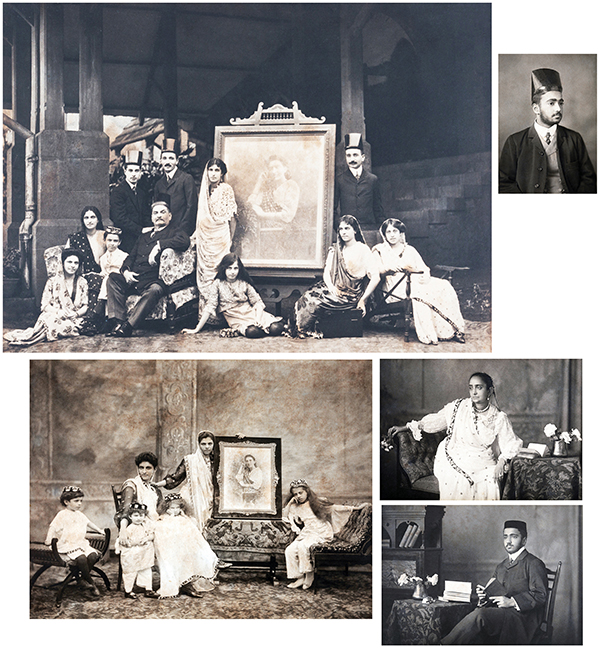
Top and above: untitled "highly stylized" photographs by Shapoor Bhedwar, c1890
Images courtesy: Museum of Art & Photography, Bangalore
Bhedwar’s pictures are rarely seen even in the community though among the subjects he selected were the Parsis. Writing in Early Bombay Photography, Susan Hapgood noted that while many photographers aspired to be artists, Bhedwar "was the first Indian to gain international recognition.” In The American Amateur Photographer 19th century photographer Alfred Stieglitz wrote of Bhedwar’s Initiation of a Parsi priest, that "the technical work…is beyond criticism” (see "The photographic art of yore,” Parsiana, September 7, 2015).
Gaskell is the associate director of the Bangalore based Museum of Art and Photography (MAP) that with financial support from the Tata Trusts’ Art Conservation Initiative is "preserving India’s visual heritage by restoring historical photographs, negatives, transparencies and prints,” as notes a press release received from the Museum. Deepika Sorabjee, the Trusts’ head, arts and culture, noted that "the Tata Trusts are happy to support this center... to create the leading photo conservation lab in the country.” The Trusts will, in a five-year partnership establish a conservation lab and train conservators to also assist at smaller museums in neighboring states with advice on preventive conservation, stated an email received from the Trusts’ public relations team.
As per MAP’s website, their flagship building scheduled to open to the public in 2020 will be a 42,000 sq ft facility in the heart of Bangalore. Meanwhile, a selection of their collection is available on their website. The Museum is the "custodian to a growing collection of over 18,000 artworks, predominantly from the subcontinent and dating from the 12th century to the present.” Over a quarter of their collection represents photographs.
Bhedwar’s photographs will "be exhibited as part of the photography section of the permanent exhibition at the Museum as (he) is important in regards to the history of the "pictorialism movement” in photography, noted Priscilla Roxburgh, head of communications and public relations at MAP, in an email to Parsiana.
The National Gallery of Australia has seven prints of Bhedwar’s work in their collection, ranging from wedding portraits, to a navar ceremony, to family tableaux.