Miraculous powers are attributed
to nirangs which can restore health,
get rid of vermin and counter evil
Firoze Kotwal
In the article "Incantations for the Festival of the Farmers and for the Consecration of Gravel (nirang I jashan I burzigaran o nirang I sang-reza yastan)” published in Dabir No 5, 2018, journal of the Samuel Jorden Center for Persian Studies and Culture, University of California, Irvine, Dastur (Dr) Firoze Kotwal emphasizes the importance of the nirang prayer and how its recitation can lessen many hardships and add to the quality of life. He bemoans the efficacy of the prayer is not appreciated by many who turn to other religions and cults for solace.
In many countries and cultures of the world the effective power of talismans and various charms and amulets has been used with great faith by people who believe in the spiritual efficacy of such wonderful objects. The Jews, as per their tradition, write down certain passages from the Torah on pieces of leather or parchment and tie these amulets to their forehead or near the heart center. This particular form of talisman was known as phylactery. The Muslims copy Arabic verses from the Quran, and use these as amulets. In the same manner, Zoroastrians have certain, short effective prayers which they call nirangs. Nirang is a Pahlavi word which can also be read as nerog, which means strength, power. The belief that a spiritual power, nerog, is present within the body of the nirang is very old. Zoroastrians also have a tradition of using the cotton thread (Gujarati: doro) consecrated during the enactment of the vendidad ritual as a talisman serving as a charmed thread. In order to maintain the purity of this vendidad thread, it is kept safely at home in a small metal box.
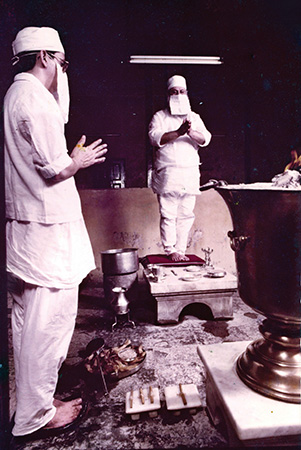
Dastur (Dr) Firoze Kotwal (r) and Ervad (Dr) Rooyintan Peer
performing the yasna ritual
As a specimen, a short translation of the Nirang of Vanant Yast is given: "All the calamities, the demons, liars, witches, rapacious persons, wizards, foul wind, pain, stomach pain and pain of the seven limbs of the body, evil produced by the evil spirit, woes of the heart and sickness of the brain, foul wind producing uneasiness of the mind, evil eye and evil resulted by seeing wicked men, and such other similar calamities may vanish and disappear.”
Jashan I Burzigaran
The "Festival of the Farmers” (Jashan I Burzigaran) is celebrated when Spandarmad roz and Spandarmad mah coincide in the Zoroastrian calendar. (When the day and the month coincide in the Zoroastrian calendar it is called a parab/parabh in Parsi Gujarati, parva in Sanskrit and Gujarati, meaning festival.) Spandarmad Ameshaspand is a female yazata who is seen as the guardian of the earth and presides over virtuous women. The prosperity of the world depends on the fertility of the earth and all human beings depend upon the earth for food and shelter. Thus rendering the earth pure and fertile for crops to be planted is regarded as a meritorious act in Zoroastrianism.
The sanctification of the earth on Spandarmad roz and Spandarmad mah is a very old Zoroastrian tradition from the days when there were no pesticides or insecticides to destroy pests attacking the crops. In order that harmful insects, noxious creatures, serpents and worms may not harm the earth and the crops sown, the farmers of ancient Iran showed their reverence to the earth by performing this jashan. On the Jashan I Burzigaran, the Pahlavi nirang for destroying vermin called Nirang I Khrafstar Zadan (incantation for smiting noxious creatures) is also ceremonially written as a spiritual weapon to destroy insects and pests which attack the crops planted by Zoroastrian farmers.
The ink for writing the nirang
The person preparing the nirang must have a bath, do the padyab-kusti and then prepare the ink for the nirang, making sure that all the vessels and implements to be used for the purpose are washed and cleaned. Preferably well water should be used for the ink. If this is not possible, then cold, running water can be used.
This special ink is made from saffron (Gujarati: kesar). Take as much saffron as required for writing the nirang and pound it into fine powder. Warm the water collected earlier and mix saffron powder gradually in this warm water, making just enough ink required for writing the nirang. If any ink remains after writing the nirang, it can be cast away carefully in the garden or under the shade of a plant or tree.
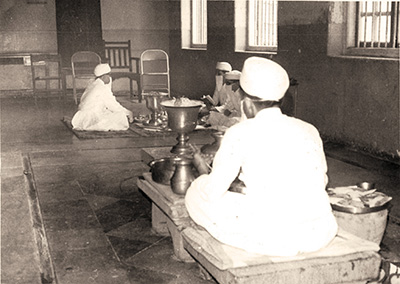
Three priests performing the jashan ceremony and the one on the stone seat, doing a baj
Paper for writing the nirang
Clean white paper should be used. The nirang is written with the ink prepared from saffron as described above. Some nirangs are written as amulets and worn around the arm or neck. There are some nirangs where the paper on which the nirang is written using saffron ink is soaked in pure well-water and when the saffron diffuses in the water, the person for whom the nirang is written is asked to drink this yellow colored water infused and made holy by the nirang written in saffron ink. A small incense burner (Gujarati: lobandan) is kept alongside and as the person drinks the holy water, blessings are sought from the fire to rid the person of affliction and restore good health.
According to Persian Rivayats, this nirang should be inscribed on deer leather, or on saffron colored paper and placed near the entrance of the house. First a priest knowing Pahlavi does his padyab-kusti, recites his obligatory prayers, takes the baj of Ardibehesht (pa nam-e yazdan…mazdaSatanam yazadmide as mentioned at the beginning of the Ardibehesht Yast) and with the padan (Persian: panam, ‘mouth veil’) tied over his mouth, writes the nirang in Pahlavi silently as he is still within the baj format. After this he leaves the baj of Ardibehesht (Yatha Ahu Vairyo, Yasnemca, Kerfe Mozd as mentioned at the end of the Ardibehesht Yast).
The scriptures clearly state that the baj of Ardibehesht should be taken, as Ardibehesht Ameshaspand is a divine physician who heals, spiritual, mental and physical ailments. Just as the Pahlavi nirang is a formula for removing the power of the evil forces, similarly the Ardibehesht Yast is efficacious in destroying the creatures that bring harm to man. This Pahlavi nirang to annihilate harmful creatures from one’s house is known as ruq a-I kazhdum "written spells against the bite of scorpions and other obnoxious vermin.”
Translation of the Pahlavi nirang: (I begin) in the name of the Creator Ohrmazd. On the day Spandarmad of the month Spandarmad, I fasten the mouth of all noxious creatures, demons, lairs, sorcerers, witches, tyrants, evil rulers and evil preachers, sinners, thieves, wolves and oppressors, in the name of the adorable one, in the name of the brave Faredun, and in the name of Star Canis Major (Tishtar), Star Canopus (Sadwes), Star Vega (Wanand) and the Constellation called the Great Bear (Haptoiring). Truth is the best good; it is happiness. Happiness is to him who is truthful for the sake of best truth.
After pasting the nirang on the wall of the house closest to the front door, according to tradition, the house is fumigated with a combination of storax (istarak), shavings from the horn of a sheep or a goat, frankincense (loban), wild rue (sipand), and cotton seeds, which are gently burned on a slow fire. Storax is a gum-like resin that oozes out of trees, and wild rue is a herb found growing in Iran. When these plants are burned the smoke emitted is very strong and acrid. Shakespeare and other classical writers term rue as the "herb of grace” as it has the properties to exorcise evil.
In the Rivayats there is an injunction to color cattle, goat, sheep and fowl with saffron on this important day. But in the villages of India, on Bahman mah, Bahman roz, which is celebrated as the parabh (festival) of Bahman or the ‘feast of cattle,’ they are colored with a vermillion powder (kanku).
Nirang for consecrating the gravel
On Spandarmad mah, Spandarmad roz, in honor of the earth, the priest prepares the gravel for consecration in the precincts of the dar-i-mihr or any other place which is purified for the ceremonial purpose. This act of consecration is called Nirang i Sang-reza (Arabic: sang-reza, ‘gravel’). During the ritual, the priest inserts a knife in the purified sand and recites the baj of Spandarmad Ameshaspand. He then intones the following nirang and recites it silently.
"On the month Spandarmad, day Spandarmad, the day Spandarmad of the month Spandarmad, Spandarmad month and Spandarmad day, I bind the poison and venom (spewing from) the mouth of all noxious creatures, in the name of heroic and brave Faridun and with the help of the Star Vega, created by Hormazd: may it (ie the nirang) be steadfast and current: may it be so; may righteousness be healing. I smite and kill (all noxious creatures). My sins be atoned for with (the increase of) good deeds for the delight of the soul.”
After completing the nirang the priest recites one Yatha Ahu Vairiyo along and upon the word siiaoiananam he turns the gravel up and down with the knife as mentioned in pav-mahal manuscripts. After repeating this process seven times, he leaves the baj of Spandarmad, and the gravel which is consecrated in this manner is sprinkled in all corners of the house, as well as in the fields, thus ensuring the removal of noxious creatures from the area for the whole year around.
Among the extant nirangs, there are some in which King Faridun is remembered and his assistance sought. Faridun Athwyan was a spiritual healer who is credited with having found many cures for physical ailments. For this reason, in the Pahlavi text of the Dadestan I Denig, he is given the title of the Pur-Beshaz i.e. one who is full of remedies. In the present times also, many religious-minded Zoroastrians commission a baj and afrinagan in honor of Faridun Athwyan, in order to be cured of physical ailments and be rid of difficulties. Their confidence in Faridun is based on the exaltation of Faridun as a proficient medic, in this nirang.
Some of our co-religionists through doubt and despair, during difficult times, lose sight of the right path and frequent ascetics (babas), demon-exorcists (bhuwas), anchorites (sadhus) and mendicants with long hair (shevdas) with no gainful result in sight. Instead, if they turn to our glorious religious traditions, they would certainly get miraculous help from the unseen divine powers of our faith.
With deep regret, it has to be stated that, barring a few exceptions, these nirangs are not resorted to as much as they should. Nirangs are precious hidden treasures which can be used with great effect by priests with a high degree of ritual power. The prevalent ignorance about these nirangs and their usage affects the ability of the community to use the miraculous powers of the nirangs for their well-being, and for the Parsi community this lapse makes it an even more difficult task to maintain the religious traditions of the faith.
It is hoped that devout dasturs and mobeds will make greater use of the above nirang on the parabh of Spandarmad and thus contribute towards the prosperity of the world.