It is commonly believed that the name Udvada is derived from Unt-Vada, the place where the camels of a local ruler, the Raja of Mandvi, grazed in the past. However, Ervad Framrose Mirza, in his booklet Ahwale Iranshah (An account of the Iranshah) published in Gujarati (now translated into English by Marzban Giara), suggests that the name Udvada is of Sanskrit origin: Udanvas, Udan meaning water and vas meaning place.
To support Mirza’s statement, one needs to study the topography (geography) of the sacred town of the Zoroastrians. A rapid survey reveals that Udvada is located largely in a low-lying area. The place gets flooded during heavy rains while the shore is lashed by giant waves during storms, resulting in erosion.
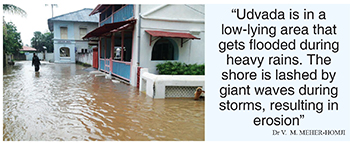
If one takes the main road from the station to the town as a reference point, the highest point along this is the hillock of Doongerwadi. From there onwards begins a very gentle slope leading into the town, where the Iranshah Atash Behram is located. The lake which irrigates the fields and now also supplies water to Udvada demarcates a shallow topography. Approaching the town between the road and the base of the Hindu temple is a drop of several feet marking the beginning of the low-lying area that extends towards Dasturwad-Meriwad and beyond up to the gymkhana area. Mirza Street and Dasturwad are at a slightly higher level compared to the steeply sloping Meriwad and the backyard of the defunct gymkhana.
An incident vaguely related to the low-lying physiography of the holy settlement is worth narrating. A notorious dacoit of Gujarat, wanted by the police for several armed robberies committed by him and his gang, came to know about the sacred Atash Behram. Misinformed that non-Parsis were not allowed to enter the sacred fire temple because precious jewels and a good deal of wealth were stored inside, he planned to raid it. Entering the town on a dark winter night, he did not anticipate that there would be a dense fog enveloping the coastal town, particularly the low-lying areas.
So thick was the fog that the dacoits could not see the road and went round in circles without being able to locate the Iranshah Atash Behram. Soon the sun came up and the dacoits had to beat a hasty retreat One could describe this unsuccessful attempt to enter the Iranshah premises by evil-doers as a miracle, but the low-lying topography also contributed by creating layers and layers of exceptionally heavy fog which thwarted the evil intentions of the robbers.
Dr V. M.MEHER-HOMJI